
The Consequences of Unintended Consequences

It used to be that when Jeroen Dijsselbloem, President of the Euro Group, would talk to reporters, he’d open with

Maybe it’s good, if I say something.

And then recently he did say something.  He said that the Cyprus model of raiding depositor accounts to bail out failing banks—in addition to holding the failing banks’ investors and creditors responsible—should be the model for all of the eurozone.

In future aid packages, one must look into whether bank shareholders, bond holders and large depositors could participate so as to spare taxpayers from having to foot the bill.

Now we get the hue and cry from the left—Spiegel International Online included.  Because, you see, it’s somehow wrong to spare those taxpayers—folks who had no investment, no control, no relationship at all with those failing banks—from their Left-manufactured responsibility to indemnify private investors and creditors from the failures of their investments.  After all, it was Very Important People who were benefitting from having their hands in the taxpayers’ pockets.

The advantages were enjoyed not only by actors on the global financial markets, but also by major banking centers, such as those in Luxembourg and London, which could count on seeing governments prop up teetering financial institutions.

And so we see a consequence of unintended consequences made manifest: the naked greed of politicians and their accomplices.

And another, more favorable, consequence of these unintended consequences is being forced to the front:

A growing number of politicians and experts are demanding an end to this arrangement.  In the future, German Chancellor Angela Merkel said, “banks must save themselves.”  And German central bank board member Andreas Dombret is convinced that the financial sector can only regain health once there are no longer “implicit state guarantees for banks.”

Even the Luxembourg Finance Minister, Luc Frieden, his financial constituency notwithstanding, is figuring out a larger result of raiding depositor accounts to pay for businessmen’s and politicians’ failure to perform.

This will lead to a situation in which investors invest their money outside the euro zone.  In this difficult situation, we need to avoid anything that will lead to instability and destroy the trust of savers.

After all, the political futures of these foxhole-converting politicians depend on it.  Because in yet another consequence of these unintended consequences, the voting public—those taxpayers—are noticing the grubby political fists in their pockets.

And there’s the potential for another consequence of these unintended consequences.  The IMF has released their latest report on the currency reserves held by the various nations of the world.

Third World economies unloaded $45 billion worth of euros in 2012 in an accelerating trend.  Some of that, certainly, is related to the failed global recovery from the Panic of 2008.  However, Europe’s decision to raid Cyprus depositors’ funds to bail out failing banks, together with the Euro Group’s view that such raids are appropriate solutions for other eurozone bank failures, won’t encourage folks from outside the EU to place their money with eurozone—or EU—banks.  Which will contribute to continued dumping of euro holdings.  Which will continue the EU’s de facto dependence on the $US as the reserve currency, rather than elevating the euro in importance and from that, elevating the EU.

Unless Merkel, Frieden, et al., can prove themselves serious.
Why We Protect Inventions

The Indian Supreme Court has rejected the idea of patent protection for Novartis’ drug Glivec, saying that an active ingredient in Glivec was well-known prior to the development of the drug.  Those worthies also rejected Novartis’ argument that the innovation that deserved patent protection was their transformation of that active ingredient into a “beta crystal” form, which made it a viable treatment for cancer.

Never mind, said the Court, India doesn’t feel like patenting this and making it harder for an Indian company to profit from the foreign Novartis’ work.

Novartis isn’t alone in this strait.

India’s patent office last year ordered Germany’s Bayer AG to issue a license allowing an Indian generics company to copy its patented cancer drug Nexavar and market it at one-thirtieth the cost.

And

In November, India’s government approved caps on a third of the country’s drugs, up from 18% under a previous regime—a level of price control not seen since the 1970s.

Novartis had this on the wisdom of further investment in India:

If innovation is rewarded, there is clear business case to move forward.  If it isn’t rewarded and protected, there isn’t.

And

We’ll continue to build our business, but we will certainly be cautious in investments in R&D and innovation in India.  And until the climate for intellectual property and the ecosystem is fully in place, I don’t think any investment in R&D will take place here.

Well, NSS.  It’s time for the Indian government to figure this out, too.

More Obama Sequester

Recall that the Department of Transportation under President Barack Obama warned a week or two ago that nearly 150 control towers at small regional airports will close down, ostensibly due to sequester budget cuts.  DoT also warned of furloughs at major airports, cynically noting that resulting delays could be “very painful for the flying public.”

To alleviate this, Senator Jerry Moran (R, KS) proposed replacing the $50 million of Obama Sequester cuts from the FAA with savings from unspent balances, a kind agency slush fund that all agencies squirrel away against various exigencies, and by reducing other low-priority spending.

Enter, stage left, Senate Majority Leader Harry Reid (D, NV).  He pulled Moran’s amendment and refused to allow it to come to the floor for a vote.

Thus, as The Wall Street Journal puts it,

…in the weeks ahead travelers will likely experience the frustration of flight delays, cancellations and closed airports.  It won’t happen by accident or out of fiscal necessity, but because Washington Democrats refuse to prioritize federal spending.

The Supreme Court and Prop 8

In California, the people—right, wrong, or indifferent—have spoken.  What the Supreme Court needs to think about as it considers California’s Proposition 8, which bans gay marriage in that state, is whether the people are sovereign or the Court presumes to be.

Justice Anthony Kennedy, in questioning lawyers defending the Proposition, pointed out that the children of gay parents have voices that ought to be heard.  And so they should.  When they’re adults, those 40,000 children (compared with the 10 million, or so, adult Californians who already have spoken in that referendum) can spearhead a new Proposition that would reverse Prop 8.  The people, after all, can change their minds.  That’s also easier to accomplish than getting the Supreme Court to reverse itself, even on an opinion with which they’ve interfered with the 10th Amendment.

Justice Sonia Sotomayor, also questioning lawyers defending Prop 8, asked why California had an interest in denying gay couples the right to marry.   But this is to misunderstand the role of the Federal government in a Republic whose social compact has a 10th Amendment.  The Federal government—and so the Supreme Court as the pinnacle of a branch of that government—has no interest in why a state wants to do a thing, a thing that does no harm to its neighboring states or to the United States, within its own borders.

The only legitimate ruling for the Court is to let the people’s decision stand.  And leave California, in competition with those other states whose citizens have determined otherwise, to live with the consequences of its choice.  That’s simply an application of Saul Alinsky’s Rule 4.

Extremist Left on the Prowl, Again

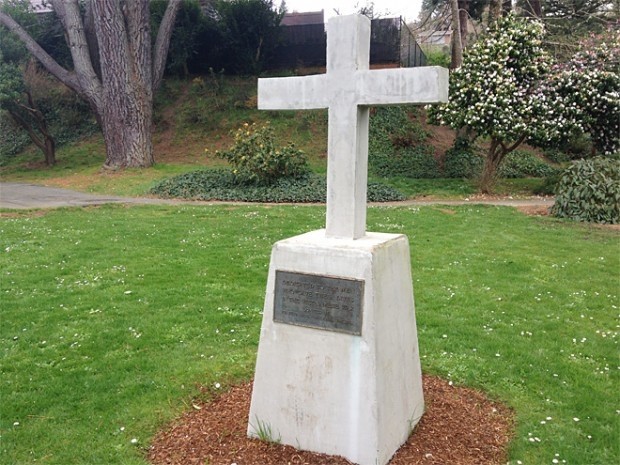
The Freedom from Religion Foundation is attacking a Viet Nam War memorial, and it’s attacking Coos Bay, OR, for having it.

The atrocity this time is a small memorial erected by the local Jaycees in 1972—as that war was winding down—and that has a Latin cross atop it*:CoosBayVietNamMemorial

FFRF attorney Rebecca Markert, in a letter to City Manager Rodger Craddock, wrote—and she was actually serious

We have no objection to the veterans’ memorials.  Our objection is to the message of endorsement of Christianity over other religions and non-religions.  The Christian-only memorial sends a message that the government only cares about the deaths of Christian soldiers, not Jewish, other non-Christian, and non-religious soldiers[.]

She might want to consult with some of those Jewish, other non-Christian, and non-religious soldiers.  They certainly have been supportive of the Latin cross at the Mojave Desert and Mt Soledad War Memorials.  Maybe it’s because Latin Crosses aren’t Christian symbols, per se, on war memorials; they’re symbols, instead of our fallen and of our respect for their sacrifice and the sacrifice of their surviving families.  That’s a degree of respect the FFRF might want to start showing.

Craddock has the right of it:

With all the issues facing our city, we probably have more important things to do[.]

Indeed.


*The photo is by KCBY.