Recess Appointments and Trust

President Obama has, in the past, criticized President Bush’s alleged tendency to push Constitutional limits in seeking to expand Executive Branch power.

Now we come to some “recess” appointments, made because Republicans allegedly were blocking Senate confirmation.  Michael McConnell, writing for Advancing a Free Society, offers some insight.

First, the present set of appointments (to the CFPB and to the NLRB) were made while the Senate was in session through a series of pro forma, short sessions, ostensibly for the purpose of blocking recess appointments.  The use of pro forma sessions for this purpose was a tactic devised in 2007 by Senate Majority Leader Harry Reid (D, NV) and then-Senator Barack Obama (D, IL) specifically to prevent Bush from making recess appointments.

Second, ex-University of Chicago Constitutional Law Professor Barack Obama appears to have acted without legal advice other than his own: even his own Office of Legal Counsel, the body intended to advise presidents ahead of time on the legality of an action (and note that this is advice; OLC opinions are not law and are not binding), didn’t issue their opinion justifying Obama’s appointments until two days after the appointments had been made.  McConnell is more generous than I, suggesting that “presumably it reflects the advice given to the President in advance.”  I have my doubts.

Third, there are a number of legal arguments that suggest that Obama’s appointments are, in fact, unconstitutional, all centering on the fact that, as Reid and Senator Obama understood in 2007, the Senate actually has to be in recess before recess appointments can be made.  McConnell offers the following.

Obama and his pet OLC insist that since the Senate had announced an intention of conducting no business during its pro forma sessions, it was, in fact in recess.  Never mind that Obama signed into law at least two pieces of legislation that had been passed during those sessions, including the infamous payroll tax reduction extension.  This is old news.  McConnell offers new insight, though:

It is hard to see why the Senate’s stated intention not to do business takes legal and constitutional precedence over its manifest ability to do so.

McConnell goes on:

[T]he Opinion creates an implausible distinction between the legal efficacy of pro forma sessions for various constitutional purposes. According to the Opinion, a pro forma session is not sufficient to interrupt a recess for purposes of the Recess Appointments Clause, but it is sufficient to satisfy the constitutional command that neither branch adjourn for more than three days without the consent of the other  and that Congress convene on January 3 unless a law has provided for a different day…. Why a pro forma session would count for some purposes and not others is a mystery.

And there are other, longer-standing demonstrations of the illegitimacy of these appointments.  For one thing, the NLRB “nominees” hadn’t even been proposed to the Senate until two days prior to their previously announced, well publicized, ordinary holiday break, which the Senate then voluntarily gave up in order to remain in (pro forma) session.  The only one who was blocking Senate confirmation here was the President.

Also, we get the strange concept that the President can decide for himself when the Senate (or, by extension, the Congress) is in session, the Senate (or the Congress) not being competent to make that determination for itself.  Certainly, the President can adjourn both houses when they cannot agree between themselves on adjournment and ask him for help.  Certainly, the President can call the Congress into session to deal with emergencies.  Deciding that they actually have convened—or not—seems a bit of an expansion of Executive Branch power.

Where’s the love?  Where’s the trust?  Hmm….
Some Thoughts on Freedom and Income

I guess today is my day for pretending to think.

Progressives have been trying to score political points by bellyaching about income inequality and pretending there’s something to this.  A couple of graphs from the Fraser Institute’s Free the World project bear on this.  The graphs below, in particular, are from their report for the year 2008; their latest report, dated 2011, covers the year 2009, and it’s not materially different vis-à-vis the poor.  Emphasis added, and kindly excuse the poor formatting.

The Institute’s reports also rank the world’s nations along various dimensions of economic freedom; there is a significant degradation in our freedoms and rankings between 2008 and 2009, as I’ll mention at the end.

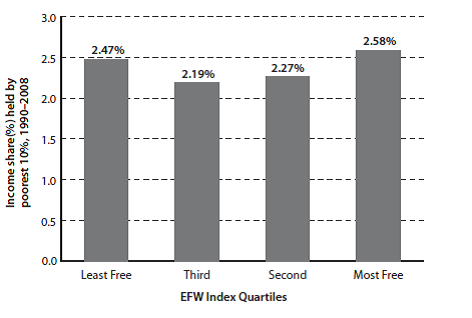
Exhibit 1.8: Economic Freedom and the Income Share of the Poorest 10%

The share of income earned by the poorest 10% of the population is unrelated to economic freedom.

Sources: Fraser Institute, Economic

Freedom of the World: 2010 Annual Report;

World Bank, World Development Indicators.

Now let’s look at another aspect of the poor’s situation.

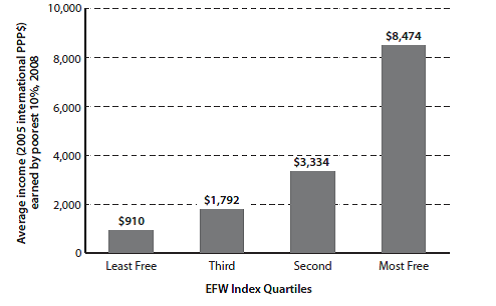
Exhibit 1.9: Economic Freedom and the Income Level of the Poorest 10%

The amount, as opposed to the share, of income earned by the poorest 10% of the population is much higher in countries with greater economic freedom.

Sources: Fraser Institute, Economic

Freedom of the World: 2010 Annual Report;

World Bank, World Development Indicators.

This is dramatic.  While the poor’s share of the wealth is independent of the degree of freedom in the country in which they live, their wealth in absolute terms is enormously greater, and it gets more so as the degree of freedom increases.  The poor of a free nation are far better off than the poor of a tyranny.  Of course this is not reason to disregard the relative plight of the poor in any nation.  Certainly, after (and only after) private and local community aid efforts for the needy (who are, in fact, only a subset of the poor) have been exhausted, an argument exists for aid at the state level (now speaking for the United States alone), to be followed—only as a last resort—by  Federal assistance to state-tailored and -run work-for-assistance programs for the few remaining that need assistance.

One more thing: where the US sits on the freedom scale is instructive.

The following small table is excerpted from Exhibit 1.5 from the same report as the graphs above.  The year is the year for which the rating is valid; the ratings themselves are on a scale from 1-10, with 10 being most free.  For context, the US is rated as 6th most free in the world, overall, with Hong Kong the freest and Chile ranked number 5.

Year        1970  1975  1980  1985  1990  1995    2000    2001    2002   2003   2004  2005  2006  2007  2008

US          7.74    7.83    8.03    8.18   8.43   8.32    8.45     8.23     8.22    8.17     8.15   8.07    8.01    8.08   7.93

Hong Kong 8.99   8.85   9.21   8.81   8.76   9.11    8.82     8.76     8.76    8.81     8.75   8.94    8.95    9.00   9.02

Chile      4.31   3.93    5.56    6.18    7.02   7.47    7.28     7.47     7.59    7.75     7.67   7.94    7.97    8.08   7.99

Notice the freedom trend for the US.  We were at our freest in 2000, then the Federal government began increasing the degree of regulation it forced onto our economy—both business and individual.  Yes, the Progressive rap on the Bush years is that he deregulated, and did too much of it.  But on this, as with so many things, the Progressives are wrong.  By 2008, the US only ranked 26th in our freedom to trade internationally and our business regulatory controls.  Appallingly, our credit market regulatory regime ranked only 103rd.  (As an aside, despite Congressman Ron Paul’s concern about the soundness of our money, as of 2008, we ranked number 2, with Japan at number 1.  Of course a lot has changed since 2008: in 2009, our rank fell to 11.)

And the degree of regulatory control has exploded under the Obama administration.  This has driven our ranking in overall regulatory freedom from 17th in 2008 down to 27th just in Obama’s first year, 2009 (we were 2nd in 2000).  Associated with this, the per centage of Americans living below the Federal poverty level has grown to historic highs these last three years.