
Economic Growth

…over last year, the 6th under the Obama administration. Which is several years late in occurring under the Obama promises, but that’s another story. See the graph. EconomicGrowth
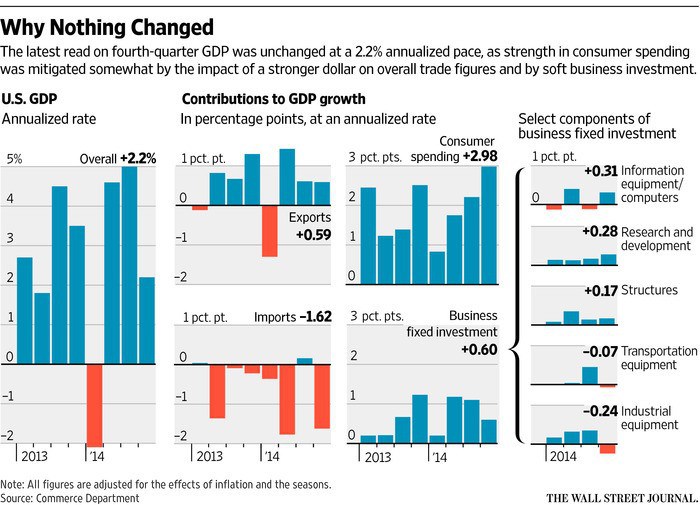
First, the overall GDP: disregard the shrinking in the first quarter of 2014; that appears to be an aberration compared to the nearby trend.

What’s interesting are the components of the GDP growth and of Business Fixed Investment in particular.

Imports remain in negative territory: we’re importing less and less (and possibly at an accelerating rate) over the last couple of years. There are a number of reasons for this, including the increasing competitiveness of domestically produced products on one hand and the continued doldrums of the our economy leaving too little discretionary funds in the hands of consumers and of businesses to buy imported goods on another. An implication of this, though, is that importation is tomorrow’s consumer and business spending.

Consumer spending is up (and possibly at an accelerating rate), but look for that to fall off if imports continue to decrease: many of those imports are for incorporation into business products for consumer purchase; that puts a lag into many of the imports’ impact on consumer spending.

Look at Business Fixed Investment, though. That never has gotten very high, peaking a bit over a year ago at just over a 1% year-on-year increase, and it’s been falling off since. Decreasing imports being used less and less by businesses.

This is especially telling in those BFI components. R&D may be accelerating, but it’s still at a pathetic rate. R&D is critical to business survival: it’s not just about how to market existing product better, though that’s important. It’s primarily developing new product, market research to guide that development, and so on. If a business’ products become obsolete, so does the business.

The tale is told in spades in Structures and Industrial Equipment. Businesses aren’t expanding their physical plant, especially in manufacturing. That means these guys don’t see any future growth in demand, either, and they don’t have the disposable funds in this still-stagnant economy to expand where they do see some glimmers.

It’s going to be a long two years on the domestic front.
Texas Education

Lawmakers in Austin are now debating SB 276, a bill that would provide school choice and educational freedom to all Texas students. It would allow parents who opt out of public schools to take with them 60% of the money the state would otherwise spend on their child—about $5,200—to pay private-school tuition. The rest of the money, roughly $3,000 per student, would go back into the state treasury.

There are a couple of alternative uses for those $3,000 than just dumping them back into the general pot.

Texas’ schooling, as elsewhere, is generally paid for with personal property taxes. Several years ago, Texas decided to consolidate those taxes, though, and redistribute them state-wide, rather than leaving them in the local community whose members had paid the taxes.

Thus: rather than sending the money to the general pot, leave the money with the school whose student(s) just left. This will increase the money available to be spent on the remaining students’ education. Of course, I’m naively assuming those $3k will be spent efficiently and for the benefit of the students….

Alternatively, the money could be earmarked, in keeping with the intent of that earlier property tax consolidation move, for the poorest of our school districts, giving them an increased opportunity to teach their students. Here, too, I’m making that same naïve assumption.

There is an alternative use for those $5,200, too. Don’t limit them to private-school tuition. Let the money be used for voucher payments/tuition at any school with room that the parents might prefer: parochial, charter, better performing public schools. Let the money be used, too, to defray parents’ costs of homeschooling.

Sending the $3k to the state’s general treasury, though, ought not at all be a deal breaker for this move, neither should the proposed commitment of the $5k to private-school tuition: SB 276 still is a major move forward. There’s plenty of time to come back again in the next legislative session to improve the move and to go farther. We’ll even have two school years of data to mull over as we consider the next move.

Now, there’s a thought.

A Reason

…to decertify public “service” unions. And to terminate for cause the government’s “negotiators” for agreeing to such a thing.

Under the 1978 Civil Service Reform Act, “official time” was named, and it allows public service union members to use company time—that is, time they’re formally working for the government in a government job as a government employee—to do union administrative things. Doing union-specific work on the government’s clock also means they’re being paid by the government—by us taxpayers—to do union, and not government, work.

The thinking behind this little fillip was the premise that the union bargains in the name of all government employees, whether they’re union members or not, and this was a way to compensate the union for those alleged extra costs.

Like all sweetheart deals, this one has gotten out of hand.

According to the Office of Personnel Management, in 2012 (the most recent year there are statistics for) federal workers spent 3.4 million man-hours on union issues and not the work they were hired for. OPM estimates the cost to taxpayers was more than $157 million.

What’s more, at two government agencies that would seem least able to afford a loss of manpower—the Veterans Affairs Department and IRS—hundreds of workers spent 100% of their time doing union work. At the VA, 259 employees worked solely on union issues. At the IRS—which only disclosed their statistics when the National Review sent them a Freedom of Information Act request—the number was 201.

But wait—there’s more:

According to the Bureau of Labor Statistics, 939,000 federal workers belonged to a union in 2014. Another 139,000 were covered by collective bargaining agreements, but weren’t in a union. That brings the total number of employees covered by the unions to 31.6% of the total federal workforce.

However, there’s no requirement for any union to bargain for non-union employees, nor is there any requirement for any employer—even the government—to apply union contract terms to non-union members. Indeed, there’s no requirement for non-union employees to accept union contract terms as their own employment terms.

And so there are no costs for bargaining for the benefit of non-union employees. There never has been, requirement or cost; those are just fictions peddled by self-serving union leadership in order to get more money for union coffers.

Hence my call for decertification and termination.

All the more Reason

…to speed reform of the way in which our economy produces medical care services and in which we pay for them.

[A] 66-year-old couple retiring this year with average Social Security benefits can expect medical costs to consume 67% of the Social Security they will receive in retirement.

A 55-year-old couple who plan to retire in 10 years can expect to devote about 90% of their lifetime Social Security benefits to healthcare costs.

There’s more:

Social Security benefits typically grow by approximately 2% a year—the overall rate of inflation. But medical costs in general tend to rise by more, 5% to 7% a year[.]

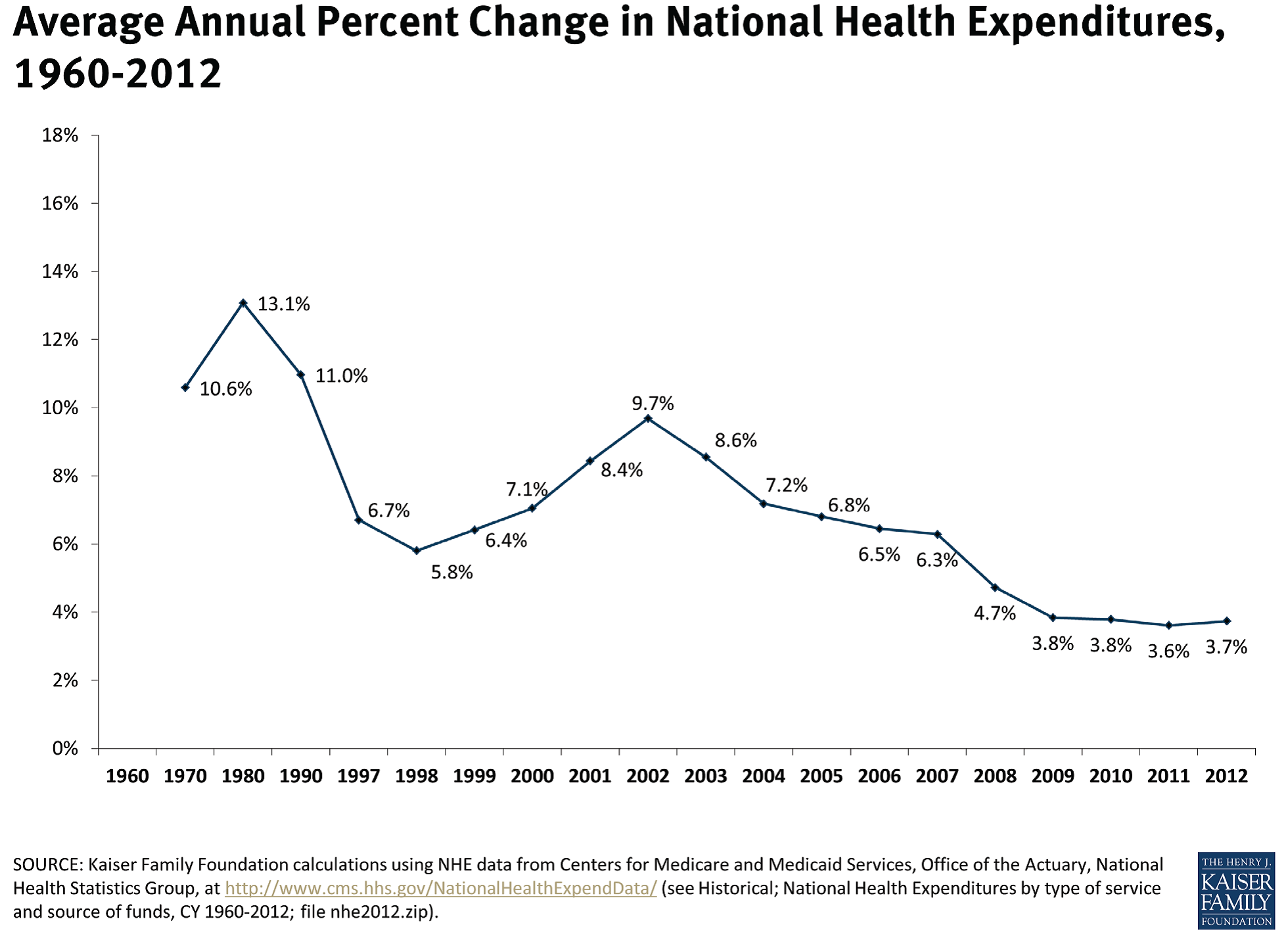
There’s this graph, too, that illustrate cost change trends since 1960:HealthCostTrends

Since Obamacare was enacted and has started to take effect (since 2010), the then-eight-year-old trend of decreasing costs has been completely stopped. That’s the effect of government intervention into a free market.

If we’re to correct this, if we’re actually to hold down, not just the rise in costs, but the actual costs themselves, we need to get government out of the way and use free market solutions: get rid of the health welfare that is Obamacare, allow insurance companies—which would sell true insurance policies—to charge premiums based on the actual risk transferred from customer to company, and allow insurance policies to be sold across state lines—that is nationwide.

All government intervention succeeds in doing is preventing competition and market forces from reducing and then holding down costs. Which hits hardest the very people these government programs are claimed to help.

The Democrats’…Budget

The House Democrats are showing their disdain for the American people with this thing (you have to drill to see what they’re burying).

Congressman Chris Van Hollen (D, MD) published the House Democrats’ version of a budget, and it nearly doubles the Federal deficit over the next 10 years and increases the national debt by nearly a third over the same period to $25 trillion dollars. On purpose. Remember this as he gears up for his run for the Senate next year.

While buying into every penny of President Barack Obama’s call for $1.8 trillion in more taxes (because Democrats can’t get enough of your money), it raises spending even more (because they need your money to buy votes to keep their power).

This isn’t a serious budget effort; it’s just an in-your-face answer to the more conservative budgets already on the table in the House and Senate. As they’ve done the last several years over multiple administrations, these Democrats are determined to block Republican initiatives, not because of any real, principled differences with them, but solely because of their Republican provenance.