
This Must Be Rejected

Puerto Rican Governor Ricardo Rosselló is coming to the mainland to stump for statehood for the territory on the basis of the just completed referendum on matter.  The referendum had only a 23% turnout after heavy boycotting by several other interests; the last referendum had a 78% turnout.  That tiny turnout, though, voted strongly for statehood rather than the status quo or independence, the alternatives on the ballot.

Rosselló’s effort should be strongly rejected.

There can be no question of Puerto Rican statehood until the territory has demonstrated stability in a responsible spending and taxing régime that also excludes outlandish debt.  This demonstration would require at the least first finishing the territory’s current bankruptcy proceedings and its recovery of its economy to a stable low debt and low taxation condition—a stability that can only be demonstrated across a generation or two.

We have enough States already with out of control spending, taxing, and debt—beginning with California, Illinois, and New York, but not ending there—and that are risks to the national weal without adding another profligate and irresponsible state government to the mess.

Despite boycotts by opposition parties that depressed voter turnout, Puerto Rican voters delivered “a clear rejection of the current colonial status and a path forward through statehood,” Governor Ricardo Rosselló said in an interview with The Wall Street Journal.

Never mind the questionable validity of the referendum from the boycott.  Take the referendum’s outcome as a rejection of “colonial,” of territorial, status, at least; it certainly has seemed that or nearly so across the several referenda.  Another way to end that status is to become an independent, sovereign nation.

Of what are the Puerto Rican elites so afraid about independence?  Oh, wait—those elites wouldn’t have such ready access to OPM to support their virtue signaling and the spending on pseudo-welfare that supports it.
Another “Leak,” Another Rumor

President Donald Trump’s firing of former FBI Director James Comey is now a subject of the federal probe being headed by special counsel Robert Mueller, which has expanded to include whether the president obstructed justice, a person familiar with the matter said.

The rest of the article continued in that vein: no real-world sources cited, only this deliberately unidentified one.  The Wall Street Journal‘s article at the link also cited a Washington Post article on the same subject; that bit also only cited “sources”—five of them in WaPo‘s case—whose identities were carefully withheld.

“…a person familiar….”  “…five officials….”  The WaPo piece even said their “five officials” demanded anonymity because they were speaking without authorization.

This raises two questions and a concern. The questions are these. First, with no substantiation, how are we to know these sources even exist?  How can we do our own checking?

Second, these sources—if they exist—begin as liars: they’re speaking without authorization, and so they have broken the terms of their employment and possibly their oaths of office.  How can we believe the claims of liars? Why would WaPo or WSJ take such claims seriously?

And this, at the end of the WSJ piece, with no trace of irony on the part of the authors:

At a June 13 hearing at a House of Representatives panel, Deputy Attorney General Rod Rosenstein declined to say who asked him to write a memo justifying Mr Comey’s firing.  …  Mr Rosenstein said he wasn’t at liberty to discuss the matter.

“The reason for that is that if it is within the scope of Director Mueller’s investigation, and I’ve been a prosecutor for 27 years, we don’t want people talking publicly about the subjects of ongoing investigations,” Mr Rosenstein said.

So much for that.

The concern is this: why WaPo and especially WSJ have walked away from basic, foundational journalist standards—that allow for anonymous sources but require them to be substantiated by two or more on-the-record sources—and descended themselves to rumor-mongering.

Rhetoric

There has been on Wednesday a deliberate, carefully targeted attack against a collection of Republican Congressmen practicing for a Congressional baseball game that was intended to be a bipartisan fund-raiser (the Progressive-Democrats were practicing their own team at another venue) that injured five, including the Republican House Whip who is the third most powerful House Republican, who was seriously injured.

In the aftermath we got Senate Minority Leader Chuck Schumer (D, NY) making a tendentious speech on the Senate floor proclaiming his regret over this shooting, and we got the House Minority Leader Nancy Pelosi (D, CA) making a similarly overwrought speech on the House floor.  Both called for bipartisanship and expressed their sympathy for the shooting victims.

Other current Progressive-Democrats also say they decry this violence.

These people are at the pinnacle of their careers; they’ve reached the top echelons of the political life and career: they’re enormously intelligent.  As politicians, too, words are their stock in trade: they choose the words and phrases they use to make their points extremely carefully.

These people also have routinely held themselves and their party out as knowing better than the rest of us—that’s what underlies their position that Government will solve our problems and must do so because we cannot handle our own lives and situations.

Now: Progressive-Democrats in Congress past and present have for years openly called Republicans unpatriotic, hostage-takers, terrorists.  They say Republicans are racist, xenophobic, homophobic, irredeemably deplorable.

The physical impact of their rhetoric has become clear over the last couple of years: their followers have physically assaulted Republicans at their political campaign rallies, including one charging onto the stage to attack then-candidate Donald Trump.  Their student followers routinely attack speakers—even fellow students and professors—who disagree with them.

Now this deliberate, carefully targeted shooting attack against a large gathering of Republican Congressmen.

Can anyone really believe these politicians didn’t—and don’t—know what they were and are saying?  Can anyone truly think that these politicians didn’t and don’t know beforehand that their carefully incendiary rhetoric would lead to violence of the murderous type that occurred Wednesday?

It’s certainly true that incitement to riot or murder is no excuse for the riot or the murder (thankfully only attempted, Wednesday).

But it’s also true that there’s no excuse for the incitement to the riot or the murder.  And the Progressive-Democrats have been doing exactly that.

Censorship

The Chinese Communist Party’s powerful disciplinary wing is taking aim at the country’s internet censors for not pushing a party-line agenda, saying they were “irresolute” in implementing the policies of President Xi Jinping and “not trying hard enough to ensure political security.”

Read: political purity.

…authorities now want people to become absorbed by politics as defined by the party.

“If you let people get too sucked into entertainment, no one will care about what the leaders are saying. If you don’t do this [crackdown], no one will watch the ‘Network News,'” he said, referring to the staid evening news program of the official state broadcaster, China Central Television.

This is the People’s Republic of China’s version of “freedom” and of “free” speech.  The PRC’s presence on the world stage needs to be watched with a careful and jaundiced eye, given how the government so disrespects its own people.

“You clap when they ban entertainment. What will you do when they ban you from clapping?” one user asked on Weibo.

Indeed.

A Couple of Disparate Thoughts

Thoughts triggered by a piece by Richard Fernandez on the dislocation of the Left…triggered…by The Brits voting to leave the EU, Donald Trump’s election as President, Emmanuel Macron’s election as French President, the resounding defeat of Theresa May and her Conservative party’s defeat in Britain’s snap elections, and Macron’s La République En Marche! party’s in-progress accession to strong power in the French National Assembly.

One thought is this.  Van Jones, ex ex-President Barack Obama’s advisor, complained about the selfishness of Democrats’ spending in the last Presidential campaign season while speaking to a crowd at the People’s Summit in Chicago’s McCormack Place.

The Hillary Clinton campaign did not spend their money on white workers, and they did not spend it on people of color. They spent it on themselves.  They spent it on themselves, let’s be honest.

Let’s be honest, indeed.  This is the identity politics of the Left, repeated.  And it’s Jones’ own selfish version of identity politics.  His beef isn’t that the money wasn’t spent to further the campaign or the interests of the American citizenry.  He’s not even decrying the spending in favor of party officials and cronies.  No, his beef is that the money wasn’t spent on his groups of Americans in particular rather than other groups of Americans—or even on Americans in general.

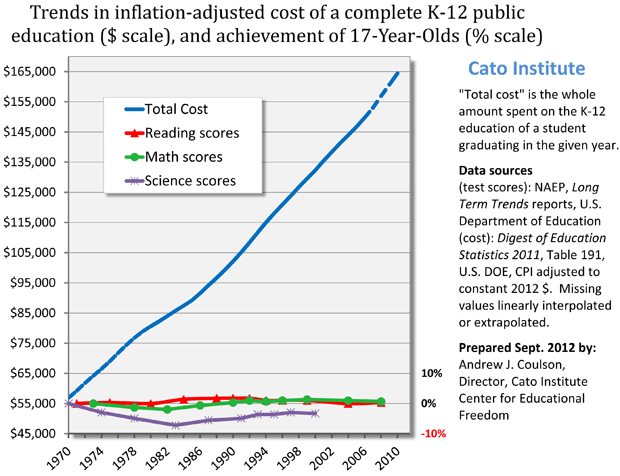
The other thought is illustrated by this graph, which Fernandez got from the Cato Institute, to which he linked in his piece (the Cato Institute article is worth reading in its own right).  It’s a five-year-old graph, but it remains valid.

Notice that while keeping in mind the predominance of union control of teaching in our K-12 schools coupled with the Left’s increasing influence on the slant of the subject matter being taught in required subjects other than science and arithmetic.  Total spending per student has nearly tripled over the last 45 and more years with no effect at all on student performance outcomes beyond a slight degfradation in science performance.

The Left just doesn’t care about performance, even at the foundation of our citizenry.  It only cares about spending and the power that brings them, and here, the Left’s ability to shape successive generations of voters.

Which dovetails nicely with the Left’s dedication to identity politics.  The thoughts aren’t so disparate, maybe.