
Continued Intransigence

European Commission President Jean-Claude Juncker makes it clear.

Britain has still not proposed any workable alternatives to the Northern Ireland “backstop” within the Brexit withdrawal agreement, the EU said on Monday.

And

President Juncker underlined the commission’s continued willingness and openness to examine whether such proposals meet the objectives of the backstop. Such proposals have not yet been made[.]

Juncker knows full well that the “backstop” is not just a deal-breaker, it’s a non-starter for the British. It demands that a core feature of the Brexit vote three years ago was so that Great Britain gets control of its own borders back, yet the “backstop” requires Great Britain to surrender its Irish border to the EU.  That can only be taken as a first step to dismantling Great Britain.

What demonstrates the cynicism of the EU and of Juncker is that they, and he, have steadfastly refused even to offer their own “workable alternatives.”  It’s the EU’s backstop.  Full stop.

In place of counter-offers, Juncker is offering only vapid, uselessly rhetorical pretense and empty willingness to “discuss the next steps.”

He plainly wants Great Britain to drop its Brexit plans and meekly beg for forgiveness for its effrontery. Despicably, so do Labour and too many so-called Tories.
Judgment

Recall that the New York Times, just a very few days ago, reprinted an excerpt from a Clinton lawyer’s book that Supreme Court Justice Brett Kavanaugh had inflicted an obscene act on a young woman while he was a college student at a “drunken dorm party.”

Immediately on publication, Progressive-Democratic Party Presidential candidates and sitting Senators Kamala Harris (CA), Elizabeth Warren (MA), Bernie Sanders (VT), Cory Booker (NJ), along with fellow candidates ex-Congressman Robert Francis O’Rourke, and ex-HUD Secretary Julian Castro all demanded Kavanaugh’s immediate impeachment.

Then the NYT, having been caught in its lie, had to print a “correction” in the form of an…Editor’s Note…buried in the article:

An earlier version of this article, which was adapted from a forthcoming book, did not include one element of the book’s account regarding an assertion by a Yale classmate that friends of Brett Kavanaugh pushed his penis into the hand of a female student at a drunken dorm party. The book reports that the female student declined to be interviewed and friends say that she does not recall the incident. That information has been added to the article.

Nor, apparently, did the NYT bother to ask the person in question to be interviewed for its article containing the excerpt. The NYT also has offered not even a single syllable of apology to Kavanaugh for its smear.

We expect that out of tabloids.  What’s particularly disgusting, though, is that not a single one of those Presidential candidates have offered a smidgeon of apology to Kavanaugh for their role in expanding the smear. Instead, with their silence they stand by their claims.  That’s a lack of integrity, an absence of morality, that’s wholly unacceptable.

Impeach on the basis of a newspaper article, rather than actual evidence.  That’s not the quality of judgment we need in the White House.  Nor is it the level of integrity needed there.

A UAW Strike

The United Autoworkers Union sent 49,000 members and employees of GM out the door and on strike Sunday night.  The strike will hammer GM plants in Michigan, Ohio, Tennessee, Kentucky, New York, and Texas among other areas.

Here is another case of a union saying it won’t let a business operate at all, unless and until that business’ managers surrender completely and give the union everything it wants.

Strikes are legalized extortion and a refusal to negotiate in good faith.  It’s impossible to reach an honest deal with a gun in management’s ear.

Strength of Consent

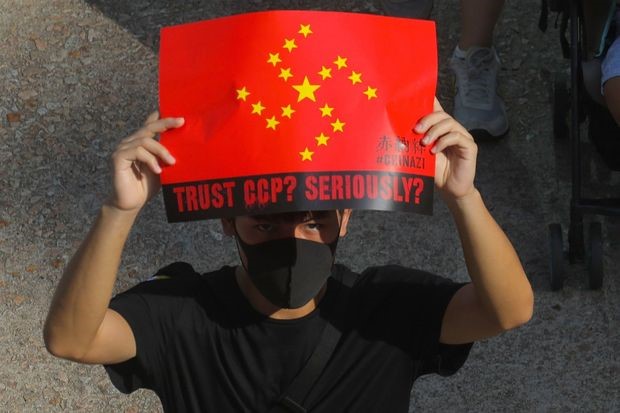
The people of Hong Kong are in their 15th straight week of protest against the People’s Republic of China’s moves to intervene in Hong Kong’s internal affairs, to impose yet more PRC controls over a nominally free, “two systems” city.

People of all ages, many unmasked and some carrying children, walked more than 2 miles from a shopping district, where usually busy stores were shuttered, to downtown Hong Kong. Many chanted, “Five demands! Not one less!,” “Fight for freedom!” and “Revolution of our times!”

Those five demands, which do not add up to freedom, but are a necessary early step on the path to freedom, are these:

  • independent inquiry into allegations of police brutality
  • amnesty for arrested protesters
  • electoral reforms to allow Hong Kongers to vote for their own leaders
  • formal withdrawal of the extradition bill that would have allowed Hong Kong citizens (and anyone else arrested) to be sent to the PRC for trial and jail
  • Hong Kong Executive Carrie Lam’s resignation

Lam has “promised” to formally withdraw the extradition bill, but she has not honored her promise, and she has categorically rejected the others. Lam’s “promise” was a cynical effort to divide and weaken the protest movement.

However, as The Wall Street Journal put it in the article at the link,

The scale of the crowds Sunday evoked mass marches earlier this summer, suggesting efforts by Hong Kong Chief Executive Carrie Lam to weaken and divide the opposition movement are having little effect, and the crisis remains a challenge for the Chinese leadership in Beijing.

This protestor illustrates the matter.

The PRC’s President Xi Jinping has a golden opportunity, here, to demonstrate the strength of consenting to the citizens’ demands, but he’s overtly eschewing it. He, and his Chinese Communist Party cronies, are simply too insecure to take the step.  And not just politically: they’re personally and emotionally too insecure.

Oil Strikes and our Economy

“Economists” cited by The Wall Street Journal say that the Iranian/Houthi strikes against a couple of major Saudi Arabian oil production facilities are unlikely to do much to our economy. Despite their anonymity, those…sources’…assessment is accurate.

Among other things, we’ve made ourselves essentially self-sufficient in oil and natural gas production, have become the world’s leading producer, and we’re a net exporter of oil and natural gas.  That last, especially, means we’ll easily be able fill any shortfall from the Saudis’ damage.  (Production cuts from that damage are likely to be short-lived in any event.)

In addition,

Today, energy accounts for about 2.5% of household consumption, down from around 8% in the 1970s

The Federal Reserve still has its misconception regarding the proper execution of its role, though:

The Saudi oil-field attack adds a new factor to consider for Federal Reserve officials, who have been weighing how a variety of geopolitical risks will influence the economic outlook, including the US-China trade war, unrest in Hong Kong, and Britain’s impending departure from the European Union.

Those things are irrelevant to the Fed’s task, which is to maintain stable pricing and full employment. The optimal way to achieve this is simply to set its benchmark interest rates at levels consistent with its inflation rate goal, and then—rather than chasing market responses to this or that “geopolitical risk,” or trying to anticipate and preempt them—sit down and be quiet.  The resulting sound economy will produce full employment.

The Fed’s inconstancy is a bigger problem for our economy than hits, even major ones, on another nation’s energy production capability.

On the other hand, the People’s Republic of China burns through three times the oil that it produces; it badly needs oil imports, much of which it got from Saudi Arabia.

Japan imports nearly all of the oil and natural gas that it consumes.  That’s a shortfall we easily can, and should, fill.