Misunderstanding

At the tail end of a Wall Street Journal article discussing the relationship between Deputy Attorney General Rod Rosenstein and Congress (and in particular the House Freedom Caucus), Rosenstein made this remark:

We have a responsibility to work with the Congress. They have a responsibility to understand their duty is not to interfere.

This is a breathtaking lack of understanding by a Federal lawyer. Oversight by Congress does not mean simply watching. Interference is absolutely required if Congress, through its oversight, detects inappropriate or wrong behaviors.

Or would Rosenstein insist that funding cuts—Congress doing its job—are interference?

Taxes and Deduction Caps

New York thinks it’s found a way around the tax reform act that cut Federal income taxes and capped the deduction taxpayers can take for State and Local Taxes (vis., State income and property taxes).

The idea, which became law last month, creates a new optional payroll tax that shifts the state and local tax deduction from individuals who can no longer fully take it to businesses that can.

However,

Employers are worried about compliance costs, interactions with union contracts, complexity across state lines, and the difficulty of explaining to workers how a plan that might lead to smaller pay raises still puts more money in their pockets.

In response,

The Wall Street Journal asked the 10 largest private employers in the state and in New York City, along with all Fortune 100 companies based in New York state, whether they would opt for the new payroll tax. None that responded said they would do so

Hmm….

Here’s an alternative idea; work with me on it, it’s simple and not very nuanced.  The State jurisdictions should simply lower their income and property tax rates.  That would bypass the SALT cap by making it less important (and as a happy side effect it would leave more money in the hands of the State’s citizens).

National Sovereignty

The European Court of Justice has decided it is the arbiter of a nation’s borders and of entry permissions, and not the nation itself.

The court heard the cases of two men, one Afghan and one with Croatian and Bosnian citizenship, and ruled the severity of their crimes or alleged crimes and how long ago they took place need to be taken into consideration before an entry ban is permitted.

The ECJ ruled that, while an EU member can bar entry to such persons, it must satisfy the court that its rationale is good enough; it is no longer a matter of national sovereignty, and that member cannot simply say, “No entry.”  This is an assault on the sovereignty of nations; it takes away from the nation its right to determine for itself who will be allowed to enter.

It attacks the principle of sovereignty that no person has an inherent right to enter any nation other than his own without that nation’s prior permission, and it attacks the tightly associated principle of sovereignty that no nation has an inherent obligation to let any foreign person in.

The ECJ’s ruling attacks the principle of sovereignty that borders are the province of the sovereign nation and its sovereign neighbor and arrogates the meaning of borders to the court.

Aside from the sovereignty question, there’s also this.  It may be a good or a bad idea for a nation to bar entry to this or that individual or to bar this or that group of individuals.  It’s often a moral question, too.  But it’s not a question that’s within the purview of an international court.  Nor is the morality of the matter a question that’s within the purview of any court.  Acting on a moral question—the very definition of what is moral—is a political act and a political definition.  It cannot be a judicial one, it cannot be the decision of a few who are unaccountable to the nation’s people.  Not in any free society.

This last, especially, has implications for immigration cases currently before the Supreme Court or soon to be.  Will the Justices make the political determination of who is allowed into the United States—as far too many district and appellate judges have presumed to do—or will they leave the political decision properly in the hands of our nation’s political actors?

Major Uncool

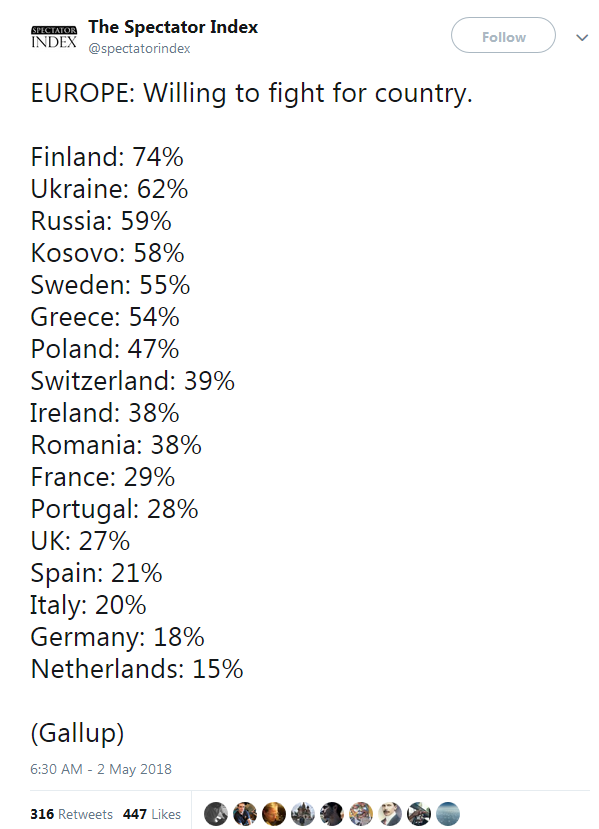
Here’s a stat from Spectator Index.

The people of most of those nations would appear to prefer to be slaves of a conqueror.  The top two nations, on the other hand, have recent and direct experience with Russian dominance.  Which makes Poland’s poor attitude surprising.

On the other hand, the general attitudes of the NATO nations makes one wonder about the utility of NATO at all, and whether we wouldn’t be better served by forming a mutual defense alliance with those eastern European nations that still have some self respect—many of which aren’t listed in the poll.

Poke around the comment thread, too.  There’s at least one who’s arguing with a straight face that Turkey and Russia are not in Europe.

Selling Weapons to the Republic of China

Especially in the face of an aggressively acquisitive People’s Republic of China that’s busily trying to cow the Republic of China, The Wall Street Journal favors our selling the RoC updated F-16s.

Such a sale would be a good start, but it’s only that.

There’s no need to wait on international consensus regarding an F-35B sale to the Republic of China (a concern of the WSJ); we should consider moving unilaterally. Or selling an F-35C that isn’t part of any consortium. The People’s Republic of China already has the F-35 secrets, anyway, courtesy of the Obama administration’s decision to eschew IT security. ‘Course, I think the F-35 is a wasteful pig, and uprated F-15s, F-16s, and A-10s would be better buys.

Aside from that, though, we should be selling the RoC high and intermediate altitude missile defense systems and encouraging Israel to sell the RoC its Iron Dome and Arrow defense systems.

And we should resume active and frequent patrols of the Tawain Strait.

It’s time to stop treating the PRC with kid gloves.  It’s time, also, to stop ignoring the RoC’s needs as a sovereign nation.