
Tax Havens

Christian Reierman, writing for Spiegel Online, thinks tax havens are bad.

He began with the usual false premise, itself as usual unspoken: that Government is owed the money earned by private citizens or their privately owned enterprises, or that Government is somehow otherwise entitled to it.  His proximate vehicle is the Paradise Papers and their exposure of how widespread is the use of tax havens—entirely legal tax havens, mind you—by international businesses.

The German newspaper Süddeutsche Zeitung leaked a vasty number of documents—the so-called Paradise Papers—that exposed

how the rich and super-rich, international stars and companies try to avoid paying taxes in their home countries. It is a game for the wealthy.

The horror—people with money try to protect their wealth from grasping governments.  This time, they’re trying to protect the gains of the businesses they run:

The players are usually multinational corporations seeking to shrink their tax bill using convoluted structures. Tech-giant Apple once again stands accused of skullduggery, as does sporting-goods producer Nike. The accomplices are also largely the same. The deals in question invariably involve tax havens such as the Bermuda Islands, British dependencies such as the Isle of Man or Jersey, and European member states like the Netherlands, Luxembourg and Ireland.

Notice that: nothing here is illegal.  No skullduggery is present.  These business owners just are supposed to voluntarily give up what governments demand, simply because governments demand it on that false theory that the businesses’ prosperity belongs first to Government.

Here’s the game given away; here’s Reierman’s telltale question:

[W]hy are EU member states still allowed to cheat their partners within the bloc out of tax revenues?

There’s no cheating going on, of course.  It isn’t Government’s money.  And there’s nothing wrong with nations competing with each other for businesses and the employment that businesses bring–including competing on tax rates.  Full stop.

As always, the right answer is not to hold back the rich, to punish the successful with high taxes, or to cap the ability of individuals to be successful by restricting them to the performance of the weaker.  The right answer is to lower taxes all around and thereby leave more money in the pockets of the earners—including the poor.  The right answer also includes restricting government spending, which crowds out private spending by artificially increasing overall demand; which increases prices with its non-economic, inflated demand; which devalues the money left in the hands of the earner—particularly harming the poor.

The right answer begins with the clear recognition and admission of whose money is involved here.
So, What’s the Problem?

Don Peebles, Peebles Corp CEO, is worried about the Senate and House tax reform plans currently on offer.

…the GOP tax bill will have a catastrophic impact on New York City, leading to a mass exodus of business owners and entrepreneurs.

And

State income deductions and the local pressure on taxes that [Mayor Bill de Blasio] is calling for, an increase in taxes on millionaires and a mansion tax increase. I think that’s also going to be hard on real estate[.]

And

Peebles said the financial capital of the world is becoming more of an anti-business environment with high taxes and a diminishing quality of life, forcing entrepreneurs and businesses to seek opportunities in other states.

“No deductibility of state income taxes and New York is one of the top three highest-taxed states in the country, and then when you add the New York City tax implications on it, it can be as high as 17%. I think it’s a pill that people are going to have difficulty swallowing[.]”
…
“We have to impose some discipline on state and local governments, and I think responsible governors and mayors will do that,” Peebles said.

Indeed.  Instead of whining about a national-level tax plan that’s good for the nation as a whole, maybe folks in these usurious tax States, including their Senators and Representatives in Congress—especially them if they’re responsible—ought to spend a measure of that energy on working to get their State and local taxes lowered.

If businesses can’t function in a tax jurisdiction without subsidies for those taxes, they should leave; they owe it to their owners and customers, and they have no obligation to stay.

Cornell Professors

…apparently support racism and racist stereotyping.

Recall that George Ciccariello-Maher, Associate Professor of Politics and Global Studies at Drexel University, routinely says it’s whiteness, white victimization, all things white that are at fault for mass shootings and violence generally. For instance, this in an interview with Democracy Now!

Whiteness is never seen as a cause, in and of itself, of these kinds of massacres despite the fact that whiteness is a structure of privilege and it’s a structure of power, and a structure that, when it feels threatened, you know, lashes out.

What makes white men so prone to this kind of behavior?

And his tweet a year ago, All I want for Christmas is white genocide.

Cornell University’s professoriate demurred from Drexel’s decision to discipline Ciccariello-Maher ever so lightly (he’s on paid vacation leave) for his inflammatory and racist remarks (over Twitter proximately), wherein he blamed white victimization (and, of course, “Trumpism”) for the Las Vegas mass murder.

Seventy professors signed a letter on Wednesday protesting the university’s decision to take disciplinary action against George Ciccariello-Maher, saying it infringes upon academic freedoms, reported The Cornell Daily Sun.

Of course they do.  It’s entirely appropriate for college professors to “stereotype” groups of Americans of whom they disapprove.

Never minding that their favored groups of Americans became favored through precisely that “stereotyping.”

And Cornell, the school, is silent about it.

Hmm….

The Tax Proposals on Offer

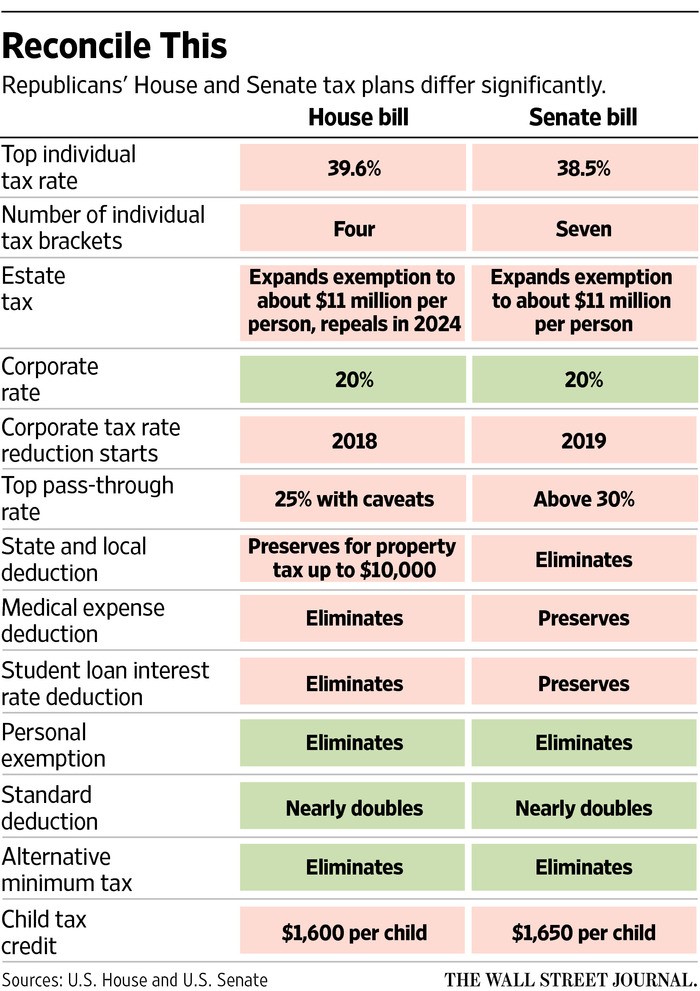
The House has one, and the Senate has one.  The Wall Street Journal, oddly, is making out like the differences between the two are enormous.  Yet, here’s the WSJ‘s own chart illustrating these humongous differences.

The big differences the WSJ singles out are these:

The big ways the Senate version breaks with the House plan: the level of top individual tax rates, the number of individual tax brackets, the timing of a corporate tax-rate cut and the particulars of estate tax changes[.]

How big are these differences, really?  The top level doesn’t even differ by a per centage point, and the number of brackets only differ in how finely income should be subdivided.  The timing of the corporate tax-rate is a matter of a year, again a small difference: put it in place in 6 months, rather than immediately; cut the rate to 27% this year and 20% next; and on and on—even trading this year vs next for something else.  Estate tax changes differ only in repeal or not—in 6 years, a lifetime in politics, a complete Senate election cycle.

Even the differences the paper elides, keeping or eliminating deductions for SALT, medical expenses, and student loan interest, is tiny.  Most folks don’t itemize, which is the only place these deductions even exist, and with the standard deduction doubled all around (personally, rather than a single/married standard deduction, I’d rather see the standard deduction keyed to the then-current year Federal Poverty Guideline, but that’s a trivial difference at present, too) and lowered personal income tax rates, the value of those deductions shrinks even further, especially for those who still would itemize.

No, the two versions blatantly, firmly, agree on the principles and the degree to which those principles should be satisfied in the tax reform effort underway.  They differ on numbers and timing—all small things that are easily resolved, except to the extent the Republican Snowflake Three in the Senate get in the way and to the extent the My Way of the Highway collection of House members let their egos get in the way.

Frightening the Snowflakes

It seems a Cambridge University professor had the effrontery to warn new students of a class of his—Physical Sciences—that life is hard and that it’s harder when you’re stupid.  For instance, this in an email that he sent to his incoming students:

Remember that you are NOT at any other uni, where students do drink a lot and do have what they regard as a ‘good time’—and you are NOT on a course, as some Cambridge courses sadly are, where such a behaviour pattern is possible or acceptable.

Oh, the wailing and bodice rending that resulted.

Student Minds Cambridge, a “mental health” activist group:

We are very concerned that this could be extremely damaging to the mental well-being of the students concerned, and potentially others as well.

And a Vice-Chancellor of nearby Buckingham University, Anthony Seldon (late of Cambridge):

Frightening impressionable undergraduates into believing that work alone is all-important is irresponsible, unkind and wrong-headed[.]

Wow.

On the contrary, what’s damaging to incoming university students, what stunts their mental development, what’s frightening regarding “impressionable undergraduates” is coddling them, rewarding them for their precious snowflake-ness, and thereby trapping them in a sense of victimhood, instead of confronting them with the difficulties of serious learning, the sterner difficulties of life in the real world, and teaching them how to cope—and especially that they can actually cope.