Hurted Feewings

…don’t make for lawsuits, even in New Jersey.

Former Democratic Councilman Dennis Kleiner quit his elected position in 2012. He then sued the municipality, the mayor, and another councilman claiming he had been forced to resign because of the rumors and false charges they made about him.

Fortunately, the New Jersey courts are a bit more grown up than this little boy.

The judge overseeing the case said Kleiner’s “complaints over his hurt feelings, damaged reputation, and potential embarrassment fall far short of violation of his First Amendment rights.

“This court will not condone this pointless litigation over [his] disappointments in the world of politics to linger….”

And he tossed the case.  So Kleiner appealed.

The appellate panel upheld the lower court’s toss and further noted that “another politician may not have resigned under the same circumstances.”

This Is Not Your Grandfather’s EU

I hope, because EU, look at you now (OK, some of you following along at home might see that I’m mixing ads and old songs.  Noted.)

Mady Delvaux, a Socialist MEP from Luxembourg, thinks robots should be considered to be persons and have rights.

Delvaux authored a report that proposes giving legal status to robots and categorize them as “electronic persons.”

But we should be able to kill those robot persons solely on our say so.  They should have kill switches which we can activate when we think they’re going to cause “dangerous damages.”  And this requirement of Delvaux’:

You always have to tell people that robot is not a human and a robot will never be a human.  You must never think that a robot is a human and that he loves you.

There are persons and there are persons, so, you know, separate but maybe not so equal.  But she has a solution for that, too.  Robots should be

made with operations that comply to all applicable laws and ethical principles.

Yeah, that’s the ticket.  We’ve done such a wonderful job of programming humans to comply with all applicable laws—even those laws that conflict with each other—and we’ve done an even better job of programming our laws to comply with our ethical principles—whatever we’ve been able to determine those to be.  Sure.

Only in the EU.

“How Barack Obama rescued the US economy”

That’s the headline on a recent Financial Times piece (sorry, the FT has a paywall) by Martin Wolf.  It’s a silly headline, for a silly article.

How should we assess the economic success or failure of Barack Obama’s presidency?

This is a difficult question to answer.

No, the question is easy to answer.  Obama’s economic policies have been abject failures.  It’s also straightforward to lay the bulk of responsibility on Obama and his administration.  While it’s true that the Panic of 2008 began in the prior administration, it was Obama’s “stimulus” package that both blew up the nation’s debt and failed in its purpose of stimulating our economy with shovel ready jobs in a massive so-called Keynesian stimulus and its bailout of failing large banks.  It was his Federal Reserve’s policies (yes, yes, the central bank is supposed to be independent, but it was Obama’s Ben Bernanke, extended at Obama’s decision, and his Janet Yellen appointment) that degraded money discipline with their decisions to ease the money supply and hold interest rates artificially low.  It was his excessive—explosively so—regulation that limited business’ ability to function in the market, that limited small business’ ability to get started, that limited job growth and employment recovery.

It was the Obama administration’s Dodd-Frank, with its too big to fail policy that distorted those big business’ risk-taking decisions, decisions that used to be made in a free market but that under Dodd-Frank are made with the perception—courtesy of that “stimulus” bailout—that if the business messed up, Government would bail them out.

[S]hockingly, most congressional Republicans opposed all significant monetary, financial and fiscal actions taken to deal with the crisis.

This isn’t shocking at all; what’s shocking is the blind, knee-jerk rejection of free market principles by a Democratic Party (soon to become a Progressive-Democratic Party) suddenly in complete control of our government and cut loose from any restrictions on their power.  Absent the “stimulus,” the Panic might have been steeper, but it also would have been much shorter.  One only has to compare the Depression of 1920-21 with the Great Depression to see the efficacy of government non-response compared with Government intervention, and the Panic of 1907 with both to see another example of the efficacy of private response compared with Government intervention.  Of course, the Democrats knew—and know—this history, yet they acted as they did, anyway.

He tried to move the US closer to the universal health insurance taken for granted in other high-income countries. The Affordable Care Act (“Obamacare”) has added an estimated 20m adults and 3m children to the insurance rolls.

He didn’t try, he did it by Party fiat and then by Executive diktats—lots and lots of diktats.  Further, while Obamacare has provided health welfare to those adults and children, it also has thrown millions more out of their health insurance plans and denied them access to their doctors in direct—and knowing—contravention of Obama’s explicit promises that these denials would not happen.  The claim of cost growth reduction is a cynical one, also, being limited as it is to the cost of selected groups of Americans.  In fact, the cost has exploded, with premiums rising in double-digit per centages, deductibles going to 10s of thousands of dollars—an annual expense—the departure of heretofore health insurance companies from the health welfare plan “market,” and the cost to taxpayers similarly growing rapidly to pay for the subsidies of those given essentially free access to this health welfare.

Wolf’s discussion of our “jobs” recovery is misleading, also. Labor force participation rate is at historic lows, held back by those policies’ suppression of job creation.  Even the male labor force participation rate, which has been in a declining trend since its early ’50s peak, is farther below that long-term trend than it ever has been in that time frame.

Finally, this graph summarizes the efficacy of the Obama administration “recovery” as compared to post-WWII economic dislocation recoveries.
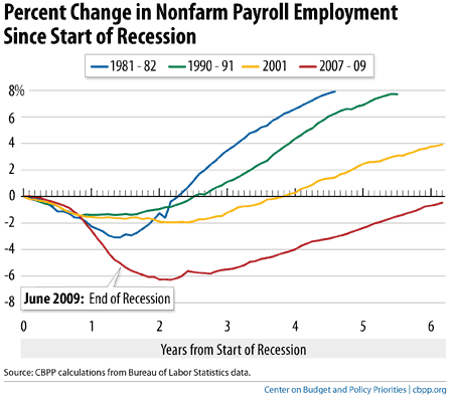
Even at the end of 2016 rate of 4.7% unemployment of 4.7%, the Obama administration’s economic policies have held back the recovery by years.

Linkages

They didn’t work when Nixon and Kissinger tried it, even though the Soviet Union generally complied, because the revolutions that the USSR was fomenting continued to occur apace after the Soviets stopped fomenting in return for nuclear and economic concessions.

Treasury Secretary Jacob Lew warned ignoring recent steps by Beijing to liberalize its economy would endanger Chinese cooperation on other major geopolitical issues, particularly containing North Korea’s nuclear program.

They’re not working now with the People’s Republic of China, but for a different reason.

And

The departing Treasury secretary further warned against steps that would prompt China to withdraw its support for tougher sanctions against North Korea.

The PRC still isn’t taking steps to “liberalize its economy,” not when it’s actively interfering with its cross-border yuan flows, manipulating domestic interest rates with a view to control who gets to lend or borrow rather than an effort to maintain a stable monetary policy, manipulating its domestic stock markets as it did in 2015 and today with manipulating the legal environment, and on and on.

Nor has the PRC ever cooperated in any meaningful way with respect to sanctions connected to northern Korea’s nuclear weapons program.  The PRC routinely slow walks its agreement to sanctions (which is why their occasional prompt agreement is such news), and it ignores sanction violations as those occur across its border with northern Korea.

And—ignored by Lew—the PRC is accelerating its aggression in the East and South China Seas and increasing its pressures on the nations rimming the South China Sea to deal with them exclusively and one at a time on trade questions.

Before today’s linkages can have effect, the parties at both ends of the lever must be willing to be responsive.

Polemics vs Reasoned Argument

As the Congress considers import taxes as part of its general tax reform agenda, toy sellers are expressing their concern: they import most of what they sell; their products are manufactured overseas.  Import taxes are surely a thing worth discussing and debating thoroughly, whether they’re essentially cost of goods sold neutral, as Doug Holtz-Eakin argues (the dollar will rise from the tax change and economic growth, and so the dollar cost of imports will fall; the cost of goods sold will simply emphasize taxes more and import costs less), or they’re dangerously like protectionist tariffs, as others argue.

Arguments that are carefully emotion-laden while devoid of facts, though, are inappropriate.  Here’s an example from Steve Pasierb, President of the Toy Industry Association:

We are fully prepared to work productively or be a royal, boisterous, media-friendly pain in the backsides of people who would take away children’s happy birthdays, steal Christmas, and destroy quality US-based jobs.  And no one wants to have to explain to their children why Santa was put out of work.

Such Leftist “feel my pain” three-hankie argument has little credibility and less validity in the sort of reasoned discourse necessary in an economic debate.