
America’s Future—Defense Policy Principles, Part III

I wrote about fundamental principles of Defense policy here.  In this post, I want to talk about some of the Defense policies themselves that are necessary to implement those principles; in a later post I’ll talk about force structures needed to begin to give concreteness and bite to our Defense.  I won’t go into identifying those policies that are suitable and already in place, or unsuitable ones that should be removed, nor will this post presume to be an exhaustive list of policies.  Instead, I’ll  identify what I consider the important with a view to offering a point of departure for continued discussion.

For the sake of review, these are the fundamental principles:

  • defense must be built around the concept winning across the full spectrum of conflict, and across the full spectrum of kinds of enemy combatants;
  • control of the high ground, which means space: LEO today, near-lunar space and at lunar altitudes in the very immediate future, Mars and along Mars’ orbit around the sun within 20 years, and Jupiter and beyond by the end of the century; and
  • flexibility, which includes mobility, agility, and adaptability of both weapons and their support systems and of the soldiers themselves.

There are a broad range of defense policies, from procurement through training, that I’ll ignore in this post.  The overriding policies about which I’ll write here are those involving the nature of combat, cyberspace, communications, and space.

Modern warfare is no longer limited to the classic set-piece battles of the last century.  Those will continue to be a major component of modern and future warfare, if for no other reason than that it always will be necessary to seize and hold the enemy’s real estate, since even his cyber equipment must have a physical location or a network of physical locations.  Those physical locations, though, will no longer be confined to earth (and already haven’t been confined to the surface for some time, now ranging from the bottom of the oceans to high atmospheric operations).

There are two other kinds of combat today, however, and these are no less a lethal threat to our country’s existence: terrorist warfare conducted by non-national entities, and supported to a greater or lesser degree by one or more nation-states, and cyber warfare.  We have seen the deadliness of terrorist war in the attacks on us at the start of this century, in the intimidation of Spain into leaving the coalition fighting terrorists in Afghanistan, and in Afghanistan itself with the terrorist war conducted for years against Afghan women and girls, and the terrorist attacks today against the body politic of that nation.  The current terrorist war that is tearing apart the nascent Iraqi democracy, before that nation can grow out of its infancy is another example.

Terrorist war, though, doesn’t only involve nation-states, and those nation-states that are involved usually participate in a supporting role.  The primary actors here are the terrorist non-national entities themselves.  Examples of these include al-Qaeda and its offshoots (al-Qaeda in Iraq, al-Qaeda in Yemen, and so on), the Taliban, and the terrorists in Iraq today who make war on Sunni and Shiite Iraqis and sometimes on themselves in efforts to frame the other.  These entities are much more diffuse and harder to identify, they use women and children as tools of their war as well as targets, and their targets are nearly completely indiscriminate: the only unifying concept of terrorist targets is how much damage and fear they can cause for the terrorists’ enemy.

Cyber warfare wasn’t even possible until the end of the last century.  Cyberwar is a contest to protect our own computer systems—in weapons systems, communications systems, national infrastructure, financial networks and systems, and so on—from penetration or disruption by our enemies together with our efforts to do exactly that to our enemy’s computer systems.  This is a shadow war that runs from malware disrupting the functionality of the systems to spyware that collects information from those systems without disrupting them to additional malware that lies dormant until activated to carry out their missions.  The malware can be implanted at any time, from being embedded in the chips comprising a system’s CPUs, xROMs, RAM, and so on at the time of chip manufacture to an email or an email’s imagery or attachment to a “memory stick” plugged into the UBS port of a laptop or PC.

Before we can do anything else, then, we must understand the nature of our enemy and the techniques he is using this time to make war on us, as well as successfully estimate how he or another enemy will make war the next time.  Thus, our most important policy in Defense must be one that both supports and facilitates intelligence gathering and fusion (the knitting together of information and estimates from a broad variety of sources into a coherent, single picture).  But this isn’t enough.  This policy also must generate a capacity for political and social research to better understand how war evolves its techniques, how technology evolves and how that impacts the evolution of war, and how all of this is influenced by the more general political, social, and economic evolution of the various societies and nations around the planet.

With this understanding in progress now, it is critical for our Defense establishment to have a policy in place that facilitates our capacity in cyberspace.  This capacity includes not just a defensive one of securing (both through encryption and through assured operations) our computational capability (for instance, but not nearly limited to, our communications, our information displays, our weapons systems, our control over our space-based systems), but also an offensive one.  We must be able to carry the war that our enemy has inflicted on us into his cyberspace (including initiating combat in that milieu, beating our enemy to that punch where possible), with a view toward the destruction of his computational capacity—in his communications, in his information displays, in his weapons systems, his control over his space-based systems.

Our cyberspace policy, to be effective, also will impact procurement.  All of our existing computing chips—those CPUs, xROMs, RAM, and so on—must be swept for malware that might have been embedded by a foreign manufacturer—especially those chips we might buy from the People’s Republic of China.  It goes beyond this, though.  Malware and malware defense are just like any other arms race:  the offensive side nearly always leads, and the defensive side nearly always is behind.  Thus, it’s entirely possible that malware will remain simply because we haven’t identified the new evolution, yet.  Accordingly, new computing chips should be obtained solely from domestic manufacturers.  Some will argue that this will elevate the cost of those chips.  These will be right, at least in the near term (I won’t go into the evolution of costs from an established domestic chip manufacturing industry in this context).  However, the elevated costs of domestic chips also must be weighed against the costs of communications failures, broken water and electricity delivery infrastructures, eviscerated financial systems, weapons that won’t fire, and so on to our survival as a free nation.

Finally, our cyber policy must facilitate our ability to target both non-national entities and their supporting nation-states.  This is especially critical when we’re fighting terrorist war.  We must deny the non-national entity all support from those nation-states that have declared their enmity toward us by supporting our enemy’s active war.  Those nation-states, by that support, will have made themselves active participants in that war, and so their capacity to fight and to support the others’ fight have become legitimate—and necessary—targets, as well.

Note that this dimension of war necessarily is asymmetric.  We have vast networks of computing systems that have become critical to our nation’s functioning, even to our existence.  Many of our enemies are not so dependent.  The reasons for this are broad.  At one end of the spectrum, the enemy simply is not that advanced, as was the case with Saddam Hussein’s Iraq and the Taliban-run Afghanistan.  At the other end of the spectrum is the diffuse nature of the enemy, who while technologically sophisticated, has no major computing systems of his own (beyond cell phones and laptop computers and the like), but who relies on the technological infrastructure of his supporting nation-states.

Next, our communications policy must facilitate support our three fundamental principles.  As with cyberspace policies, our communications policy must include both defensive and offensive (including information war) guidance.  After protecting our computing systems, and so the infrastructure and other systems which depend on these for functionality, communications is most important.  An intact cyberspace is foundational to our Defense capability, but we must be able to communicate with our soldiers, our systems, and our infrastructure, our finances, and we must be able to disrupt, to destroy, our enemy’s ability to communicate with his.

Thus, our communications policy must be aimed at ensuring the security of our communications—both in terms of hardening against espionage or real-time eavesdropping and in terms of reliability.  When a unit commander needs to communicate with a soldier, or a space asset, he must be able to do so promptly and with assured contact, and when Headquarters must communicate their commanders in theater and so on down the chain, and/or with a space asset, they must be able to do so promptly and with assured contact.  The information coming back to the commander (at this point I’m deliberately eliding civilian communications, for instance with financial entities; in this context, civilian communications are variations on  this principle theme) must be rapid, reliable, and as accurate as the sensors and soldiers who are initiating the information.

Our communications policy must have two offensive components.  One is an ability directly to attack our enemy’s ability to communicate with his soldiers, his systems, his infrastructure, his finances, and this capability must be able, at our choice, freely to eavesdrop on and to fatally disrupt, if not completely destroy, those communications.  The other component is information dissemination.  Our communications policy must facilitate the rapid, reliable spread both of truth and of propaganda to our enemy’s civilian population, and it must support the rapid and reliable spread of disinformation to our enemy’s military and civilian leadership.  And we must be able to strike, if not first, then in immediate response, as well as repeatedly without regard to our enemy’s subsequent actions.

Finally, space is almost as new a conflict terrain for us as is cyberspace, and we have lost our access to it, except through begging rides from our potential adversaries.  We do retain an ability to reach LEO, in a benign environment, with satellites, but our most likely nation-state adversaries are capable of reaching farther into space—reaching higher ground—and they have active programs for improving on that, including increasing their military capabilities in space.  Accordingly, our next most important policy, and one directly related to our first fundamental Defense principle, is an effective space policy.

It is critical that we rebuild our failed national space program and that we make our own progress along this dimension.  This effort must involve both a new Federal space agency, replacing the wholly dysfunctional National Aeronautical and Space Agency with a body that is capable of assisting DoD in developing the requisite space-oriented and -based assets, and a commercial industry capable of exploiting the resources in space and of supporting national control of that high ground.

Thus, our space policy must center on development of transportation into space and the development of weapons and communications systems that either will pass through space en route to their destinations or that will reside in space.  This policy also must facilitate commercial exploitation of space and of the bodies in space, beginning with the moon and the debris that collects at L4 and L5, and moving outward (and inward) in the solar system.  This facilitation, though, should be limited to a sharing of technologies and techniques with our domestic commercial enterprises.  An example of this sharing is early NASA’s technology transfers to private enterprise during NASA’s heyday of the Mercury and Apollo programs.

With these policies in place, which are primary in supporting our three fundamental principles, along with effective policies covering such other important Defense needs as acquisition, training, general technology development, and so on, we can begin to outline the force structures that will effect our fundamental principles.  That’s the subject for a later post.
The Caliphate

Is it being established after all, and with the present administration’s acquiescence through ignorance?

There’s this from the Pittsburgh post-gazette (h/t to BLACKFIVE):

The war in Afghanistan may end this year in thinly disguised surrender.

“The Taliban per se is not our enemy,” Vice President Joe Biden said in an interview with Newsweek magazine Dec. 15.

We went to war in Afghanistan to oust the Taliban regime because it had sheltered al-Qaida. Perhaps Mr. Biden forgot.

and [link added]

A story in an Indian newspaper Dec. 29 suggests the reason for the vice president’s memory lapse.  The Obama administration apparently is conducting secret negotiations with the Taliban and has recruited Yusuf al-Qaradawi, the Muslim Brotherhood’s leading jurist, to mediate them.  “Earlier this month, Mr. al-Qaradawi helped draw a road map for a deal between the Taliban and the United States aimed at giving the superpower a face-saving political settlement ahead of its planned withdrawal from Afghanistan, which is due to begin in 2014,” wrote reporter Praveen Swami, citing “Indian diplomatic sources.”

Mr. al-Qaradawi seeks the establishment of a worldwide caliphate ruled by Islamic law.

(Mr Swami also goes on at some length about al-Qaradawi and the threat he poses to India as well as to the West.)

BLACKFIVE points out this:

The bottom line is we have been severely weakened by Obama….  We can start w/ losing one war and one peace [respectively, Afghanistan and Iraq],…the Arab Spring installing Islamists in Egypt, Libya and much of the rest of the Middle East….

Spain surrendered to the Islamists some years ago when it was driven from Afghanistan with its tail between its legs after a series of train bombings followed by instructions from the bombers’ handlers to depart forthwith.

Withal, we have the Umayyad Caliphate being rebuilt from the Middle East west across north Africa and back onto the Iberian Peninsula to the Pyrenees, and east through Pakistan and back into Afghanistan.  The lone holdouts seem to be Portugal and the Sarkozy French in and above Iberia, and a seemingly abandoned Israel in the heart of the redeveloping Caliphate.  It’s true enough that the present reconstruction is no more monolithic than were the Umayyads, but that doesn’t reduce the present threat any more than it did with the Umayyads.  Especially given the current Islamist goals.

National Defense Cuts vs National Defense Purpose

Yochi J. Dreazen  of the National Journal describes the announced US military reduction as follows.  He characterizes the reduction as “a decisive shift away from manpower-heavy counterinsurgencies like Afghanistan,”  and this isn’t inaccurate.  Our military leadership, in fact, insists

that ground wars like Afghanistan are a thing of the past while air and naval conflicts with nations like Iran or China represent the most important threats of the future. The document explicitly said the Pentagon will shift military and financial resources away from Europe and toward the Middle East and Asia-Pacific regions.

and consequently,

potentially significant cuts to the size of the Army and Marine Corps[.]

However,

Both men [Panetta and Obama] have previously indicated that the purchases of costly armaments like the F-35 Joint Strike Fighter, the most expensive warplane ever built, and several next-generation types of warships may be slowed or reduced to save money, though they offered no new details on Thursday.

There are some problems with this thinking, though.  In the first place, if the primary upcoming threats are Iran and the PRC, then what do they call the terrorist organizations like the ones actively at war with us now?  These are just competitors, then?

Secondly, if we’re to rely on our Navy in the Asia-Pacific region, and PRC is building up its navy, its long-range counter-ship capability, and its air force, how will we deter and defeat that threat without modernized—and more—ships?

Thirdly, do we no longer care about the safety of our only reliable ally in the Middle East, Israel?  Are there no important threats there to our interests or to our ally?  Or, for how long do the Pentagon and the White House expect that Israel can hold out while we’re “spoiling” an attack there, perhaps one by a nuclear Iran, while we are fully engaged elsewhere?

Additionally, air and naval forces can’t seize and hold territory—which is what terrorist organizations and their supporting nations, as well as directly threatening nations occupy.  To defeat these enemies, we need to take their territory away from them and hold it ourselves until a more peaceable government can be installed.  That requires ground forces not merely equipped and trained to the task, but numerous enough for it, as well.

Secretary of Defense Leon Panetta says

The U.S. joint force will be smaller and it will be leaner.   The Army and Marine Corps will no longer need to be sized to support the kind of large-scale, long-term stability operations that dominated military priorities…over the past decade.

He’s partly correct.  The Marines are an expeditionary force, best used for power projection and for breaking down the barriers to entry into enemy territory, and it’s the Army’s job to complete that entry and then to effect the subsequent destruction of the enemy’s ability to prosecute his war against us.  Reversion of the Marines to its primary role—if that’s what’s actually intended, and not simply a “cost-saving” across the board slashing of manpower for its own sake—is a useful move.  However, also stripping the Army of the numbers it needs to do its job—and there is a threshold number required, regardless of skill and equipage—simply strips us of our ability to protect ourselves.

Dreazen adds

Canceling or curtailing planned weapons buys is always difficult politically because lawmakers typically work to shield armaments built in their states as a way of saving jobs. It is likely to be even harder now because of election-year partisanship and legitimate concerns about the Pentagon taking steps that would almost certainly mean job losses at a time of deep economic weakness throughout the U.S.

To a large extent, though, as with the “smaller and leaner” bit above, this is only partially true.  Where weapons systems cuts are legitimate—the F-22 is a prime example of a boon-doggle, and the F-35, within the new defense concept, is of questionable value, unless it can deliver the goods in the secondary “spoiling” engagements elsewhere in the world that is a part of this new “fight one and hope for the best everywhere elsedenying and deterring aggression elsewhere” strategy—the systems should be eliminated and the funds put to better use in the DoD.

On the other hand, systems that are necessary for this new strategy (vis., modernized and enlarged naval forces, longer-ranged air forces with larger payloads and better protection systems, and additional forward basing systems in places like, oh say, the Republic of China, the Republic of the Philippines, the Socialist Republic of Vietnam, the Republic of India) will need to be increased, not cut.  Congressmen of all parties and independencies will have to decide whether they’re going to be partisan hacks for favored private companies or Representatives of their constituents come together with their fellows at the Federal level, and look to doing what’s best for the nation as a whole: making the requisite cuts here and increases there, regardless of personal political profit.

Finally, I have to ask:  Is Panetta now suggesting we have no more need of dealing with terrorists?  The GWOT is over?  As I mentioned above, neither insurgency and its associated terrorism, nor terrorism directed against us or our friends and allies, are destroyed unless someone is prepared, in the aftermath of the fighting, to occupy the territory and engage in “stability operations.”  In the end, assuming we’ve won the proximate fight, who else will conduct the stability operations?  The just defeated nation?  With what resources, and to what motivated end?  Europe?  With what resources?  They ran out of bombs five minutes into the Libyan No Fly campaign and had to drop American ordnance for the duration.  Given that failure, from where will Europe get the manpower and equipment—including civil engineering manpower and equipment—to conduct stability operations?  Or is Panetta’s plan to simply to shoot up the area, crush the enemy forces in the field, for today, and then just walk away?  This seems somehow…incomplete.

In the end, the Pentagon and the White House seem to have lost sight of a fundamental tenet: quantity has a quality of its own.  What’s the value of the best trained, best equipped, most courageous and dedicated force in the world if it can be overwhelmed by sheer numbers from an attacker that cares not a whit about his own casualty rate, so long as he kills and wins the battle?  The terrorists in the World Trade Center attacks achieved ~110:1 kill ratio, and at Mumbai the terrorists achieved a kill ratio of nearly 20:1.  Across both attacks, one attacker survived.  The enemy simply didn’t care; he achieved his goals.

In the Korean War, the PRC forces kept coming against the American and Republic of Korean forces, absorbing enormous casualties to achieve their victories.  Over the course of the Chosin Reservoir battle, for instance, the Chinese absorbed nearly 50% casualties in their attempt to pen up and destroy an Allied force half their size at the start of the battle.  Even though the allied force escaped, the Chinese carried the battlefield, and so they counted the outcome as worth its cost.

Our enemies don’t think like us; it’s foolish—and fatal—to base our planning, strategy, and tactics on the assumption that they do.

It appears the present “draw-down” is based more on political rationale than on the evolving threat environment.  Our new national defense concept seems based on a muddled, ill-thought out view of the purpose of our national defense, and of who the threats against us really are.

There are nation-states that remain our enemies and would like nothing more than to see our destruction.  War is not out of the question with these.  There are non-national organizations that already are at war with us, intending to destroy us.  The force structures and capability sets necessary to engage and destroy these threats are as different from each other as are the threats themselves.

Does any rational person really think the proposed rump military that will result from the present reduction will be capable of being fully engaged simultaneously against both types of threats and defeat them—rather than itself being destroyed in those battles leaving us disarmed and helpless?  Or that it’ll be able to function at all without control of the high ground—space—which went completely unmentioned?

Misunderstanding the Threat

Former CIA Director Michael Hayden (USAF Gen, ret) is reported by FoxNews as saying,

But externally it [closing the Straits of Hormuz] just doesn’t make any sense.

Number one, they [Iran] need the straits as much, perhaps more, than anyone else, the free flow of oil, otherwise their economy is more in the tank than it is today.  Number two, does closing the straits make Iran more or less isolated? … Does closing the straits make it more or less likely that someone will think it’s a legitimate step to attack the nuclear facility at Natanz?  I think it makes it more likely.  So why would the Iranians do that?

Our government’s blinders here (yes, Hayden isn’t any longer in the government, but those who are think similarly) is the utter misunderstanding of Iran and its goals.  As Hayden also says, “This government and its decision-making processes are incredibly opaque.”

I offer some clarification, from my lofty perch on my navel.

“Number one, they need the straits as much, perhaps more, than anyone else, the free flow of oil, otherwise their economy is more in the tank than it is today.”  Number one, the sanctions going into place have the potential to seriously threaten their ability to export oil due to a lack of buyers.  In that scenario, no, they won’t “need the straits…”.

“Number two, does closing the straits make Iran more or less isolated?”  Does Iran care about its isolation?  Certainly the lack of international intercourse can hurt, but is the Iranian government’s pain tolerance the same as ours?  Plainly not.  Nor does the Iranian government care about its isolation as isolation.  Finally, do the Iranian people have any capacity to act, should they disagree with their government?  Those people watched while a previous American administration seemed to incite Iraqis to rebellion against Saddam after our first Iraq war and then stood by while Saddam butchered the Shiites and Kurds.  Lately, they did try to act against their government and experienced the present administration standing by and watching the present Iranian government butcher them.

“Does closing the straits make it more or less likely that someone will think it’s a legitimate step to attack the nuclear facility at Natanz?”  The Iranian government, after years of loud and vociferous chit-chat and firm finger-shaking by the rest of the world, and after years of active support by Russia and the PRC for the Iranian nuclear program, has no reason seriously to think anyone will do anything at all along these lines.  Oh, and not being complete fools, they have been dispersing and bunkering their nuclear weapons facilities.  They think the Israelis might have the stones to act, even though an Israeli mission is fraught with difficulties and has an uncertain outcome.  The Iranian government isn’t too worried about strikes; a greater or lesser likelihood of one is irrelevant to them.

Understanding the threat from a nation begins with understanding that government’s goals.  Let’s broaden Hayden’s question of “why would the Iranians do that?”  One overriding goal of Iran’s is the utter destruction of Israel.  To that end, a successful nuclear weapons program gives them the tools with which to achieve that.  They don’t care the cost to themselves of achieving that destruction; indeed, Iran (at least those who populate the government; the only ones whose goals matter) will simply view their own fate as honored martyrdom.

Another overriding goal of theirs is the destruction of the United States.  To that end, a successful nuclear weapons program also is useful for arming terrorist groups who then will attack the United States (and Europe, and the hands that feed their armorer, Russia and the PRC).  Again, both the terrorists and the Iranian government will simply view their own destruction as a  martyrdom to be sought after.

This threat doesn’t think like we do.  Basing our assessments on the premise that they do is fatally flawed.

National Defense or National Security

When did they become mutually exclusive concepts?  In the Progressive meme, the downsizing of the US’ status in the world is in full force.  Because of cuts to our national security—our defense—budget driven by Progressive intransigence in cutting spending anywhere at all and their parallel intransigence in demanding increased taxes, our military capability is shrinking dramatically.  Rather than being able to fight two wars simultaneously, which we have been able to do for decades, the defense cuts will reduce us to being able only to

…fight and win one major conflict, while also being able to “spoil” a second adversary’s ambitions in another part of the world while conducting a number of other smaller operations, like providing disaster relief or enforcing a no-flight zone.

Notice that: we’ll be able to win once (maybe—war always is an iffy thing) and only hold elsewhere, hoping for a miracle there.

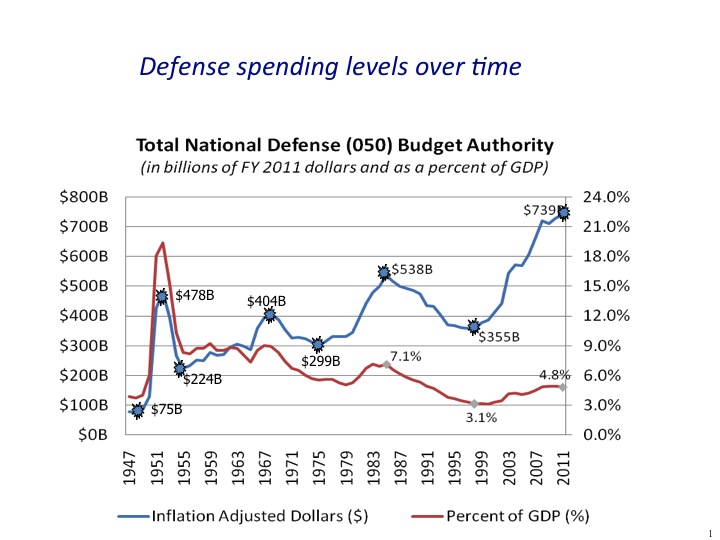
This is based on the idea of a superfluous military—we won the Cold War 20 years ago, for crying out loud, and if we hadn’t had this large military-industrial complex, we would never have been able to start those evil wars in Iraq or Afghanistan.  Besides, defense spending has been going up and up and up, and we need to stop it.

But here’s a graph that sheds some light on that last (I’ll not dignify the others with a response.  (a hostile Russia and China, 9/11, a nuclear Iran, Saddam’s inhuman butchery are sufficient answer.)

Notice that.  As a percent of GDP, defense spending has been remarkably stable.

Nevertheless, for the sake of national security, defense spending must be cut—the deficits and debts are too great and they threaten the weal and the safety of the nation.  The debt and the deficit picture certainly are as threatening as they’re made out to be, but consider: with no defense capability, where is the security?

What do we gain, though, by cutting defense?  Consider these items, courtesy of Neptunus Lex:

…shutting the doors on DoD entirely would still result in an $800 billion increase to next year’s aggregate deficit….

…radically reduce the ground forces, a couple of fighter wing equivalents and at least one or two aircraft carriers—the same forces which have allowed the US since the Cold War days to provide forward presence and deterrence.

Which is actually OK, because the Islamic Republic of Iran has just told us that the USS John C. Stennis is no longer welcome in their neck of the woods….

Well, at least one of those carriers won’t be needed, since it’s worn out its welcome in Iran as well as in DC.

One Progressive argument is that we can get away with such draconian cuts.  Even with cuts as deep as 90%, we can still wipe our attackders off the face of the earth.  But there are a couple of flaws with this argument.  The first is a moral one—and so a practical one.  With such deep cuts, we could wipe our enemies off—by going nuclear.  But with no intermediate capabilities, we’re stuck with the moral, and practical, choice of nuclear war or surrender.  There aren’t any intermediate options with such deep cuts.

The other flaw, though, goes to that ability to go nuclear.  Our nuclear weapons are aging.  They need testing and upgrade.   That takes money that’s being cut from the defense budget.  In the end, we have to ask ourselves, “what is the value of our nuclear weapons when we can’t count on them working?”  while our enemies are asking us, “Do you feel lucky, punk?  Well, do you?”

But the whole “we can cut defense” attitude suffers from another fundamental misconception.  It assumes that our enemies think like us, that their pain level is similar to ours, that their goals are similar to ours.

What do we gain by cutting defense rather than cutting somewhere else?   We keep three entitlement programs that are bankrupting us, and that will continue to do so, even after gutting national defense: Social Security, and Medicare, Medicaid.  But those are the programs that politicians use to buy votes with which to stay in power.

In the end, national defense and national security aren’t mutually exclusive.  Without both, we have neither.