What is the Obama Administration’s Goal?

[T]he [UN] Security Council adopted the presidential statement calling for an “immediate and unconditional humanitarian cease-fire….”

This is the second Security Council cease-fire resolution in the last few days that the US has supported. Such cease fires plainly are one-sided. On the one hand, they allow the terrorists breathing time during which to rearm, refit, and replace their combat losses, at least to an extent. On the other hand, they provide no benefit to the Israelis; rather, they actively harm the Israeli effort by interrupting, if not breaking, IDF momentum.

On top of that, there’s no evidence the Palestinian Authority would respect even this cease fire, anyway: they’ve either rejected other cease fire offers—from Egypt, for instance, and Jordan—or they’ve simply, cynically, violated them.

This present terrorists’ war also is a direct outcome of the prior “major” cease fire implemented just two years ago, as predicted at the time.

The Obama administration knows all of this.

The Progressive Second Economic Bill of Rights

Here they are, via CatholicVote.org.

1. We believe that Wall Street needs stronger rules and tougher enforcement, and we’re willing to fight for it.

Because We Know Better than you. A free market can’t possibly be as good as government; we citizens acting on our own imperatives in that free market just aren’t smart enough to act without Big Government oversight.

Certainly, a case can be made for tougher enforcement of existing law. However, we have enough such laws and rules; we don’t need more. Indeed, enforcement would get much simpler were the extraneous laws and rules—vis., Dodd-Frank’s rules regarding who is allowed to extend credit, and the requirements that must be met independently of the terms freely agreed by the participants to the contract—rescinded.

2. We believe in science, and that means that we have a responsibility to protect this Earth.

Really? Is that why basic tenets of science are violated through suppression of scientific journals that publish papers that dispute, if not refute, the “settled science” of climate change? Is that why climate models are protected from peer review? Is that why data are outright falsified?

3. We believe that the Internet shouldn’t be rigged to benefit big corporations, and that means real net neutrality.

No need for a free market here, either. Progressives know what’s “fair,” Progressives know what “neutrality” is. No one else need comment.

4. We believe that no one should work full-time and still live in poverty, and that means raising the minimum wage.

5. We believe that fast-food workers deserve a livable wage, and that means that when they take to the picket line, we are proud to fight alongside them.

Both 4 and 5 together…. Never mind that minimum wage law, that invention of FDR, originally was written explicitly on racist grounds so that white, northern union workers wouldn’t get priced out of jobs by black workers heading north to find work. Never mind that those who most need the jobs today—teenagers (especially black teenagers in the inner cities) just starting out, adults (mostly black single mothers) working the minimum wage job as a second source of income, working poor married couples taking the minimum wage job as a second source of income—now will be priced out of those jobs. Never mind that other jobs will go over to automation. Never mind that minimum wage jobs have a disparate impact on minority workers. Those jobs will be lost, as the CBO already has noted. Lost jobs get increased poverty which gets more government handouts which gets…votes.

6. We believe that students are entitled to get an education without being crushed by debt.

That would be nice, and work-study arrangements already are available, so are merit-based scholarships. Government subsidies of colleges and universities—both outright subsidies and those masquerading as “research grants” of one sort or another as well as outright grants to students—contribute heavily to the high and rising tuition prices. Cutting those subsidies would go a long way to alleviating the cost to the student. On the other hand, Progressives have yet to explain why a taxpayer in bankrupt Illinois with a child in college should contribute his tax money to mitigating the college expenses of a taxpayer in bankrupt California whose child also is in college.

7. We believe that after a lifetime of work, people are entitled to retire with dignity, and that means protecting Social Security, Medicare, and pensions.

Pick one; the two are mutually exclusive. “Protecting” means raising taxes. Increased taxes means less money in the private sector with which to run businesses, create jobs, have money to spend—which turns the cycle of running businesses, creating jobs, having money to spend anew. Moreover, there’s no dignity in living one’s own retirement by taking money away from someone else’s currently working child.

Certainly, after a lifetime of work, people should be able to retire with dignity. But that means people should be putting money aside for their own future retirement, not giving their money to someone else who’s retired now. That requires privatizing Social Security and Medicare. That requires letting bankrupt pension plans stay failed within the existing Federal pension insurance law, and moving employees onto defined contribution plans (á la 401(k)s). People with skin in the retirement game, people responsible for their own futures, will do a far better job of managing their money than the Federal government, empirically, has done.

8. We believe—I can’t believe I have to say this in 2014—we believe in equal pay for equal work.

9. We believe that equal means equal, and that’s true in marriage, it’s true in the workplace, it’s true in all of America.

These also mean actually equal work. Time off for child raising, for instance, whether taken by a man or a woman, is time not working. It’s also time, nearly universally, not staying current on the work requirements and techniques, not accruing experience in the work, etc. Paying these folks a wage numerically equal to others who’ve not taken that time off most assuredly is not equal pay.

10. We believe that immigration has made this country strong and vibrant, and that means reform.

Of course. But what the Progressives elide here is that “reform” to them means open, uncontrolled borders with, as Attorney General Eric Holder demanded, a “civil and human right” to enter our country illegally and without consequence. But with grave harm to what it means to be a nation.

11. And we believe that corporations are not people, that women have a right to their bodies. We will overturn Hobby Lobby and we will fight for it. We will fight for it!

These are two separate items. Corporations aren’t people—OK. In that case, I assume Progressives are fine with having to get sales approvals from each of the several tens of thousands of individual owners of General Electric in order to buy one of their washing machines. More to the point, as even Progressives are wont to say (when it’s convenient to them), it’s the law of the land. Moreover, it’s settled law. Corporations are people; the courts have long ruled so.

Finally, of course women have a right to their bodies. What they don’t have is a right to OPM for paying for their contraceptives. What they don’t have is a right to overrule the religious beliefs of others in order to force those others pay for women’s stuff.

Paul Ryan’s Expanding Opportunity in America

House Budget Committee Chairman Paul Ryan’s “Expanding Opportunity in America” proposal can be seen in full here. I’ll only comment on parts of it in this post.

On the 50th anniversary of the War on Poverty, then, we should reexamine the federal government’s role. For too long, the federal government has tried to supplant, and not to support, the people fighting poverty on the front lines—families, neighborhoods, community groups. In the fight against poverty, the people ultimately are the vanguard, and government is the rearguard. Government protects the supply lines. But it is the people themselves who take to the front lines.

A major part of his proposal is his Opportunity Grant Pilot-Project

[T]his proposal [The Opportunity Grant Pilot-Project] would create a new pilot project in a select number of states. In participating states, the federal government would consolidate a number of means-tested programs into a new Opportunity Grant (OG) program. The largest contributions would come from SNAP, TANF, child-care, and housing-assistance programs, and the funding would be deficit-neutral relative to current law.

It is important to note that this is not a budget-cutting exercise—this is a reform proposal. This consolidation does not make judgments about an optimal level of spending. Instead, this proposal is concerned with our ability to use resources effectively and to find out what works. It allows the federal government to leverage its strengths—vast resources—while also allowing states, localities, and communities to leverage theirs—deep knowledge of their population and the unique challenges they face. Therefore, this proposal seeks to create the space and flexibility necessary for local, state, and federal government to add value without making judgments about the right level of spending.

OG Funding Stream

  • Consolidates several means-tested programs into a new Opportunity Grant program.

  • Each participating state gets the same amount of funding they receive from the programs listed in Appendix I.

  • The proposal is deficit-neutral relative to current law.

  • Within the Opportunity Grant, states would have flexibility in accommodating housing-aid recipients, the elderly, and the disabled—either by maintaining the current programs or dedicating the same amount of resources to them in the new program.

He offers, though, few ideas on how this program would eliminate the welfare tax cliff he mentions and that’s also described here. “Sign a contract:”

Providers must be held accountable, and so should recipients. Each beneficiary will sign a contract with consequences for failing to meet the agreed-upon benchmarks. At the same time, there should also be incentives for people to go to work. Under each life plan, if the individual meets the benchmarks ahead of schedule, then he or she could be rewarded. For example, if the goal of an individual’s plan is to find a job within six months, and he or she starts working within three months, he or she could receive a bonus. Bonuses could take a number of creative forms, such as a savings bond.

He offers no examples of how this might work; he relies solely on the hope that State experimentation will suffice. This isn’t all bad, if only for the admission that the Federal government has no solutions—and that’s the point of his entire proposal. It’s also not a forlorn hope: State experimentation is necessary; it’s there that the answers will be developed.

Of course the Progressives in government will not like this plan: it encourages people to see to their own ends, it enables them to become responsible, independent, contributing citizens, and it will end their dependency on the welfare handouts of Progressives—it will reduce the need for those whose jobs, political or bureaucratic, depend on being able to provide welfare handouts.

Regarding Ryan’s Earned Income Tax Credit expansion, I confess to misgivings here, too, although Ryan’s proposal makes sense as a first cut. I’ve never been enamored of this; it’s hard to see how the welfare cliff from losing the credit in return for advancing in work isn’t a discouragement from finding advancement in work. However,

The consensus among independent economists is that in most cases the EITC makes low-income families more likely to work by increasing work’s rewards. CBO also finds that it encourages households to enter the labor force.
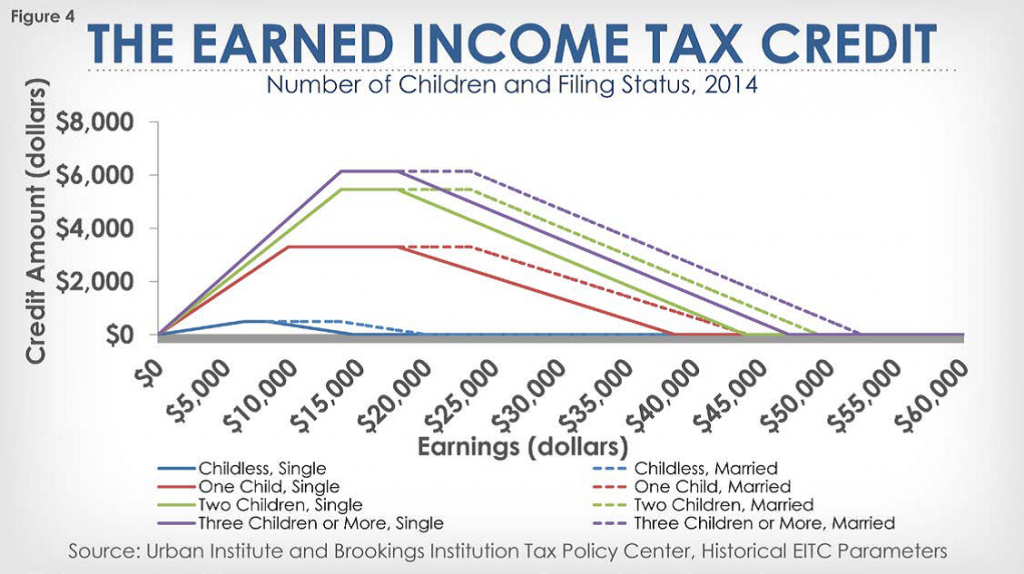
EITCGraphRyan’s proposal is simply to expand EITC eligibility to younger workers and to childless single and married parents (not to raise the upper income bound for eligibility), and to pay for that expansion with spending cuts—real cuts—elsewhere in the budget.

Running the numbers seems to mitigate the other part of this: that discouragement from advancement through the reduction in EITC subsidy that results. A married couple, one child family, for instance, making $25,000/yr gets roughly $3,500 in EITC for total income of $28,500. Were that family gets a wage increase to $30k, EITC falls to a rough $3k for total income of $33k. Thus, the family would keep $4.5k of that total income increase; the drop in EITC would constitute only a 10% “tax” on that raise.

Federal criminal justice system

Ryan’s proposal here centers on sentencing and prison reform, and this is good. A couple things are lacking, though, regarding sentencing. One specific sentencing reform that would be valuable—and that would dovetail nicely with his jobs training proposal—regards nonviolent criminal sentencing. This should center on community service, but not just any service: the criminal’s time here should be in a service that also teaches the man a marketable skill, so that when he’s finished paying his debt for his crime, he’s not only a free man again, he has the means with which to earn his way through life, rather than (be forced to) resume stealing it.

The other reform here will be much harder to achieve, and in truth it’s outside the scope of a budget proposal. We have too many Federal laws on the books, and in particular, we have too many Federal criminal laws. These need to be culled.

In the end, there’s much not to like in Ryan’s proposal—it’s deficit neutral, for instance; it by design leaves spending and taxing alone—but there’s also much to like. Progressives in government won’t like it, either. It reduces the Federal government’s role in our economy and in our individual lives, and from that it reduces those Progressives’ raison d’être.

The largest likability, and this alone is a deal maker, is that it’s a net improvement over the existing welfare régime: it takes control over welfare away from the Federal government, which for all its good intentions is too remote and too slow to respond to changing conditions, and puts welfare in the hands of those closest to the particular welfare needs: the State governments and local agencies.

Ryan’s proposal does this—another strong likability—by reallocating existing spending into consolidated block grants and shipping those to the States. The strings attached to these grants—and I’m of mixed minds regarding any Federal stringing—are minimal and centered on satisfying a Federal agency (primarily HHS and Education) that a State’s plans for the grants are suitable to the task.

****

Finally, we also must be mindful of two things: the first is that better is the enemy of good enough. This plan is good enough, for today. This plan is good enough as a first step.

The other thing is a direct follow-on to the first: welfare reform—nothing in politics—is a once and done affair. Most discussions of welfare reform, tax reform, spending reform, what-have-you reform only look at a specific proposal as though it’s entire in itself and nothing more need be done, or rejected. It’s not good enough now, so toss it and start over.

This plan is not fully grown or perfect, either. But it’s good enough for now. It’s good enough (since passage in 2014 is unlikely) for next year, and that year’s status as the first year of the 114th Congress. Pass it, knowing that the work isn’t done and knowing that the work can be improved. Then come back the following year, the second year of that Congress and correct the defects that will have become apparent by then, and add to the plan additional, de novo, changes as the experimental results come in, as experience suggests new ideas. Then in each of the sessions of the 115th Congress, do it again. And again in the 116th. And so on.

False Tax Premises

Edward Kleinbard, a USC law professor, had some thoughts on tax inversions, the process whereby a domestic company merges into a foreign company and moves its headquarters to that foreign company’s domicile in order to avoid high domestic taxes. The subject has come up in the last few weeks in the context of US companies doing the inversions. Dr Kleinbard, though, is proceeding from some false premises.

He argues, for instance,

Firms that invert argue that the deals are…harmless to US tax-revenue collection, and a necessary response to our anticompetitive world-wide corporate tax system. [“Harmless” is] demonstrably false…..

If allowed to continue, inversions will eviscerate the US domestic corporate tax base, because making a foreign company the parent of a US firm opens up new tax-avoidance possibilities.

The false premise is this. It isn’t the government’s money; it’s the money of the corporation’s owners. It simply isn’t possible for the government to be harmed by not receiving that which doesn’t belong to it.

Moreover, there shouldn’t be a “US domestic corporate tax base” in the first place. The corporation really doesn’t pay much of those taxes; the corporation’s customers do in the form of higher prices—which ultimately makes the American citizens doubly taxed.

Another of Kleinbard’s false premises is this:

Corporate tax reform will not be able to undo the damage done to the US tax base.

Part of this second error is simply a restatement of the first: no damage can be done to the government’s tax base by not receiving that which doesn’t belong to the government.

The larger question here, though, is the predicted failure of corporate tax reform. With American corporate tax rates lower than anywhere else in the world (their complete removal, say I) the US will be far more attractive to all companies, foreign and domestic. Including to those inverted companies, still inverted, or with the inversions undone as the more attractive alternative for the putative new senior partner company.

Besides, in the end, as always, the government doesn’t need the money; it needs to reduce spending.

The Border Children Crisis

The president of the United States is the world’s sugar daddy and that has to stop. That’s the incentive for those kids to come here” protested Congressman Mo Brooks (R, AL) one of the most-conservative voices in the House. “To spend billions of dollars on foreign children that we don’t have is financial insanity.”

As someone noted earlier, the House should appropriate the funds, or most of them, with suitable spending reduction offsets, and with the vast bulk of the funds block granted to the border states for their use in dealing with the crisis and with border control, and the remainder allocated to the Federal government for the mandated purpose of transporting the present children back to their countries of origin.