
Obama and Jobs

Here’re a couple of charts that illustrate the impact on American joblessness caused by Democratic Presidential Candidate Barack Obama’s economic policies.  They’re from an article last spring by Dan Mitchell, writing at The Center for Freedom and Prosperity.

This graph shows the degree of long-term joblessness extant in our present economy.

For almost the entire post-war period, long-term joblessness had been stable, if noisy, around a low rate in the range of 10%-15% of total unemployed.  But throughout the administration of Democratic Presidential Candidate Barack Obama, this long-term unemployment travesty has skyrocketed into the 45% range—nearly half of all of our unemployed in the present economic dislocation have been out of work long-term—for six months or more.  Larry Summers, ex of Obama’s National Economic Council suggests a reason:

Empirical evidence shows that two causes are welfare payments and unemployment insurance.… The second way government assistance programs contribute to long-term unemployment is by providing an incentive, and the means, not to work.  Each unemployed person has a “reservation wage”—the minimum wage he or she insists on getting before accepting a job.  Unemployment insurance and other social assistance programs increase that reservation wage, causing an unemployed person to remain unemployed longer.…  Clark and I estimated [in a study using state data on registrants in Aid to Families with Dependent Children and food stamp programs] that the existence of unemployment insurance almost doubles the number of unemployment spells lasting more than three months.

Another reason is the inordinate spending and borrowing generally of the present administration, which I addressed in another post.

The chart below shows another effect of Obama’s policies on jobs: the size of the labor force, or the number of people working, at least part-time, or still actively looking for work.

The labor force shrank by roughly four per centage points from the start of our current economic Time of Troubles at the end of the Bush the Younger administration.  And it has remained flat, rather than recovering as it did in earlier times, throughout the Obama administration.  This also is associated with the above long-term unemployment.  After a sufficiently long period of failure, people just give up trying to find work—they don’t see that there is any to be had.  And it’s been that way for nearly four years, now.

We need to change the Federal government’s economic policy.  For that we need to change the Federal government’s Executive and Senate personnel.
Paul Ryan Bad for Women?

NBC’s Andrea Mitchell says so.  Ryan’s “not a pick for women” she pronounces.   Follow the link inside the link to the Fox News article to hear her remarks.

Then refresh yourselves regarding her political acumen, and her integrity, with the two clips here, which show her airing her cynically and dishonestly edited video of a Romney speech.

Now decide for yourselves whether this woman is qualified to speak for women—or for any other adults.

Government Keynesian Waste

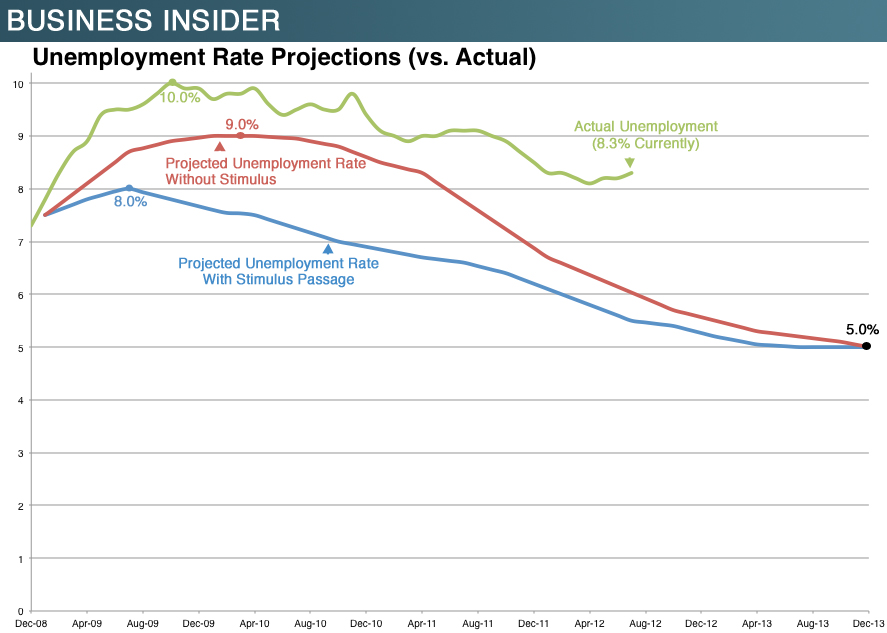
As if there’s any more need to demonstrate the fallacy of Keynesian stimulus pseudo-theory after its failure in the ’30s, some empirical evidence from today’s economic dislocation and failed “recovery” is neatly summarized in the following graph from Business Insider:

Most are already familiar with those projection curves, from the 2009 hype associated with ramming the American Recovery and Reinvestment Act of 2009 (the Stimulus Act) through the Democratic and then-economically timorous Congress.  Government standing aside and letting the economy recover on its own was going to let unemployment peak at around 9% and not move below 7% until Dec 2011 or reach “full” employment until Dec 2013.  On the other hand, the Obama Stimulus would cause an almost immediate peak (in August 2009 after a February enactment) at 8% and lead to recovery below 7% unemployment by fall 2010, a year sooner than under non-interference.

Instead, the Obama Stimulus has actively suppressed employment—and so economic recovery.  Unemployment, at roughly 8.5% at the time of stimulus enactment, continued rising unabated to above 10%, and it has remained above the worse-case no-government projection ever since.  Notice further, that actual unemployment has generally followed the shape of the no-government projection curve: the only effect of Obamanomics in this milieu has been to make government involvement worse than no involvement—it hasn’t altered anything else.

Do we have empirical data for the contrary position, that government noninvolvement is actively beneficial?  You betcha.  The Depression of 1920-1921 ran from the start of 1920 through the middle of 1921, and President Warren G Harding’s administration sat it out, with no significant government intervention attempted.  The graph below is constructed from data taken from Table 9 in a paper by none other than Christina Romer.

There are a couple of takeaways here.  One is the sharp, high peak to unemployment and the rapidity with which both the peak and the recovery occurred.  Another is the rapidity with which our economy actually worked its way through this Depression compared to the projected recovery rates in the first graph above.  The projections for our current failing recovery are, compared to hard data, cynically pessimistic.  This pessimism, though, cannot be laid at Democratic Presidential Candidate Obama’s feet; a broad range of economists assumed that slow pace.

In general, to repeat earlier posts and statements made by others: money spent by government is money not available to the private sector or to individuals to spend on their own goals and needs.  Money spent by the government is money that first must be taken from those private enterprises and citizens in the form of taxes today to pay for that spending or greater taxes tomorrow to pay both for that spending and for the interest on the debt incurred by that spending.  And here we’ve seen empirical evidence that government spending, above a minimal level for funding government itself and national defense, isn’t just useless, it’s actively counterproductive—destructive.

Pax Obama

The Wall Street Journal‘s Monday op-ed likened Democratic Presidential Candidate Barack Obama’s actions on the world stage—in particular vis-à-vis Syria—to a Samuel Beckett play.  After all, all the Syrians have to do is simply to hang in, and wait upon Obama’s convenience.

But the cost of that is enormous.  Aside from the 20,000 Syrian murders that have resulted from Obama’s dithering, aside from Iranian near-nuclear bomb achievement (to broaden the scope and result of his waffle), we’ve gone in these last three years from what was Pax Americana to a disastrous Pax Obama:

…thanks in part to Mr. Obama’s calculated abdication, Middle East tension and turmoil are rising.

And everywhere else in the world, especially including Europe and North America, if the Syrian butchery is allowed to continue apace and Iran is allowed to get nuclear weapons.

Paul Ryan and the European Press

Spiegel Online International occasionally summarizes the views of other European (mostly German) newspapers on the subjects of the time.  Monday’s edition brought these remarks about the Republican Vice Presidential Candidate, Congressman Paul Ryan (R, WI).

From Süddeutsche Zeitung:

…Ryan fits in almost absurdly well with the caricature of Romney the Democrats have been painting for weeks now — namely that he is a cold, money-grubbing multimillionaire and would have to transfer nary a cent to Washington in taxes if his pupil Ryan actually got the opportunity to implement his radical fiscal concepts.

From Frankfurter Allgemeine Zeitung:

[Ryan’s] ability to attract swing voters is likely to be limited. Although they may be dissatisfied with the current situation, it is unlikely that a radical restructuring of the social system will warm their hearts….

From Handelsblatt:

The choice of Paul Ryan as Mitt Romney’s vice presidential candidate is…an act of desperation.

And so on.

As I wrote a while ago about Republican Presidential Candidate Mitt Romney, if the liberal European press doesn’t like Ryan, he must be pretty good.