Broadening Attacks on Vote Sanctity

Now President Obama is having his DoJ attack Pennsylvania’s Voter ID law.

The letter from DoJ to Pennsylvania’s Secretary of the Commonwealth can be viewed here.  Not only is Obama objecting to protecting the sanctity of a legitimate vote by trying to block efforts at screening “voters” who are ineligible, in this letter he’s also demanding a potful of wholly irrelevant personally identifying information on voters and potential “voters.”  Here’s a sample from his DoJ’s letter:

  • The current complete Pennsylvania voter registration list, including each registered voter’s full name, address, date of birth, identifying numbers (including driver license, social security, or other numbers), voter history, and race.
  • The current complete Pennsylvania driver license and personal identification card list, including each individual’s full name, address, date of birth, identifying numbers (including driver license, social security, or other numbers), and race.

There are a total of 16 different items of information being demanded, including the legitimate request for clarification of the apparent disconnect between the governor’s statement that 99% of eligible voters already have acceptable ID, and the commonwealth secretary’s statement that 758,000 registered voters lack acceptable ID.  However, this question’s legitimacy only exists on the basis of a legitimate concern for voter eligibility and has nothing to do with any voter ID requirement itself.  Since the administration’s attack on the Pennsylvania law has no legitimacy, the question about the disconnect is irrelevant.

Moreover, a voter’s voting history is wholly irrelevant to such an inquiry: what other fishing expedition is Obama’s DoJ conducting, sub rosa?  Nor is the individual’s address or age relevant.  Nor is the voter’s race, except that this administration intends to play, again, its race card.  In fact, the prior question that must be answered is whether legitimate voters are being removed from the voter registration lists in any significant number.  Only then can a question of racial motivation come into play.  (Disparate impact has no legitimate role, here, only motive.)  Since DoJ hasn’t established that legitimate voters are being removed in Pennsylvania, the entire investigation is bogus.

Finally, the Supreme Court already has upheld a substantially identical Voter ID law passed by Indiana.

Why is Obama running this, then?  So he can add names and addresses to his campaign and fund-dunning mailing lists?  So he can target those who might vote or support the wrong candidate?

You Didn’t Build That

Now President Obama has an ad out in which he tries to walk away from his earlier comments that business owners—especially small business owners—didn’t build their businesses, that they owed government for their success.

Now he’s insisting that what he was talking about was Big Government “investing” in education and training, roads and bridges, research and technology.  And more:

Somebody helped to create this unbelievable American system that we have that allowed you to thrive.

No.  Today’s successful schools are charter and other schools to which parents send their children by choice.  These schools are run by private businesses; they’re not government organs, as today’s public schools are.

Private enterprises built the roads and bridges; Big Government didn’t send in the Seabees or the Army Corps of Engineers to build our transportation network, or to maintain it, except in the direst of localized emergencies, like post-Katrina.  Even then, though, the government’s constructors have been adjuncts to the private construction companies.  It’s true that Big Government funded significant portions of those build-out and maintenance projects, but the Government’s “investment” was heavily inflated: the privately run construction companies were—and are—required to pay “prevailing” union wage rates; the companies are not allowed to bid competitively.

It was Xerox that built the Internet, for instance, not Government, as Obama claims, and Xerox built it so they could share internal data on internal computer networks more easily, not “so that all the companies could make money off the Internet.”

And that “unbelievable American system that we have?”  That’s our free market economy that private individuals, singly and in groups, built up since our inception as a nation.  Big Government had no role in that.  Little Government had the important role of staying out of the way of our private, free enterprise, only enforcing laws against cheating and the like.

As an aside, President Obama had a closing refrain in his “You Didn’t Build That” speech: Americans often work together to do things they can’t do, or do as efficiently, alone.  But who was he talking about in this “working together” of his?  Not Americans working together on their own initiative—forming companies or charitable organizations, for instance—oh, no.  Obama was talking about Big Government as the “together,” a Government that does things for us.  Not at all anything about Americans working together without government…help.

Fun Facts with Taxes

Some of this is old hat, but it’s worth reviewing, and some of this is relatively new.  All courtesy of Ari Fleischer in a recent Wall Street Journal piece.

[T]he only group in America paying at least a “fair share” is the top 20%—people who make more than $74,000. For everyone else, the tax code is a bargain.

This figure shows the rest of that breakout—who earns and who pays:

Note that: 60% of the income-receiving population, those bottom 3 quintiles, are just that—receiving, while paying far less in taxes.

Additionally, the trend is toward greater concentration of tax payments into fewer earners—greater unfairness.  The CBO’s “The Distribution of Household Income and Federal Taxes, 2008 and 2009” report makes this plain.

In 1979, the top 20% made 44.9% of the nation’s income and paid 55.3% of all federal taxes.  By 2009, the top 20% had risen to 50.8% of the nation’s income while their share of federal taxes paid had risen further, to 67.9%.

That’s a 13% increase in income and a 23% increase in federal tax “share.”  Meanwhile,

In 1979, the bottom 20% paid 2.1% of the federal taxes.  In 2009, their share of taxes has shrunk to 0.3%.

In 1979, middle-income earners ($34,900 to $50,100) paid 13.6% of all federal taxes.  In 2009 they paid 9.4%.

Hmm….

On the Cost of Tax Breaks

Here’s one more argument for a flat, no deduction, credit, subsidy, etc tax code.  Using the structure as a social or economic engineering tool just doesn’t work.

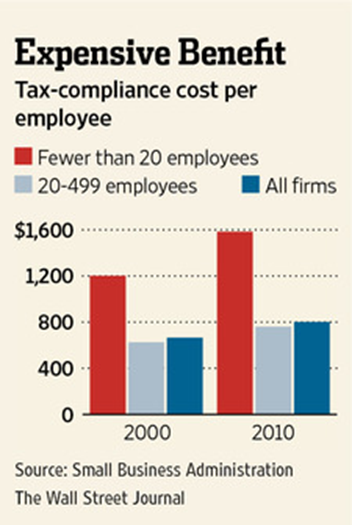
From John D McKinnon’s article in The Wall Street Journal at the above link comes this figure, showing the cost of meeting the requirements for getting Federal tax breaks generally, broken out by company size.

John Raine, CEO of Raine Inc., an Indiana manufacturer of belts and holsters for the military and other customers has an all too typical position about these “breaks.”

I usually avoid these targeted tax incentives, because it costs so much just to be compliant that it’s not worth messing with.  I can’t run a business based on what area the federal government is trying to juice.

The Federal Work Opportunity credit is another example, and it, too, has a typical response.  The Work Opportunity credit was designed to reward companies for hiring people from any of a number of disadvantaged categories of workers—welfare and food stamp recipients, youths seeking summer jobs, ex-felons, and the like.  The credit is worth up to $2,400 per employee, and for businesses hiring unemployed veterans, it can be worth as much as $9,600 per.

The credit is too much trouble to collect, though.  It requires extensive paperwork for each claimed worker, and incredibly, the paperwork can take a year or more to process.  Assistant Professor of Economics at the University of Florida, Sarah Hamersma, has estimated that the credit is taken for only 20%-35% of all eligible workers.

McKinnon reports

JJ Pledger, Chief Financial Officer for the Twisted Root gourmet burger chain in the Dallas-Fort Worth area, said he spent the better part of a day last year trying to figure out how his company could obtain the credit.  Mr Pledger, a CPA, knew the credit likely would be available for a number of his company’s 200 or so annual hires.  But the more he read, “it seemed like the documentation of the tax credit could be really hard to administer,” he recalled.  One concern was all the personal information needed from job applicants. “So I put it on the back burner….

There are other examples in McKinnon’s article.

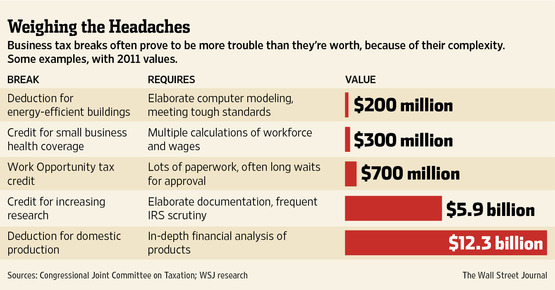
Compliance costs for US businesses and individuals have reached 1% of GDP, roughly $150 billion last year.  Out of 1.78 million US corporate tax returns, only about 20,000—just above 1%—claimed any of three dozen main business tax credits, the IRS estimates.  This figure illustrates another aspect of the costs of these “breaks.”

It’s just too hard a thing to do to collect these, never mind the value.

I’ll say it again: flat tax.  No deduction, no subsidy, no credit, no nothing.  Say what your top line income was.  Pay 10% of that.  Be done with it, and all on Governor Rick Perry’s postcard.

Defense Cuts on the Stump

President Obama, speaking before the VFW the other day, had some interesting words to say about defense, and cuts to our defense capability that are looming.  Naturally, I have a few words to say about what he said.

People in Congress ought to be able to come together and agree on a plan, a balanced approach that reduces the deficit and keeps our military strong[.]

Indeed.  When are the President and his fellow Progressives in the Senate going to get out of the way of a bipartisan solution and allow one, instead of throwing our nation’s security away on his demand to raise taxes on his disfavored group of Americans?  After all, it’s Obama’s demand that taxes be raised, rather than spending be cut elsewhere—like in our bloated entitlement programs—that’s standing in the way of salvaging our defense establishment.

And there are a number of Republicans in Congress who don’t want you to know that most of them voted for these cuts. Now they’re trying to wriggle out of what they agreed to.

Nah—they’ve made no bones about this.  Obama held a gun to their heads and forced the idiocy of sequestration during the debt ceiling “negotiations” when he threatened to destroy our economy if he couldn’t get his tax increases, even to the point of cynically blowing up an agreement that had been reached—including revenue increases, if not tax rate bumps—with his last-minute (literally) demand for an additional $1 trillion increase in taxes.

Instead of making tough choices to reduce the deficit, they’d rather protect tax cuts for some of the wealthiest Americans, even if it risks big cuts in our military.

Again, indeed.  Instead of making tough choices to reduce the deficit, Obama is ready to impose destructive cuts on our military in order to get his taxes on his disfavored Americans, and I’ve got to tell you, Mr Obama, I disagree.

As we look ahead to the challenges that we face as a nation and the leadership that’s required, you don’t just have my words, you have my deeds.

President Obama’s deeds are especially frightening.  His “deeds” include the idle chit-chat that’s allowing Iran to get nuclear weapons.  His “deeds” include the idle chit-chat that’s allowing the Syrian boss Assad to butcher his own citizens—19,000 of his fellow Syrians—and to move his chemical weapons arsenal and prepare it for use against surviving Syrians dissidents.  His deeds include surrendering to Russian demands and throwing Poland and the Czech Republic into the teeth of the Bear and cancelling a plan to build missile defense installations in those two countries.  His deeds include surrendering American foreign policy to the veto authority of Russia and The People’s Republic of China, especially vis-à-vis Iran and northern Korea.

His deeds include his claimed end to a war in Iraq that was already won and done, with only a SOFA to facilitate American troop presence for training to be negotiated.  Without any American presence—Obama’s crowning achievement here—Iraq is falling apart under terrorist attacks and secular and religious strife, and al Qaeda is resurgent.

His deeds include winding down the war in Afghanistan with an announced withdrawal schedule and nothing left behind.  He’s snatching defeat from the jaws of victory, as the Taliban are still in the field and effective, while the Afghan army is neither.

House Armed Services Committee Chairman, Buck McKeon (R, CA) has the right of it:

President Obama played no small part in setting the time bomb that is sequestration.  Indeed, automatic defense cuts were included in the Budget Control Act at his insistence.  Now he owes our troops his best efforts to defuse the cuts.  Ultimatums from the campaign trail are not enough.

The challenges we face as a nation are legion, the future is near, and the leadership Obama has demonstrated and the deeds he’s done, make change imperative.