You Didn’t Hear It Here First

Although I have written something similar before.

Freedom of speech is on no use to a man who has nothing to say, and freedom of worship is of no use to a man who has lost his God.

And

We cannot read the history of our rise and development as a nation without reckoning with the place the Bible has occupied in shaping the advances of our Republic.

And

The lessons of history, confirmed by the evidence immediately before me, show conclusively that continued dependence upon relief induces a spiritual disintegration fundamentally destructive to the national fiber. To dole our relief in this way is to administer a narcotic, a subtle destroyer of the human spirit. It is inimical to the dictates of a sound policy. It is in violation of the traditions of America.

And on Social Security, as it was drafted originally (and ultimately as passed and evolved; although the remark was made of the draft):

This is the same old dole under another name.  It is almost dishonest to build up an accumulated deficit for the Congress of the United States to meet in 1980.  We can’t do that.  We can’t sell the United States short in 1980 any more than in 1935.

Who said this stuff?  A man not known for his modern conservatism: Franklin Roosevelt.

The catalog of Roosevelt’s economic and regulatory failures is long, but there also is much that the present administration could have listened to and thereby avoided the damage done by its own economic and regulatory failures—as could FDR, had he listened to himself.


h/t to Power Line

Capital Gains Taxes and Federal Revenues

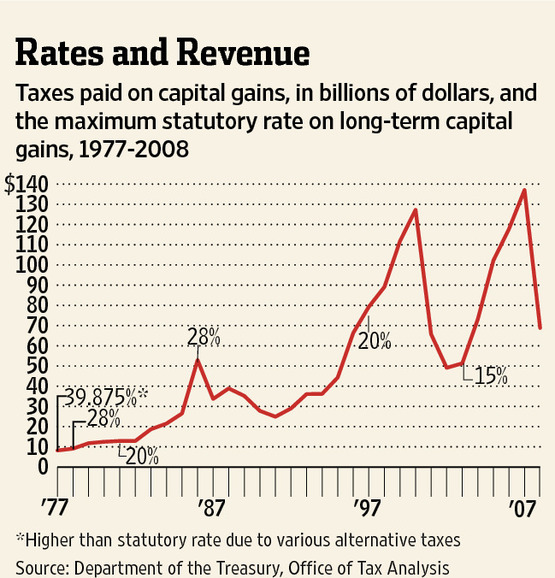
The Wall Street Journal offered a history lesson with empirical data relating taxes on investment to revenues collected by the government since 1977, a period when capital gains taxes were alternately raised and lowered by a capricious Congress.

This figure tells the story, which I’ll only summarize; you should read the whole lesson.

Essentially, raising tax rates—as has been noted for other Federal taxes—lowers tax revenues, and lowering the rates increases the collected revenues.

A couple of things in the figure are noteworthy, though.   The tax rate drop to 20% in 1981 did not lead to a drop in revenue—surprise—but 1982 was a year of a sharp recession, and collected revenue from that lowered rate still remained flat: no drop with the recession.  Collected revenue then ran up hard as we came out of the recession.  Additionally, the sharp drops after the sharp increases that resulted from the rate decreases in 1997 and 2003 came from the dot-com bubble burst that saw the NASDAQ, for instance, lose 60% of its value and from the Panic of 2008, whose hard recessionary effects we’re still in the middle of.

There’s another impact of higher capital gains tax rates, though, as the WSJ also points out.  High rates disinclines investors from selling their holdings as soon as they might.  This sequesters those investment monies in present investments, making them unavailable to other investments—younger, newer, more agile businesses with more current ideas, for instance—that might be better places, on a purely business basis, for investment dollars.  Moreover, the higher capital gains tax rates lower the returns on investments, leading other investors to demur from committing their funds in the first place to such investments.  The taxes distort the investment decisions.

But President Obama doesn’t care about healthy revenue collections for government; he doesn’t care about a healthy economy.  He cares about his definition of “fairness.”

GIBSON: So why raise [capital gains tax rates] at all, especially given the fact that 100 million people in this country own stock and would be affected?

OBAMA: Well, Charlie, what I’ve said is that I would look at raising the capital gains tax for purposes of fairness.

Another Thought on Self Defense

I wrote, a short time ago, about individual self-defense.  In this post, I’d like to explore a little bit of the self-defense rights of a nation.  Senator Jon Kyle (R, AZ) asked, in a Wall Street Journal op-ed, “What’s at Stake in the Missile-Defense Debate?”  His question also raises a larger question concerning a nation’s right to self-defense.  I’ll address the second question first, then I’ll talk about the role of missile defenses within that right.

As our Declaration of Independence acknowledges, all men have a right, among other things, to our Lives, our Liberty, and our Happiness.  In that earlier post I demonstrated the right, and the obligation, of each individual to defend himself—lethally, if necessary—against threats to himself, his family, his property, and to extend that defense to others whom he might see under similar threat.

Far too often, that individual is incapable of conducting that defense, even acting in concert with a few of his fellows.  This is why, as Hobbes, Locke, Rousseau, et al., have demonstrated, men come together to form social compacts, nations, with governing structures.  Universal among these men’s demonstrations was a purpose of those compacts: to defend the individual members against external threats.  Thus, nations are formed for an explicit purpose of defending its citizens—of defending itself.

The right of a nation to defend itself thus flows directly from its members’ individual rights to defend themselves.

Within a national right of self-defense, where do missile defenses fit?  Plainly, a nation that does not use all of the tools at its disposal is limiting itself in its ability to carry out its duty of defending its citizens, of defending itself.  A nation that disgorges itself of any of the tools it has, and/or turns its back on acquiring all the tools it might, that are useful in defending itself is turning its back entirely on its obligation to defend itself.

This failure is exacerbated in a nuclear world, where one of the weapons of attack is fully capable of destroying an entire city, murdering the hundreds of thousands or millions of people who live(d) there.  A missile defense capability becomes critical to national defense, even to national survival, when such offensive destruction is possible.  Certainly, a missile defense of the kind discussed by Lyle and dismissed by President Obama is useful only against missiles and is not proof against those missiles.  However, with our enemies capable of missile delivery of nuclear destruction, not defending against that threat is not just amoral, it’s actively immoral.

For the United States to walk away from a maximally capable defense capacity solely to appease our enemies who have that nuclear offensive capability is not just amoral, it’s actively immoral.  Yet this appears to be the path on which Obama is setting us.  He already has withdrawn missile defenses against rogue Iranian missiles from eastern Europe (where they could defend Israel and Europe against Iranian attack) at Russia’s behest.  Now he’s telling outgoing Russian President Dmitri Medvedev and incoming Russian President Vladimir Putin that, given time to win his reelection before being pressed on our missile defense system, he’ll then no longer be accountable, and he can give the Russians everything they want in the complete removal of any American missile defense capacity.

Senator Kyle rightly points out legal concerns about this course.

[President Obama] may have to ignore or circumvent commitments he made to Congress to secure support for the 2010 New Strategic Arms Reduction Treaty (Start)—among them, that he would deploy all four phases of planned U.S. missile-defense systems for Europe, and that he would modernize the Ground-based Midcourse Defense (GMD) system for the protection of the U.S. homeland.

Never mind that acceding to Russian demands would eliminate

…the only U.S. theater missile-defense system capable of catching intercontinental-range Iranian missiles, making it important for the defense of our homeland.

Senator Kyle adds

It is questionable whether concessions on missile defense would induce Russia to further reduce its nuclear arsenal.  Unlike the U.S., Russia maintains a robust nuclear warhead production capability, and its national security strategy is to increase reliance on nuclear weapons.  Russia is also modernizing ICBMs and submarine-launched ballistic missiles.

Indeed.  I’m reminded of the Third Punic War.  Rome insisted that Carthage disarm itself, and Carthage acceded to the demand.  After that, Rome attacked, razed Carthage to the ground, occupied all Carthaginian territory, and enslaved its surviving people.

But Obama has said of his moves to eliminate our missile defenses

As a nuclear power – as the only nuclear power to have used a nuclear weapon – the United States has a moral responsibility….

Sorry.  The one who would unilaterally remove our ability to defend ourselves is in no position to discuss any part of our military posture.

Further, the champion of wealth distribution, of “you’ve made enough money,” give up what I’ve determined for you as excessive for me to redistribute; the champion of denying anyone his right to live his life to the fullest of his own potential through that wealth redistribution is in no position to lecture anyone on morality.

Another Government Mandate

Last December, the Director of the Labor Department’s Office of Federal Contract Compliance Programs, Patricia Shiu, proposed, in all seriousness, a regulation requiring companies, apparently with 50 or more employees, to adopt a 7% hiring quota for disabled job applicants or be debarred from doing business with the federal government.  Note that this isn’t 7% of the total number of employees—Ms Shiu is a better micromanager than that.  This is a quota of 7% in each separate job category: “one or more jobs with similar content, wages rates, and opportunities.”

Moreover, Shiu’s rule attempts to require companies to encourage all job applicants to label themselves as “disabled” prior to being hired—apparently without any screening of applications or applicants for accuracy of the claim—and to require companies to engage in an ongoing compliance regime: companies must encourage all employees “to label themselves disabled after being hired, and once a year thereafter,” again apparently without any regard for the accuracy of such self-labeling.  Additionally, the rule would require each company to document, in detail, for each applicant not hired, why that applicant was not hired.  I wonder whether “Because I already hired someone for the position” would be acceptable.  On top of this, each company would be required annually to (re)justify and to  (re)document “the physical and mental job qualifications for [every] job opening…and to provide an explanation as to why each requirement is related to the job to which it corresponds” and to prove each requirement to be “consistent with business necessity.”

Labor’s estimate of the cost of compliance is cynically understated by two orders of magnitude: they claim a cost of just $81 million for roughly 200,000 companies to comply—a cynical $400 per company.  HR Policy estimates the true cost (not counting productivity costs, which are much harder to estimate) to be in the region of $1.8 billion—a more realistic $9,000 per company.  Of course, not included in Labor’s estimate is the cost of hiring all those bureaucrats into Ms Shiu’s burgeoning empire to monitor compliance.  Nor is the cost of all the lawyers companies will have to retain to defend themselves against all the litigation such a rule is going to encourage.

What constitutes an eligible disability?  Reading, concentrating, thinking, communicating, and interaction with others all are on the list.  I have to wonder at the productivity costs of having to have folks on the payroll specifically to read instructions to employees who can’t read; to do so repeatedly to employees that can’t concentrate long enough to absorb the instructions; to monitor employees who can’t concentrate long enough to complete the job assigned; to guide employees who can’t think clearly enough to understand the instructions they’ve just read or had read to them, or to figure out a task when no monitor is readily available; who can’t explain the trouble they’re having to their peers or supervisors; or who don’t get along with their peers or supervisors.

Oh, and hypocrisy notice: the Federal government itself has only 5% disabled on its payrolls—and the Labor Department’s percentage of disabled employees has decreased every year since President Obama took office, despite Obama’s sharp increase in Labor hiring.

There went the “opportunities.”  Why would a company hire at all in such an environment?  Sounds like a good reason to decline to do business with the Federal government.

Government and Due Process

Senator Barbara Boxer (D, CA) and Senate Majority Leader Harry Reid (D, UT) want to bar American citizens from leaving the country solely on the basis of the say so one of the collections of President Obama’s decried “unelected officials”—this time the bureaucrats of the IRS.

Boxer’s Senate Bill 1813, “Moving Ahead for Progress in the 21st Century Act” (MAP-21), is “AN ACT To reauthorize Federal-aid highway and highway safety construction programs, and for other purposes.”  Reid tacked on to this his amendment, which reads in part (it’s in Section 40304 of this 1,700 page bill):

If the Secretary [of the Treasury] receives certification by the Commissioner of Internal Revenue that any individual has a seriously delinquent tax debt in an amount in excess of $50,000, the Secretary shall transmit such certification to the Secretary of State for action with respect to denial, revocation, or limitation of a passport….

Hmm….

The Editor of the Congressional Quarterly publication’s Senate Watch, Niels Lesniewski, insists that such a thing has legal precedent:

Existing law says that passports may not be reviewed for applicants owing child support in excess of $2,500.  So I think supporters would say: “You can’t get a passport if you don’t pay child support, but you can get a passport if you don’t pay taxes?”

But this is a red herring.  The deadbeat parent has been found in open court to be guilty of the arrearage.  An IRS filing of notice, which is all Reid’s amendment requires, is not even an accusation of tax evasion, as Constitutional Lawyer Angel Reyes points out, much less an actual conviction for tax evasion.  Reyes expanded on the point:

It takes away your right to enter or exit the country based upon a non-judicial IRS determination that you owe taxes.  It’s a scary thought that our congressional representatives want to give the IRS the power to detain US citizens over taxes, which could very well be in dispute.

Our Bill of Rights’ 3rd, 4th, 5th, 6th, and 7th Amendments each carry very a strongly implied right to due process, and the 14th Amendment makes that right explicit.  But, then, as the Progressive opinionist, Ezra Klein, has already pronounced, the Constitution isn’t binding on anyone.

This is a bad amendment, and one marvels at the cynicism of the Progressive Senators in attaching such a wholly irrelevant amendment to what is, at bottom, an attempt at a jobs bill.  If they really believed in the legitimacy of this concept, they’d put it into a separate bill of its own and bring it to the floor for open debate.

One marvels further, though, at the margin of passage: this bill passed out of the Senate on a 74-22 vote.  There are entirely too many RINOs in the Senate.