
Basic Economics

A thought on Keynesian economics.  Brad DeLong offers this thought concerning our current debate over government spending:

The government purchases $100 billion of goods, issues $100 billion of bonds, and raises taxes by $3 billion a year in order to amortize the bonds.  Government purchases go up by $100 billion this year.  Private consumption goes down by $3 billion this year.  Net fiscal impetus is not $0 but rather $97 billion.  Cochrane [and other Keynesians] doesn’t understand the Ricardian Equivalence argument he is trying to make.

Keynesians think $97 billion were created through this spending and taxing program and that government spending is a good.  But having sold $100 billion in bonds generate this “demand increment,” from where would those $100 billion have come, and to where would they have gone otherwise?  The Keynesian view can be summarized in either (or both) of two ways: supply creates its own demand, or demand creates its own supply. Talk about trickle down, or building fields of fancy and hoping fanaticizers come.

No, what goes on actually is this.  Falkenblog commenter Aaron Brown explains:

The main point is…that people react to the $100 billion future tax increase (or spending cut, or reduction in value of nominal assets from inflation, or some other loss).  You might argue that people will under-react in some cases, but it’s highly implausible that they don’t react at all, or that they systematically under-react (and there’s no data supporting either implausible contention).  I think systematic over-reaction is plausible (although also has no empirical evidence) since once currency debasement begins i[t] almost always seems to accelerate.

The question of where the $100 billion would have gone otherwise is a different one.  It could come from private consumption or private investment, in either case likely making the net effect of the stimulus spending negative, even before factoring in the future costs.  Government takes money today from privately-selected uses to government-directed ones (loss of utility there) and also must take money tomorrow from privately-selected uses to repay the debt.

And since the economy continues to be depressed from the government having withdrawn so much money from it for its own spending, government must, apart from tomorrow’s taking for current borrowing, repeat the whole borrowing and taxing cycle tomorrow, also.  This continues to hold down the economy, as we saw with the government’s “stimulus” spending in the Great Depression, and as we’re seeing today.  Brown continues:

The Keynesian hope is that today’s $100 billion comes from hoarding or asset bubbles, in which case the net effect could be neutral or even positive.  The further hope would be that the future debt repayment will go to sound private investment or elimination of future wasteful spending (sort of “stuff then starve the beast”).

However “hoarding” and “bubble” are in the eye of the beholder. So even if you make the assumption people under-react to the future implications of stimulus spending, you also have to assume that the government’s judgment using other people’s money, with officials being paid whether they are right or wrong, is better than people making choices with their own money, bearing the losses if they are wrong.

If people are correctly preparing for future bad times instead of “hoarding” or correctly anticipating a rise in nominal asset prices instead of feeding a “bubble”, then the stimulus will be doubly harmful.

But the fact is, we don’t hoard.  We (both individual and business) save/invest.  We may have a good idea of why we’re saving—a new house, future retirement, or future expansion—or we may not, saving only against an inchoate reservation about the future—but this isn’t “hoarding.”  And government judgment?  We’re seeing how that’s playing out with the government’s substituting its judgment for ours in its use of our money for its entitlement programs.  Keynesians are all about the superiority of government’s judgment.  Otherwise, they wouldn’t keep taking our money and spending it for us, even (especially) when we don’t want to spend, in order to stimulate our economy (which, just incidentally, Keynesians also view as government’s economy).

h/t to Eric Falkenstein at Falkenblog.
They Don’t Get It

Jim Tankersley of the National Journal is talking about the just concluded Iowa Caucus.

…what Republicans have on their hands now, and will likely have until the party rallies around a nominee to face President Obama, is another chapter in a longstanding struggle among ideological factions within their party—factions including social conservatives, libertarians, business leaders, and the GOP political establishment.

Perhaps the starkest divide came on the question of what caucus-goers were looking for most in a presidential candidate.

This is a typical misunderstanding of the dynamic.  Rather than the Democratic Party’s demand that its members strictly accept the party line handed down by its leadership, conflicts among Republicans in their primaries constitute a microcosm of democracy in action.  This is simply the open debate through which the party arrives at its position, for good or ill, with no fear of the public listening in.  In fact, the eavesdropping is encouraged; it helps the public understand the positions developed.  This is in sharp contrast to the Democrats’ philosophy of monolithic positions, against which disagreement is not allowed.

Of course it could be argued, without being too far wrong, that the Republicans depend too much on the publicness of their debates as their means of messaging, rather than, having arrived at a position, going to that same public and speaking to us directly and plainly.

The Progressives’ misunderstanding goes far further, though.

There’s no unifying characteristic of the economic proposals offered by Iowa’s top-finishing trio of Romney, Santorum and Rep. Ron Paul, other than their general conservatism; the three plans differ sharply on core economic issues, including how much to cut taxes, how deeply to slash the federal budget, and how to spur new investment in America.

And yet these plainly are “unifying characteristics:” cut corporate taxes, slash government spending, spur new investment.  The differences among the candidates on these, as monolithic Democrats do not understand, are not yawning chasms, but  minor quibbles around the edges.  Moreover, this unifying message stands in sharp contrast to the Progressives’ unifying characteristics: raise taxes, spend even more, use subsidies to favored businesses for spurring “investment.”

Further, the Republicans have succeeded in changing the dynamic of the public discourse.  There’s no more argument over the specific size of tax increases, or of spending increases (or fictitious reductions in future spending increases), or how large government should be.  It’s about how much lower to reduce tax rates, how much to cut from actual spending, how small government should be.

What the Democrats Stand for in the Coming Campaign

Straight from the horse’s mouth.  As President Obama says,

Part of what 2012 is about is…framing this larger debate about what kind of country are we going to leave for our children and our grandchildren….

He’s right about that.

Then he says that Republican policies amount to

…a different theory that says, we’re going to cut taxes for the wealthiest among us, and roll back regulations on things like clean air and health care reform and Wall Street reform, and that somehow, automatically, that assures that everybody is able to succeed.

This is his demonization of his opposition’s desire, and the American people’s need, to get government out of the way of our economy so that it can begin to recover, and to get government out of our lives so that we can go about our business free of government interference.

Further, the Progressives of the Obama party insist that government Knows Better.  Government should be populated with university-trained Patrons who will run our economic and social lives, because we can’t be trusted to manage our own: more government management of competition, for instance (the Consumer Financial Protection Bureau), and Obamacare, under which Big Government presumes to be to dictate to us what we will buy or not buy.

And the Democrats stand for government by fiat, and the Constitution be damned.  On Wednesday, Obama simply ignored Constitutional requirements and appointed Richard Cordray as CFPB director, despite the fact that the Senate has not advised and consented to Cordray’s appointment.  Obama claims this is a recess appointment; however, the Senate is not in recess.  Doesn’t matter.  “I refuse to take ‘no’ for an answer,” says he.  He followed this with another unconstitutional set of appointments, this time of three new members that must be Senate-approved–but without that approval, and while the Senate is in session–to flesh out the blatantly pro-union NLRB.

We can look forward to bigger government, more governmental interference in our affairs, and the removal of the Constitution from its status as the supreme Law of the Land if the Progressives are reelected this year.

Another thing for which the Progressives stand in the coming campaign: ad hominem attacks on their opponents, since the Dems can’t run on their record of accomplishment—or on their ideology.

National Defense or National Security

When did they become mutually exclusive concepts?  In the Progressive meme, the downsizing of the US’ status in the world is in full force.  Because of cuts to our national security—our defense—budget driven by Progressive intransigence in cutting spending anywhere at all and their parallel intransigence in demanding increased taxes, our military capability is shrinking dramatically.  Rather than being able to fight two wars simultaneously, which we have been able to do for decades, the defense cuts will reduce us to being able only to

…fight and win one major conflict, while also being able to “spoil” a second adversary’s ambitions in another part of the world while conducting a number of other smaller operations, like providing disaster relief or enforcing a no-flight zone.

Notice that: we’ll be able to win once (maybe—war always is an iffy thing) and only hold elsewhere, hoping for a miracle there.

This is based on the idea of a superfluous military—we won the Cold War 20 years ago, for crying out loud, and if we hadn’t had this large military-industrial complex, we would never have been able to start those evil wars in Iraq or Afghanistan.  Besides, defense spending has been going up and up and up, and we need to stop it.

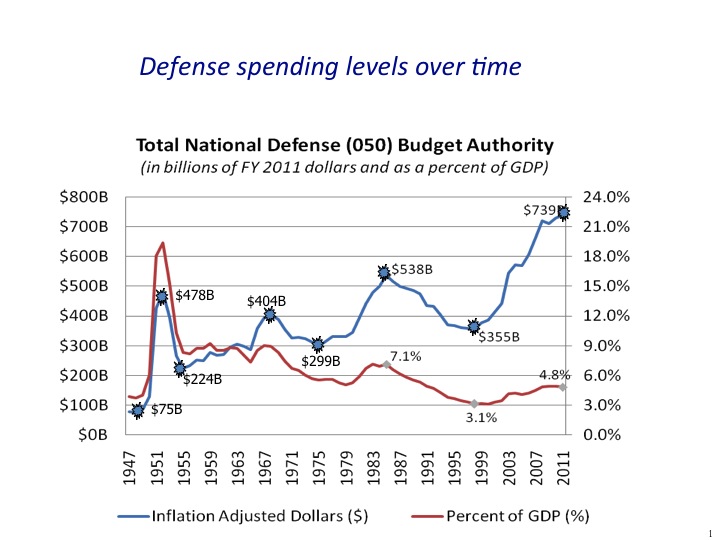
But here’s a graph that sheds some light on that last (I’ll not dignify the others with a response.  (a hostile Russia and China, 9/11, a nuclear Iran, Saddam’s inhuman butchery are sufficient answer.)

Notice that.  As a percent of GDP, defense spending has been remarkably stable.

Nevertheless, for the sake of national security, defense spending must be cut—the deficits and debts are too great and they threaten the weal and the safety of the nation.  The debt and the deficit picture certainly are as threatening as they’re made out to be, but consider: with no defense capability, where is the security?

What do we gain, though, by cutting defense?  Consider these items, courtesy of Neptunus Lex:

…shutting the doors on DoD entirely would still result in an $800 billion increase to next year’s aggregate deficit….

…radically reduce the ground forces, a couple of fighter wing equivalents and at least one or two aircraft carriers—the same forces which have allowed the US since the Cold War days to provide forward presence and deterrence.

Which is actually OK, because the Islamic Republic of Iran has just told us that the USS John C. Stennis is no longer welcome in their neck of the woods….

Well, at least one of those carriers won’t be needed, since it’s worn out its welcome in Iran as well as in DC.

One Progressive argument is that we can get away with such draconian cuts.  Even with cuts as deep as 90%, we can still wipe our attackders off the face of the earth.  But there are a couple of flaws with this argument.  The first is a moral one—and so a practical one.  With such deep cuts, we could wipe our enemies off—by going nuclear.  But with no intermediate capabilities, we’re stuck with the moral, and practical, choice of nuclear war or surrender.  There aren’t any intermediate options with such deep cuts.

The other flaw, though, goes to that ability to go nuclear.  Our nuclear weapons are aging.  They need testing and upgrade.   That takes money that’s being cut from the defense budget.  In the end, we have to ask ourselves, “what is the value of our nuclear weapons when we can’t count on them working?”  while our enemies are asking us, “Do you feel lucky, punk?  Well, do you?”

But the whole “we can cut defense” attitude suffers from another fundamental misconception.  It assumes that our enemies think like us, that their pain level is similar to ours, that their goals are similar to ours.

What do we gain by cutting defense rather than cutting somewhere else?   We keep three entitlement programs that are bankrupting us, and that will continue to do so, even after gutting national defense: Social Security, and Medicare, Medicaid.  But those are the programs that politicians use to buy votes with which to stay in power.

In the end, national defense and national security aren’t mutually exclusive.  Without both, we have neither.

Gridlock Works

Lost in the hoo-raw over the payroll tax reduction extension at the end of the year was Congressional inaction on a couple of other weighty matters—and this inaction redounds to our benefit.

Congress failed to continue a 45 cent per gallon tax credit for corn-based ethanol and a 54 cent per gallon tariff on imported ethanol (mostly from Brazil—Obama wants us to be one of their best customers).  Since these two items were among the few things Congress even constructed reasonably—they actually had sunset clauses—they expired Dec. 31.  Of course we can expect the Progressives to attempt to redress this egregious failure or to score the evil Republicans for stopping a resumption—that is, if the Republicans find their courage, lost in the debt ceiling fiasco and which loss was underscored by their screw-up on the payroll tax reduction, and block a resumption.

Another useless “green” subsidy expired through Congress’ inaction, also: the thousand dollar tax credit for installing an electric car charging station in a residential garage expired, as did the related tax credit (up to $30 thousand) for installing a commercial charging station.

Unfortunately, the gridlock didn’t achieve a sweep: fuel refiners still are required to add 36 billion gallons of ethanol to their fuel mixes by 2022, and the (maximum) $7,500 tax credit for buying an electric car remains in place.

Of course, as with all subsidies, these had just made the subsidized items more expensive.  The 45 cent credit for the ethanol-in-gasoline just followed the fuel right into your cost at the pump, for instance.  The $6 billion per year we taxpayers were being hit for this credit bought everyone else’s ethanol gasoline.  And we paid those $6 billion even when we bought an electric car, instead.  Those of us that have bought one; sales are steady, but far from outstanding.

That credit for buying the electric car is interesting in its own right.  Just to take an anecdote for an illustration, a Ford Fusion (ignoring the usual haggling, and only looking at MSRP) runs around $20 thousand.  The correspondingly ungussied-up Fusion Hybrid is a bit under $29 thousand.  With the subsidytax credit, that drops the Hybrid to a shade over $21 thousand.

In some cases, the credit doesn’t do the buyer as much good, though.  The Tesla’s Model S is a $50 thousand electric car, and their Roadster seems, from Tesla‘s Web site, to be of a price that if you have to ask, you can’t afford it.  The tax credit doesn’t have so much practical effect here.  As to the Fisker Karma, well, that electric car isn’t available at any price, at least for a while: its batteries are…defective.  The credit is useless for it.

Maybe instead of renewing the ethanol subsidies, we can get Congress to eliminate the electric car subsidy and the requirement to dump ethanol into our gasoline, too.  Keep in mind that ethanol is hard on your car‘s engine.

Or am I hoping for too much change this year?