President Obama made his position clear in his State of the Union address (as if it wasn’t clear from his performance these last three years, already). He wants more spending, and he wants to “pay” for it by increasing taxes on the hated rich. He couldn’t find the energy to spend more than a sentence or two on spending cuts in his SOTUS; although he did find plenty of “green” energy for spending and tax hikes.
Indeed, when it comes to actually reining in government’s use of our money, Obama has been the czar of chimeras and false flags. As the House Budget Committee Chairman, Congressman Paul Ryan (R, WI) has put it:
We have learned already that the president who’s had three years to try and propose real solutions to fix our fiscal crisis is ducking it…. He formed commissions and super committees, so he sort of outsourced the leadership only to decry their results.
Indeed. Obama’s committees and study groups (I don’t share Ryan’s disdain for Obama’s use of them, per se; when one is ignorant of a subject, asking experts for advice is entirely appropriate) actually did generate some ideas worth serious discussion and which could have served as points of departure for real reform. But for Obama, they were merely cynical tools of distraction; he blew off their recommendations without so much as a fare-thee-well. And he’s been clear about how seriously he takes his own ideas. Obama yukked it up over his “shovel ready jobs” chant:
…shovel-ready was not as shovel-ready as we expected.
Obama does have his apologists. Third Way think tank’s Jim Kessler insists:
[W]hen you’re in the middle of a recession it’s very dangerous to stop priming the pump. You know, you need to get escape velocity, get out of the atmospheric pull of recession, break loose and then let the economy go loose.
But what Kessler, et al., don’t understand is that that “atmospheric pull” actually is government interference in our economy. We can’t “get escape velocity,” to mix metaphors, with the government’s enormous sea anchor dragging us back.
How has Obama’s Progressive policies of higher taxes and more spending been working out?
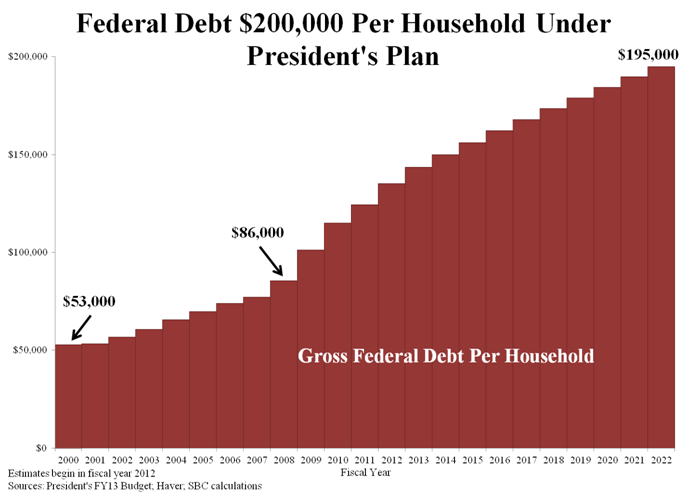
His first installment, nearly a trillion dollars’ worth, failed to reduce unemployment or deliver the shovel-ready jobs he promised. Of course he’s demonstrated how seriously he took his “shovel-ready” claim, even as he was making it. His profligate spending, while succeeding in exploding the Federal deficit and the Federal debt—which now our grandchildren will have trouble paying down—beyond anyone’s worst nightmare at the start of the Panic of 2008, have done nothing else but hold back a normal cyclic recovery that has been struggling since the official end of that recession in the spring of 2009—nearly two years ago—just as similar Keynesian foolishness did for the Depression.
For his second try, he wanted to spend even more, and now he wants to raise taxes on a narrow group of Americans of whom he disapproves. Ryan suggests checking the numbers. Doing so exposes the depth of Obama’s cynicism in continuing to push for higher taxes.
All these tax increases that the president is talking about, they only cover 8 percent of his proposed spending increases. The other 92 percent of the president’s spending increases are borrowed money.
Ryan is being polite. Those 92% are actually fantasy money—that’s the level of seriousness with which Progressives take other people’s money.
Here’s an alternative: reform our tax structure, including reducing rates, closing loopholes, and ending subsidies and credits. To paraphrase Ryan’s argument, with Progressive tax increases hitting small businesses disproportionately (and hitting all of us—individuals and businesses of any size—too hard, simply by existing), comprehensive tax reform is far better than arbitrarily and capriciously raising taxes.
And then cut government spending to below the tax revenue generated.
One step currently under consideration, with both Republican and Demoncrat support, is the continuation of the temporary payroll tax holiday. But this is a chimera; it will produce no effect on our economy. It will, though, continue defunding an already dysfunctional Social Security system. With the Progressives already having agreed that a 2 percentage point cut in taxes is good (and with Obama originally calling for a 3 percentage point cut in payroll taxes for both individuals and businesses), Republicans are blowing an excellent opportunity to begin serious reform. The better place to put these cuts is as permanent income tax cuts for individuals and businesses, and as a first step toward larger income tax cuts and tax reform, generally.
Arthur Laffer suggests a more specific tax reform in a column in The Wall Street Journal. As Laffer points out, and as thinking Americans have understood for a long time,
Jobs and wealth are created by those who are taxed, not by those who do the taxing. Government, by its very nature, doesn’t create resources but redistributes resources.
Laffer goes on to suggest that a flat tax is the optimum reform. Although he uses Newt Gingrich’s version (an optional 15% flat tax for individuals, with the option being to continue paying under the present system, and a 12.5% flat tax for business) as his example for discussion, Laffer’s point is generally valid.
Laffer argues
Fairness in taxation means that people and businesses in like circumstances have similar tax burdens. A flat tax, whether on business or individuals, achieves fairness in spades.* A person who makes 10 times as much as another person should pay 10 times more in taxes. It is also patently obvious that it is unfair to tax some people’s income twice, three times or more after it has been earned, as is the case with the death tax.
The current administration’s notion of fairness—taxing high-income earners at high rates and not taxing other income earners at all—is totally unfair.
Progressives—led by Obama—argue that it’s the rates that have to be progressive in a fair tax system, not just the amounts actually paid. But concern with rates paid rather than amounts paid fails to achieve equal treatment at the start—at the point of equal opportunity; “progressive” tax rates only look to create equal outcomes, after the differing levels of ability, work ethic, and so on have been applied by the people involved, folks who behaved voluntarily according to their own imperatives. Progressive rates punish hard work and success while subsidizing lesser effort. There’s no fairness in this.
Finally, as Laffer points out,
[A] flat tax proposal is not revenue-neutral, nor should it be. If there’s one truism in fiscal policy, it’s this: Wasteful spending will always rise to the level of revenues. Whether you’re in Greece, Washington, D.C., or California, overspending is a prosperity killer of the first order. [A] flat tax…would put a quick stop to overspending and return America to fiscal soundness.
*I fully anticipate that Laffer will be called racist for using this term, and I’ll be similarly accused for repeating it. Understand, though: only a racist will actively look to create racism where none exists, so he can cry, “Racist!”