Obamacare, Errors, and Attitudes

The AP has an article that goes into the pitfalls and pratfalls that Obamacare faces this fall, 2014 enrollment period. I’m interested in one error in particular and the attitude of one Democrat in particular who voted for Obamacare’s passage.

The error was the overpayment by the Federal government of many of the subsidies it handed out to…defray…the premium costs of having an Obamacare health plan. Overpayments could occur from a plan buyer underreporting income, from ObamaMart not correctly matching income data with subsidy accruals, and so on.

As a result of having discovered those overpayments, the government is trying to recoup them from the recipients. Congressman Bill Pascrell (D, NJ) disagrees with making people pay back part of their premium subsidy.

Why should individuals be punished if they got a bump in salary? To me, this was not the ACA I voted on.

Indeed, why should individuals be punished? Yet they would be, if Pascrell’s attitude prevails, by paying out more subsidy than was due. Oh, wait, the individuals being punished are taxpayers.

Of course Pascrell (and his fellow Democrats) know this; they just don’t care about those individuals. Taxpayers, after all, are just money trees with which to fund Democrats’ voters.

In Which a Judge Gets It Right

…but is forced to rule wrongly.

The SEIU sued University of Pittsburgh Medical Center, alleging “unfair” labor practices in that, claimed the union, UPMC management interfered with employees’ right to organize. In connection with that suit, the NLRB issued three subpoenas demanding “highly confidential and proprietary information” be released from UPMC to the union.

Federal District Judge Arthur Schwab found the NLRB’s subpoenas, among other things, over broad and unfocused, and so illegitimate. He also found the subpoenas fundamentally irrelevant to the underlying case (which itself would have rendered the subpoenas inappropriate). He went further. In noting that the NLRB itself made no serious effort to argue the relevance of its subpoenas, he wrote [emphasis added]

The Court does not see how these requests have any legitimate relationship or relevance to the underlying alleged unfair labor practices; instead, the requests seek highly confidential and proprietary information…and, the requests seek information that a union would not be entitled to receive as part of a normal organization effort. Indeed, the scope and nature of the requests, coupled with the NLRB’s efforts to obtain said documents for, and on behalf of, the SEIU, arguably moves the NLRB from its investigatory function and enforcer of federal labor law, to serving as the litigation arm of the Union, and a co-participant in the ongoing organization effort of the Union.

But he was forced to the wrong outcome and to uphold the subpoenas; although he stayed his upholding pending appeal.

However, the practical effect of case law as to enforcement of subpoenas of federal government agencies is that this Court is constrained to essentially “rubber stamp” the enforcement of the Subpoenas at hand.

The Third Circuit, the appellate court for Schwab’s district, can overrule Schwab and strike down the subpoenas. The appellate level is the normal place where Federal agency subpoenas get struck. Schwab also, though, has given the Third an out.

If the practical effect of this legal predicament is to be altered, it is not the District Court’s role to do so, but the role of the appellate court. The Court is at a loss of how to adequately address the above issues of whether the matter under investigation serves legitimate purposes, whether the inquiry is relevant to that purpose, and not unduly broad or burdensome, while still conforming to the extremely narrow and limited nature of the proceedings at hand. If the United States Court of Appeals for the Third Circuit finds that the District Court has the authority to conduct a meaningful and/or thorough review of the three (3) Subpoena[s] at issue here, the Court is prepared to do so.

Schwab’s opinion can be read here.

Scottish Independence

The view of a poor, dumb colonial.

Suppose the Scottish referendum next week goes in favor of independence. What would be next for Scotland?

Among the complexities of separation is the matter of pensions provided by employers. Most such pensions are not fully funded; although, most such pension providers have apparently viable plans for curing the shortfall, over some number of years. However, the EU (and we’ll assume Scotland succeeds in joining the EU for this bit) requires all pension funds with members in two or more countries to be fully paid up. Moreover, funds that are not have only two years to get fully paid up. There are quite a number of large-ish UK companies, employing thousands each, whose pension funds have members in both countries, and whose pension funds are on one of those “some number of years to fund” plans.

There’s some chatter in the UK about splitting the pensions in two, one for the UK and one for Scotland, as a means of ducking this problem. I see a possibility of splitting the companies themselves in two, each with its own pension scheme. Either course, though, is fraught with complexity.

A larger complication is the UK national debt, some £1 trillion ($1.62 trillion): how would this be divided, and based on what criteria? I’ll elide whether the new Scottish economy could handle its new debt.

That sort of thing is trivial, though, compared with a couple of larger questions. Scotland has some serious economic problems, including that debt, a risk of sharp inflation, lack of clarity on what it would use as a currency, what sort of trade arrangements a settled-on currency would imply, and so on.

The economic problems will have their impact on independent Scotland’s near- and mid-term stability.

Too, accession to the EU requires a unanimous vote of the existing members, and that’s not a done deal. Which means Scotland would not be able to count, soon, on any EU…assistance.

Frankly, I think Scotland would be better off outside the EU than in it (recall the EU’s treatment of Ireland and Iceland), but this is a move Scotland has to make, and properly so, without my sage advice.

Regardless of EU membership and those “larger problems” just mentioned, though, independent Scotland will need to broaden its economy. 80% of its national income is from North Sea Oil which, aside from questions of how to divide that with the UK, is a declining asset value [sic], and the bulk of the remaining 20% is from tourism. A self-sustaining independent Scotland will need a more broadly based economy in order to function without the UK subsidies it currently gets.

Finally, I don’t know that Scotland would be better off independent from the UK. Certainly, there are advantages for a nation that’s free to chart its own course without having to say, “Mother, may I” to a higher-up. I think, though, given Scotland’s socialism and those subsidies, the UK would be better off with an independent Scotland.

The aftermath also will be fun to watch. Northern Ireland? Catalonia? Basque Country? Sicily?

Obamacare and Health Coverage Cost Growth

President Barack Obama promised us, all those years ago, that if only Obamacare were enacted, a family’s health plan premium would drop by $2,500 per year, and no one would lose their employer-provided health plan. Period.

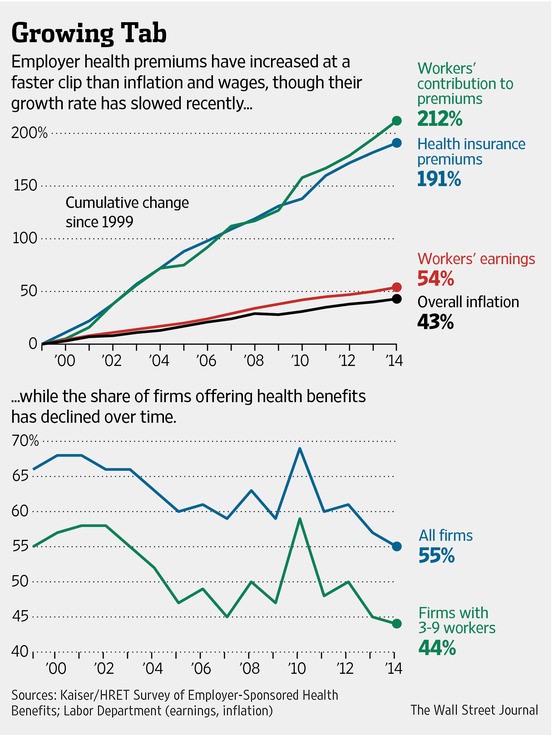
These two graphs from The Wall Street Journal draw a different…picture.ObamacareCost

These graphs cover the period since 1999. As the upper graph shows, the premiums for employer-provided health insurance and, since Obamacare’s passage in 2010, for employer-provided health plans, have risen at a steady pace—unchanged by Obamacare, and specifically, no drop in premium cost. It’s the same with the employee’s share of those premiums; that share’s pace of increase also has been unaffected—that is, no drop in cost—from Obamacare.

Now look at the lower graph. After spiking in Obamacare’s year of enactment in 2010, the per centage of businesses offering health plans to their employees has fallen to the lowest level in the 15 years depicted.

At best, Obamacare isn’t lowering employer-covered workers’ health coverage costs. There has been, though, a sharp decrease in the number of folks even offered employer-provided plans.

(That wages have risen much more slowly than health plan premiums is a different subject.)

Continued VA Cover-Up

This time with the VA’s IG participating. It’s an unfortunate side effect of having an organization’s inspection/watchdog function be an internal one, even if it works for the organization’s boss and not for anyone further down the totem pole.

Crucial language that the Department of Veterans Affairs Inspector General could not “conclusively” prove that delays in care caused patient deaths at a Phoenix hospital was added to its final report after a draft version was sent to agency administrators for comment….

The single most compelling sentence in the inspector general’s 143-page final report on fraudulent scheduling practices at the Phoenix veterans’ hospital did not appear in the draft version, according to a staff analysis by the House Committee on Veterans’ Affairs.

It was inserted into the final version, the only one that was released to the public, after agency officials had a chance to comment and recommend revisions.

It’s certainly legitimate for IG draft reports to be run by the group just inspected and about whom the report is being written, but that’s to give the inspectees an opportunity to check facts and to suggest corrections to factual errors. Giving the inspectees the ability to “correct” the conclusions themselves is entirely illegitimate.

A separate report, written by the inspectee, is a normal part of the proceeding. Here, the inspectee indicates its concurrence with IG conclusions and its plan of corrective action regarding those conclusions. It’s also in this separate inspectee response report that the inspectee indicates its disagreement with a conclusion and the reasons for that disagreement.

Then the IG responds, again in a separate report, indicating its acceptance of the inspectee’s disagreement or the IG’s overruling of the inspectee, with the original conclusion standing and the inspectee required to take corrective action. All three of these reports are part of the official record.

Notice that: the legitimate course is to disagree with an IG conclusion, in writing, in a separate report, not to rewrite the IG conclusion itself.

And the cover-up of the cover-up:

The House committee obtained the draft version of the report late Thursday, after the [Washington] Examiner published a story that IG had been refusing its release.

Again, I say, it’s time to disband the VA altogether and send the VA’s existing budget and what would have been its future budgets directly to our veterans as voucher checks with which they can be free to seek out their own doctors and their own medical facilities.