What Hath Socialism Wrought

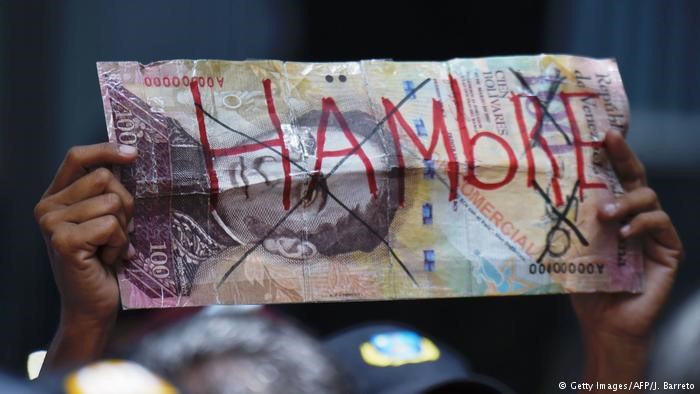
This image, from a Deutsche Welle article on Venezuela’s inflation rate—which last month reached 24,571% year-on-year—says it all.

The word drawn on the 100 bolivar note (and yes, it’s a real note, and it’s actually that big) translates to “hungry.”  In the context, it means more broadly, “a widespread, intense, and prolonged shortage of staple foods that a population suffers.”

Hungry indeed, too.  A bit over two pounds of meat cost about 2 million bolivars (or did once, daily inflation is running at 2.4%), or €16.9 or $20, against a surgeon’s monthly salary of not even 6 million bolivars.  Meat, not steak in particular.  That’s some expensive hamburger or shank cut.

And, not to put too fine a point on it, that works out to a bit over three ounces of meat per day, with nothing left over for anything else: vegetables, rent, transportation, etc.  And that’s for a relatively well off man like the surgeon.  What about the middle class, or especially the poort.

This is reminiscent of what Joseph Stalin did to the Ukrainians and White Russians when he collectivized—socialized—the Soviet Union’s kulak farms.

Brexit Failure in the Offing?

Great Britain’s Labour Party is about to offer legislation that looks a great deal like it [emphasis added].

It shall be a negotiating objective of Her Majesty’s Government to ensure the United Kingdom has full access to the internal market of the European Union, underpinned by shared institutions and regulations, with no new impediments to trade and common rights, standards and protections as a minimum.

There’s very little difference between this and Remain.  Labour is suggesting Britain’s abject surrender in the Brexit negotiations with the Moghuls of Brussels.

Maybe not failure.  Maybe this is Labour’s betrayal of the British people, who voted to leave the EU because they wanted out of the EU.

Merit?

We don’t need no stinking merit.  That’s what the Progressive-Democratic Party in Pennsylvania says.

In May, two women were elected to the Progressive-Democratic State Committee.  Then the Committee said the election doesn’t matter.  They rejected the women, denied them their places on the committee.  The committee instead

[gave] the positions to men who garnered fewer votes. Believe it or not, Democrats are justifying this decision in the name of gender equity.

If Darrell Clarke and Noam Kugelmass, the two men who were gifted the seats resoundingly won by Judi Golding Baker and Mariel Martin, had a scintilla of grace, of self respect, of integrity, they’d have refused to accept the seats.  But….

It’s not only the dishonesty of the Party’s hypocrisy that’s in play here.  It isn’t even the Progressive-Democrats’ plain war on women that this move illustrates.  It’s both of those, but even more importantly, it’s the deliberate overruling of the will of the voters.  The Progressive-Democrats didn’t just ignore their voters.  Having been issued their instructions by those voters, the Party flat overruled them.  Voters’ votes just don’t count according to this Party.

This is the sort of thing we can expect if the Progressive-Democratic Party regains a majority in the House this fall—in spades if they regain the Senate.

Most of What They Wanted

Recall that, in a breathtaking attack on Italy’s democracy, the nation’s President Sergio Mattarella vetoed formation of the coalition government that hard-Left 5Star Movement and hard-Right League, as the two winners of Italy’s elections, had formed because Mattarella didn’t like the coalition’s choice for Economics Minister, Paolo Savona.  Mattarella held Savona personally unacceptable over the latter’s disdain for the euro and for the European Union.

5Star and League have formed a new coalition, and it seems that Mattarella has approved the new coalition.  The coalition’s Econ Minister will be Giovanni Tria, an economist from the Tor Vergata University.  Tria has “criticized the eurozone, saying it had failed to achieve the convergence of the different economies;” he doesn’t seem that far from Savona’s position or from the coalition’s, just perhaps a bit more politic in expressing it.

Also, far from being banished to the sticks, Savona also will get a position in the new government: Minister for European Affairs.  The position has no formal portfolio, but he’ll still be in a position of influence and in the venue for which he was found ill-suited by Matterella.

Maybe Mattarella is figuring out that he’s President of Italy, not a mucky-muck of the EU.

Europe’s Italian Crisis

Europe is a-roil over Italy’s inability to form a government at any time since the nation’s elections some months ago.  And so is the old guard in Italy.

Italy’s woes rippled across the eurozone, driven by investor worries that an exit by the bloc’s third-largest economy could force others out.

Bank of Italy Governor Ignazio Visco said this with a straight face:

We must never forget that we are only ever a few short steps away from the very serious risk of losing the irreplaceable asset of trust[.]

They’re risking losing that trust, anyway, on the political front—from which flows all economic trust.  The Italian Old Guard is in the way here.

Italian President Sergio Mattarella blocked the formation of a euroskeptic coalition government formed of the antiestablishment 5 Star Movement and the League parties, raising the prospect of new elections.

He perpetrated the decidedly anti-democratic move of refusing to allow a coalition of the two parties who won the election to form a government because he personally didn’t like their finance minister nominee.  I would have thought Italy would have had done with fascism.  And so, sub rosa, would many in Europe, it seems.

And there’s this, based in no small part on those erstwhile coalition parties’ shared lack of enthusiasm for eurozone membership:

Italy hurtled toward a political crisis that is reigniting debate over Europe’s future, including whether the eurozone’s third-largest economy should remain in the currency union.

They’re worried that an Italian exit—if it actually were to happen—would spell the end of the currency union altogether.

Which brings me back to that matter of trust.  Having blocked the formation of a government, Matarella has virtually guaranteed new elections soon—there are no other possible combinations of Italian parties capable of forming a governing coalition.  And those new elections, given who won the last round, will surely be less an election of a new government and more a national referendum on whether Italy should remain in the eurozone.

Of course, Italy should not; they’re a terrible match for that currency union.  Italy, along with Portugal, Greece, and Spain—the original PIGS—should form their own currency union.  Those four nations’ philosophies concerning the purpose of money and of government’s role in society are much closer to each other’s than they are to the rest of Europe’s.