
Discrimination

Recall the California law that requires (required) the boards of directors of California-headquartered public companies to have at least one member of an “underrepresented” race, ethnicity or sexual orientation, and two to three for larger boards. Recall further that California Superior Court Judge

Terry Green judge struck the law for violating California’s constitution.

Now The Wall Street Journal includes a bit of the judge’s reasoning from his opinion.

the judge says no one “appears to have made any effort to identify, define, or survey the qualified talent pool for director positions.”

Oops.

In an associated footnote, the judge went on, with clarity that even a California Progressive-Democrat should be able to discern.

Some of the experts have identified common feeder positions (such as “C-Suite” executive roles) and academic qualifications (such as an MBA), but there appears to be no one single” gatekeeping “qualification that could be used to define the pool in the way that a license might for lawyers and medical professionals, or a credential might for teachers.

Then he drove the point home in his conclusion.

Corporations Code § 301.4 [the board of directors membership law] violates the Equal Protection Clause of the California Constitution on its face. The statute treats similarly situated individuals—qualified potential corporate board members—differently based on their membership (or lack thereof) in certain listed racial, sexual orientation, and gender identity groups. It requires that a certain specific number of board seats be reserved for members of the groups on the list—and necessarily excludes members of other groups from those seats.

It’s hard to get any clearer than that, but if the California Progressive-Democratic Party legislators are true to their history, they’ll work hard to find a way to be confused.
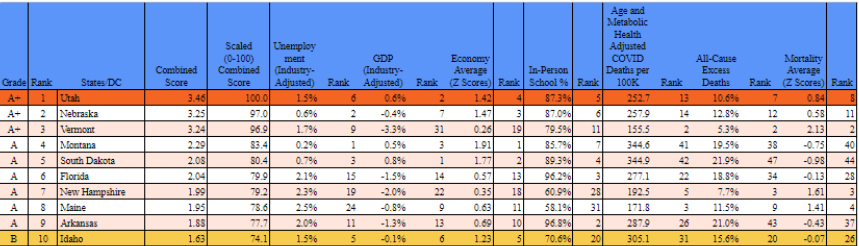
Two Tables

These two are excerpted from Phil Kerpen’s, Stephen Moore’s, and Casey Mulligan’s A FINAL REPORT CARD ON THE STATES’ RESPONSE TO COVID-19, a working paper published through the National Bureau of Economic Research. The first table identifies the 10 States that performed best during the height of the Wuhan Virus situation, as assessed across three variables: the economy, normalized by State industry composition; education, as measured by lost school days; and mortality, normalized by State population age and the prevalence of obesity and diabetes (leading co-morbidities for Covid deaths).

The second table identifies the 10 States that did worst.

States that opened from lockdowns early in the virus situation did better overall and on education and economic measures, and those same States did as well as (Florida vs California, for instance) or better on health outcomes related to lockdowns.

Oddly, those States that did best are Republican-led, and those States that did worst are Progressive-Democrat-led.

Go figure.

Note: right-click on the tables and select Open Link in a New Tab to get a bigger image.

Where Is Joe Biden?

Turkey is reopening its embassy in Kyiv.

European Commission President Ursula von der Leyen and EU High Representative of the Union for Foreign Affairs and Security Policy Josep Borrell went to Kyiv, along with Matti Maasikas, Head of the Delegation of the European Union to Ukraine, last week to meet face-to-face with Ukrainian President Volodymyr Zelenskyy, and Maasikas said he’d stay, reopen delegation facilities, and assess the safety of returning staff to the facilities.

British Prime Minister Boris Johnson traveled to Kyiv Saturday and met face-to-face with Zelenskyy.

Italy intends to reopen its facility in Kyiv right after Easter—17 April.

Where’s President Joe Biden (D)? Oh, yeah—he still has his embassy hiding out in Poland. And neither Biden nor his Secretary of State Antony Blinken have been to Kyiv since Russia’s invasion and apparently have no plans to go.

Biden is channeling Sallah: Russians. Very dangerous. You go first.

Canceling Charter Schools

The Biden-Harris administration is trying to. His Department of Education Secretary, Miguel Cardona, is proposing a cancelation rule, cynically called, in part, Expanding Opportunity Through Quality Charter Schools Program. The rule provides, among other things:

prov[e] there’s a demand for a new school—e.g., evidence satisfactory to Miguel Cardona that there is “over-enrollment” in existing public schools

Prove to the government’s satisfaction, that is. A government that the teachers unions, recall, heavily influence—lately regarding Wuhan Virus requirements for opening and operating in existing public schools.

show[] how they would ensure diversity

Not how they would ensure a quality education. That’s no longer a factor under this administration or the teachers unions.

limit the degree of control over their own schools that would be allowed outside for-profit companies

Because Big Government Knows Better than actual businessmen and educators how to run a school.

[A]n applicant [for Federal startup seed money] must propose to collaborate with at least one traditional public school or traditional school district

And

In its application, an applicant must provide a letter from each partnering traditional public school or school district demonstrating a commitment to participate in the proposed charter-traditional collaboration.

Under these two requirements, a new charter school functionally must get permission from its competitors—those public schools—even to operate. That permission is granted in part, or withheld entirely, by whether an existing partner school will agree, or not, to “partner” with the supplicant applicant.

The proposed rule goes on like that for over a dozen Federal Register pages, every single one of which is unnecessary, since this…rule…is less than unnecessary, it’s Government overreach.

It’s long past time to put these people out of office.

Student Debt

President Joe Biden (D) is at it again. Now he’s extending for yet another time, and by diktat, not by Congressional action, the “moratorium” on student debt repayment requirements. As The Wall Street Journal‘s editors noted, this is debt cancellation on the installment plan.

Never mind that our economy—according to no less an authority than Biden, anyway—is fully capable of return[ing] to more normal routines. In what amounts to a deep insult to grown American citizens who still have student debt outstanding, Biden is excluding them from that return to normal. Apparently, Biden does not think this particular group of Americans is capable of much of anything.

I have a better idea. It begins with ending the debt moratoria, which only hurts those debtors, the lenders who lent to them, and us taxpayers, whose tax remittals will go—eventually—to those lenders in partial mitigation.

My idea continues with garnishing the wages and welfare payments of those without wages, of those debtors who claim to be unable to pay, even if those garnished payments are less than the payments the student loan contracts specified.

My idea finishes with limiting the root cause (to coin a phrase) of a student need to borrow in the first place: the over-high cost of going to college. One branch of this path is to get rid of the stigma of not being a college graduate. The trades are far more important than graduating with degrees in women’s studies, this or that race studies, or basket-weaving froo-froo. The trades are every bit as important as degrees in architecture or engineering: nothing gets built, no matter how creatively or usefully drawn up or engineered, without tradesmen—plumbers, electricians, carpenters, heavy equipment operators—to do the actual work. That needs to be emphasized.

Another branch is for the Federal government to stop sending taxpayer money to colleges and universities. What started out as a good idea, enlisting these institutions in basic research, has become badly abused in hiring “diversity” mavens, pushing identity separations, expansions of those froo-froo studies. The Federal monies have become excuses to hire excessive administrative overhead and to raise tuition to absorb the Federal influx. Cut it out.

A third branch is to require two things of colleges and universities: one is to publish, for each major the school offers, including “independent studies,” the average salaries of its graduates five years after graduation. The other is to require the college/university whose student applies for a loan(s) to be the lender of the majority of the borrowed amount or to guarantee the entire loan(s) provided by any other lender.