Banks and Governmental Reform

The World Bank report, “China 2030: Building a Modern, Harmonious, and Creative High-Income Society,” concerns China’s future over the next 25, or so, years, and it describes a number of “challenges” its economy faces.

The report suggests, with regard to the financial sector in particular (beginning in Chapter 5 of “Supporting Report 1”):

Despite the many reforms introduced so far, the Chinese financial system remains repressed, unbalanced, costly to maintain and potentially unstable….

and

Banks have been used as instruments of the government’s macroeconomic and sectoral policy goals and have not always been in a position to lend prudently.

The Epoch Times summarizes this way:

The report suggests that China’s financial sector is constrained by state ownership and regime interference. The Chinese state uses the financial sector to enforce its policies, preventing lending institutions from becoming a true market force.

Sound familiar?


h/t to Belmont Club

Jobs

The March Jobs report said there were 120,000 nonfarm jobs added in March, compared to economists’ expectations of 200,000 jobs and some 267,000, 275,000, and 240,000 added in December, January, and February, respectively.  The report also said that the population of folks actively looking for work—the denominator in the headline unemployment rate—shrank by 161,000 to 63.8% American adults as yet more people gave up on our suppressed economy and stopped looking for work.  This participation rate has fallen steadily for the last three years, from its nearby high of 65.8% in January 2009.

The long-term unemployed (jobless for 27 weeks and over) remained at 42.5% of the total unemployed.

Meanwhile, initial jobless claims increased by 13,000 to a seasonally adjusted 380,000 in the week ended April 7.  This also is the largest jump in a year.

Keep in mind that one month does not make a trend.

But.  Our economic recovery is in full bloom, all right.

Lobbying with a Red Herring

The Associated Press is joining the lobbying of the Supreme Court over the Patient Protection and Affordable Care Act, and its effort is either cynical or ignorant, depending on their motive for their chosen focus:

During the recent oral arguments some of the justices and the lawyers appearing before them seemed to be under the impression that the law does not allow most consumers to buy low-cost, stripped-down insurance to satisfy its controversial coverage requirement.

The AP presents this as a “possible misunderstanding” the “could cloud” the Court’s deliberations.

Of course, cost is only a peripheral issue, arising primarily from Justice Antonin Scalia’s discussion of the subsidy a young, healthy American (who does not need health insurance—and who used to be able to make that decision for himself) must pay, through forced purchase of unneeded/undesired health insurance, so that others, claiming the need, can afford to get health insurance.

The question before the Court—as all the players understood, making their arguments concerning the constitutionality of PPACA’s Individual Mandate, and by extension of the PPACA itself, as they did—is the question of individual liberties and the degree to which Government can, under our Constitution, limit our liberty for our own good.

Cost isn’t the issue—freedom and government control over an individual’s decisions is.

You Didn’t Hear It Here First

Although I have written something similar before.

Freedom of speech is on no use to a man who has nothing to say, and freedom of worship is of no use to a man who has lost his God.

And

We cannot read the history of our rise and development as a nation without reckoning with the place the Bible has occupied in shaping the advances of our Republic.

And

The lessons of history, confirmed by the evidence immediately before me, show conclusively that continued dependence upon relief induces a spiritual disintegration fundamentally destructive to the national fiber. To dole our relief in this way is to administer a narcotic, a subtle destroyer of the human spirit. It is inimical to the dictates of a sound policy. It is in violation of the traditions of America.

And on Social Security, as it was drafted originally (and ultimately as passed and evolved; although the remark was made of the draft):

This is the same old dole under another name.  It is almost dishonest to build up an accumulated deficit for the Congress of the United States to meet in 1980.  We can’t do that.  We can’t sell the United States short in 1980 any more than in 1935.

Who said this stuff?  A man not known for his modern conservatism: Franklin Roosevelt.

The catalog of Roosevelt’s economic and regulatory failures is long, but there also is much that the present administration could have listened to and thereby avoided the damage done by its own economic and regulatory failures—as could FDR, had he listened to himself.


h/t to Power Line

Capital Gains Taxes and Federal Revenues

The Wall Street Journal offered a history lesson with empirical data relating taxes on investment to revenues collected by the government since 1977, a period when capital gains taxes were alternately raised and lowered by a capricious Congress.

This figure tells the story, which I’ll only summarize; you should read the whole lesson.
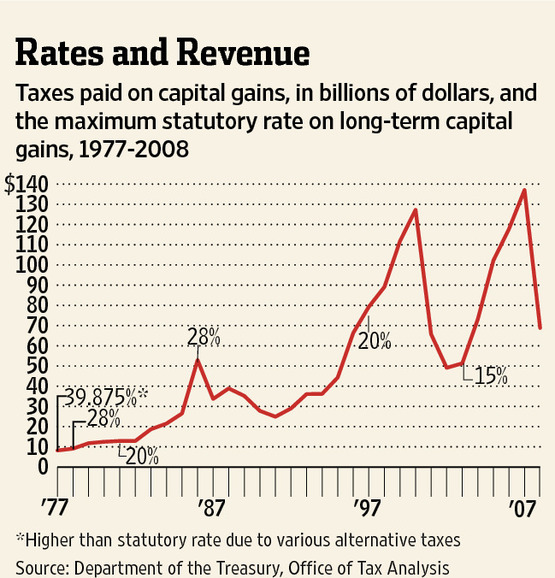
Essentially, raising tax rates—as has been noted for other Federal taxes—lowers tax revenues, and lowering the rates increases the collected revenues.

A couple of things in the figure are noteworthy, though.   The tax rate drop to 20% in 1981 did not lead to a drop in revenue—surprise—but 1982 was a year of a sharp recession, and collected revenue from that lowered rate still remained flat: no drop with the recession.  Collected revenue then ran up hard as we came out of the recession.  Additionally, the sharp drops after the sharp increases that resulted from the rate decreases in 1997 and 2003 came from the dot-com bubble burst that saw the NASDAQ, for instance, lose 60% of its value and from the Panic of 2008, whose hard recessionary effects we’re still in the middle of.

There’s another impact of higher capital gains tax rates, though, as the WSJ also points out.  High rates disinclines investors from selling their holdings as soon as they might.  This sequesters those investment monies in present investments, making them unavailable to other investments—younger, newer, more agile businesses with more current ideas, for instance—that might be better places, on a purely business basis, for investment dollars.  Moreover, the higher capital gains tax rates lower the returns on investments, leading other investors to demur from committing their funds in the first place to such investments.  The taxes distort the investment decisions.

But President Obama doesn’t care about healthy revenue collections for government; he doesn’t care about a healthy economy.  He cares about his definition of “fairness.”

GIBSON: So why raise [capital gains tax rates] at all, especially given the fact that 100 million people in this country own stock and would be affected?

OBAMA: Well, Charlie, what I’ve said is that I would look at raising the capital gains tax for purposes of fairness.
