Defense Cuts on the Stump

President Obama, speaking before the VFW the other day, had some interesting words to say about defense, and cuts to our defense capability that are looming.  Naturally, I have a few words to say about what he said.

People in Congress ought to be able to come together and agree on a plan, a balanced approach that reduces the deficit and keeps our military strong[.]

Indeed.  When are the President and his fellow Progressives in the Senate going to get out of the way of a bipartisan solution and allow one, instead of throwing our nation’s security away on his demand to raise taxes on his disfavored group of Americans?  After all, it’s Obama’s demand that taxes be raised, rather than spending be cut elsewhere—like in our bloated entitlement programs—that’s standing in the way of salvaging our defense establishment.

And there are a number of Republicans in Congress who don’t want you to know that most of them voted for these cuts. Now they’re trying to wriggle out of what they agreed to.

Nah—they’ve made no bones about this.  Obama held a gun to their heads and forced the idiocy of sequestration during the debt ceiling “negotiations” when he threatened to destroy our economy if he couldn’t get his tax increases, even to the point of cynically blowing up an agreement that had been reached—including revenue increases, if not tax rate bumps—with his last-minute (literally) demand for an additional $1 trillion increase in taxes.

Instead of making tough choices to reduce the deficit, they’d rather protect tax cuts for some of the wealthiest Americans, even if it risks big cuts in our military.

Again, indeed.  Instead of making tough choices to reduce the deficit, Obama is ready to impose destructive cuts on our military in order to get his taxes on his disfavored Americans, and I’ve got to tell you, Mr Obama, I disagree.

As we look ahead to the challenges that we face as a nation and the leadership that’s required, you don’t just have my words, you have my deeds.

President Obama’s deeds are especially frightening.  His “deeds” include the idle chit-chat that’s allowing Iran to get nuclear weapons.  His “deeds” include the idle chit-chat that’s allowing the Syrian boss Assad to butcher his own citizens—19,000 of his fellow Syrians—and to move his chemical weapons arsenal and prepare it for use against surviving Syrians dissidents.  His deeds include surrendering to Russian demands and throwing Poland and the Czech Republic into the teeth of the Bear and cancelling a plan to build missile defense installations in those two countries.  His deeds include surrendering American foreign policy to the veto authority of Russia and The People’s Republic of China, especially vis-à-vis Iran and northern Korea.

His deeds include his claimed end to a war in Iraq that was already won and done, with only a SOFA to facilitate American troop presence for training to be negotiated.  Without any American presence—Obama’s crowning achievement here—Iraq is falling apart under terrorist attacks and secular and religious strife, and al Qaeda is resurgent.

His deeds include winding down the war in Afghanistan with an announced withdrawal schedule and nothing left behind.  He’s snatching defeat from the jaws of victory, as the Taliban are still in the field and effective, while the Afghan army is neither.

House Armed Services Committee Chairman, Buck McKeon (R, CA) has the right of it:

President Obama played no small part in setting the time bomb that is sequestration.  Indeed, automatic defense cuts were included in the Budget Control Act at his insistence.  Now he owes our troops his best efforts to defuse the cuts.  Ultimatums from the campaign trail are not enough.

The challenges we face as a nation are legion, the future is near, and the leadership Obama has demonstrated and the deeds he’s done, make change imperative.
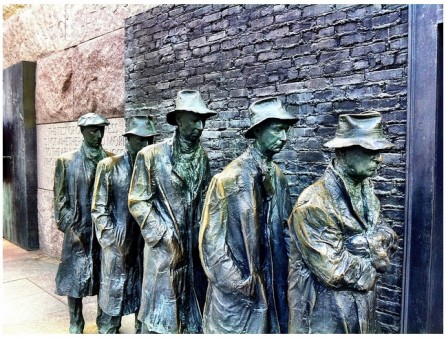
Social Engineering Taxes

The efficacy of these taxes are amply demonstrated by their extremely regressive nature.  For instance, the payroll taxes for Social Security and Medicare/Medicaid hit the lowest income folks the hardest.  They’re taxed at the same nominal rate as everyone else (except the well-off in the case of Social Security: there’s an upper limit on the income taxable for this purpose).

However.

Someone making the Federal Poverty Guideline income ($22,350 for a man in a four-person family in 2011) was taxed at 4.2% of that income (6.2% when the cut expires next January, but we’ll stick to the lower rate here)—$938.70.  A man making $100,000 paid a tax of $4,200, including that same $938.70 on his first $22,350 of income.  Who do you suppose was hit harder by that $939 tax?

The poor man already is living at the edge of his income; the dollar taxed to him—the very same dollar that is taxed to our better off man—is far more important to the poor man.

So it is with income taxes, whether those taxes are for Article 8 purposes, or some of them are for other government-determined—social engineering—purposes.

Legitimate taxes must be evaluated for their impact on what Wretchard of Belmont Club has described as the design margin: how much safety is left for handling the unforeseen when a tax dollar is taken away from a man?

The correction, of course, is not to raise taxes on everyone else—the well-off already are paying far more than their share, while the half [sic] at the “bottom” of the distribution are paying next to nothing.  Moreover, this would do nothing to reduce the importance of those tax dollars that are in the poor man’s margin of safety between what he has and what he needs for an emergency.  No, the answer is to lower tax rates—to increase the width of the design margin—and to move to a flat tax with no deductions.  Taxation for government-mandated social engineering purposes just hammers at that design margin, shrinking it, no matter the good intentions behind the assessment.

A tax dollar always will be more important to the poor man than to the better off man; no amount of attempted progressivity in a tax code will reduce this.  A flat tax will reduce the difference in relative importance, though.

The American Welfare State

James Pethokoukis, of AEIdeas, an affiliate of the American Enterprise Institute, has an article that shows the economic devastation extant in the policies of the Federal government.  It’s important to note that, much as I dislike the present administration, these results also flow from the “efforts” of a long string of administrations.

I don’t have much to add, so here is the complete article, reprinted with the kind permission of AEI.

6 charts that show the Welfare State run amok

The original purpose of Medicaid was to provide improved healthcare access for poor people, while not turning the safety net into a trap. Under President Obama’s Affordable Care Act, Medicaid will be greatly exapnded beyond what Congress originally intended.

In fact, as these charts show, it has already expanded beyond what Congress surely originally envisioned and, in the process, has created a terrible fiscal problem for the United States. (These charts and graphics come from a briefing today here at AEI, conducted by Gary Alexander, secretary of public welfare for Pennsylvania.)

A few scary factoids:

– In the 1960s, there were 18 workers per Medicaid recipient. Today that number is 2.5.

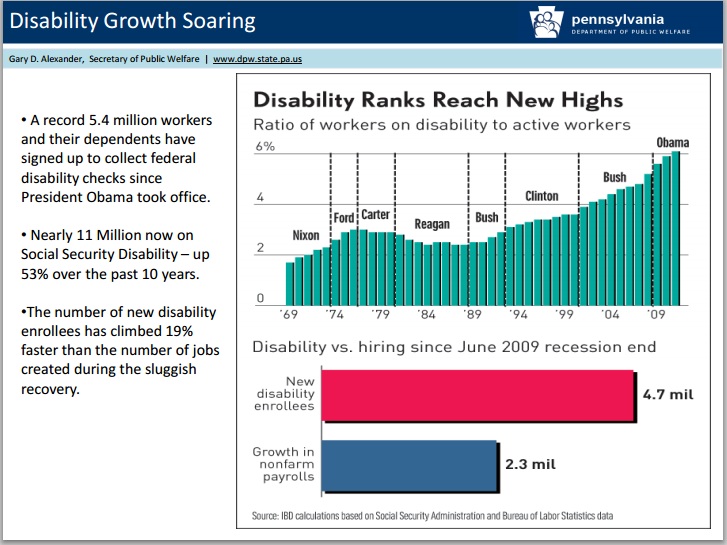
– The number of Americans on disability has risen 19% faster than jobs created during this recovery.

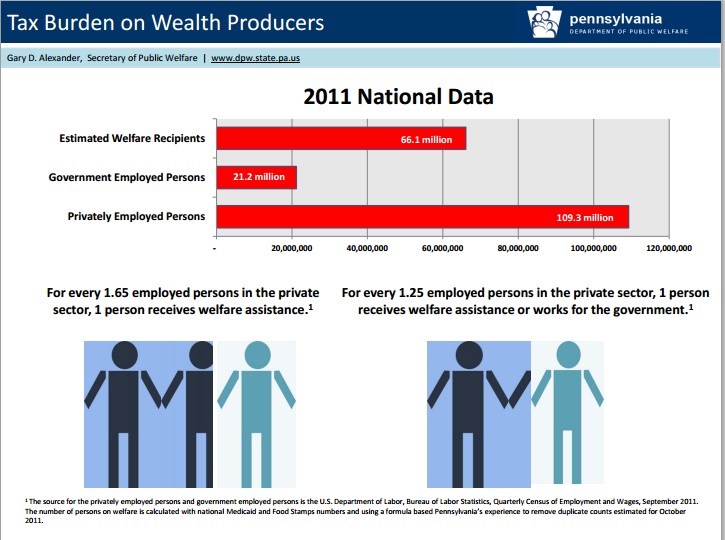
– There are just 1.2 private sector workers per 1 person on welfare or working for government.

– There are now just 1.65 employed persons in private sector per 1 person on welfare assistance.

Check out the charts and graphics for yourself:

1. Fewer workers and their tax payments have to support more and more Medicaid recipients.

2. The number of takers is now approaching the number of makers.

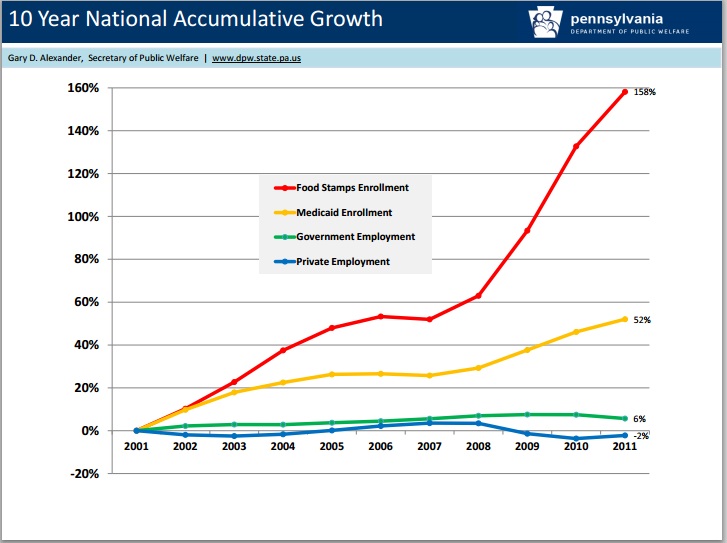
3. Medicaid and other welfare enrollment has exploded.

4. Medicaid enrollment is growing faster than economy.

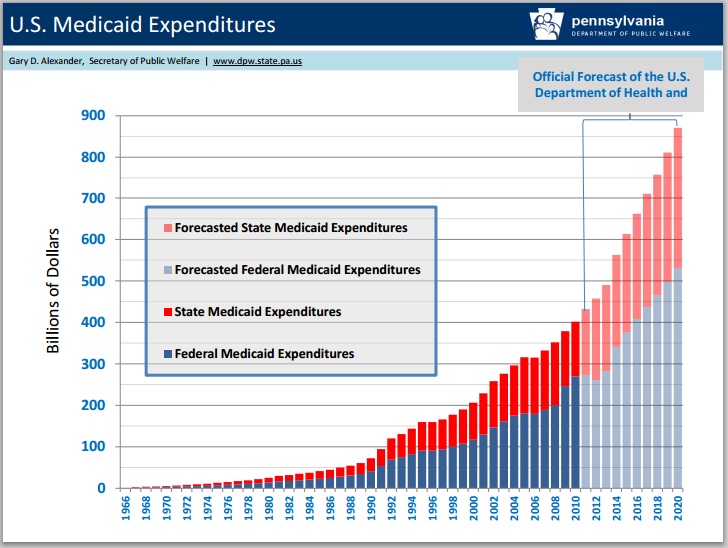
5. Medicaid spending? You ain’t seen nothing yet.

6. Disability enrollees have exploded and are rising faster than job creation.

These charts show an out-of-control welfare state that is about to get even bigger, increasing both budget costs and dependency.

Dependency of America

Greg Mankiw, a Harvard University economics professor (OK, he’s the Chairman of the Department of Economics), has on his blog some hard numbers that show the increasing dependency of Americans on government.  Here’s what he says [bold emphasis added; italic emphasis in the original]:

Because transfer payments are, in effect, the opposite of taxes, it makes sense to look not just at taxes paid, but at taxes paid minus transfers received.  For 2009, the most recent year available, here are taxes less transfers as a percentage of market income (income that households earned from their work and savings):

  • Bottom quintile: -301 percent
  • Second quintile: -42 percent
  • Middle quintile: -5 percent
  • Fourth quintile: 10 percent
  • Highest quintile: 22 percent
  • Top one percent: 28 percent

The negative 301 percent means that a typical family in the bottom quintile receives about $3 in transfer payments for every dollar earned.

The most surprising fact to me was that the effective tax rate is negative for the middle quintile.  According to the CBO data, this number was +14 percent in 1979 (when the data begins) and remained positive through 2007.  It was negative 0.5 percent in 2008, and negative 5 percent in 2009.  That is, the middle class, having long been a net contributor to the funding of government, is now a net recipient of government largess.

The CBO report can be read here or here.  The supplemental tables, which contain the Table 7 from which Mankiw made the calculations above, are here.

I recognize that part of this change is attributable to temporary measures to deal with the deep recession.  But it is noteworthy nonetheless, as other deep recessions, such as that in 1982, did not produce a similar policy response.

Again, I ask: what are we to make of the motives of the politicians that are doing this, knowing as these highly intelligent and rational human beings do, what the outcome is?

A Thought on Failure

Or at least President Obama’s quasi-admission of his own.  This excerpt is from Sunday’s CBS News interview with Charlie Rose.  There’s also more, including Obama’s whining that he hasn’t been able to “change the atmosphere” in DC, with his partisan, character-assassinating politics.

Rose: But suppose, I mean he clearly would say, ‘Let’s look at your record; let’s look at the fact the unemployment is at 8.2%, and it’s unlikely to change.  Let’s look at how effective the stimulus was.  Let’s look at your management of the economy.  Yes, it was a bad hand you were dealt, but you have not made it to what it ought to be.  That is the centrality of their campaign.

Obama: Exactly.  That is his argument, and you don’t hear me complaining about him making that argument, because if I was in his shoes, I’d be making the same argument.

Hmm….

As an aside, it’s also interesting to see Rose’s mindset so plainly: government should be managing the economy.