He Built This

…and it’s not pretty.  The costs of Obamacare are starting to come home to roost, now that its various mandates are starting to take effect.  Gerri Willis has a listing; this is a brief summary.

The requirement that lets grown adultschildren stay on mummy and popsy’s health insurance policy until they’re 26 will cost $3,400 per grown adultchild per year.  But there’s an additional cost: employers are beginning to not include such policies at all in their benefits package; they’re too expensive.  There’s yet another cost: colleges where Buffy or Junior might go—and might have gotten coverage as students—are beginning to drop the policies: they’re too expensive.

But wait.  There’s still the little 26-year-old tyke’s pre-existing condition that’s required to be covered.  Except that coverage still is hard to find.  Willis writes

Insurers in 20 states have given up offering child-only insurance plans.

Those child-only plans matter because that’s all that’s left after those other policies have been withdrawn from the market.  RTWT.

There’s more, though.  Medical equipment manufacturers are being forced to cancel plans for medical equipment manufacturing in the US.  Cook Medical, the US’ largest privately held maker of medical devices, with annual revenue of more than $1.8 billion and employment of around 4,000 people in the Bloomington, IN, area and 10,000 worldwide, is an example.

Cook says it will have to cancel plans to build an additional five manufacturing plants, each employing 300 people when those plants were scheduled to open.  The medical device tax that’s another important part of Obamacare, will cost Cook Medical $20 million this year alone—that’s the price of one of those additional manufacturing plants.

It gets worse—or better, if you like the Obamacare move.  Follow the Fox News link to the larger article and video at Indianapolis Business Journal.  Executive Vice President of Strategic Business Units at Cook Medical, Pete Yonkman, described one of those unintended consequences that are so monstrous and so ubiquitous in Obama’s centerpiece.  With this medical device tax, Cook can’t economically bring a new technology to patients and hospitals in the US; Cook instead is looking to Asia.  Moreover, as this technology is developed in Asia, that’s where the expertise will be developed.  As a consequence of that, that’s where the engineering, and then manufacturing, jobs will appear:

It’s important to have that [engineering and scientific expertise] around your manufacturing base[.]

And this: Yonkman noted that

One of the fastest growing areas in our company every year is always our regulatory team having to deal with the increased burden coming from…increased regulation….

A medical device manufacturer’ fastest growing area has nothing to do with its device manufacturing or sales.

And finally this: Obamacare’s medical device tax is a 2.3% tax on medical devices; however, the impact is greater than just this immediate 2.3%.  Yonkman said the impact on actual earnings is another 15%.

He’ll stop that from being built.

Eurozone Breakup Disaster?

Spiegel Online International carried an interesting article the other day.  They cited the Institute for New Economic Thinking as saying

We believe that as of July 2012, Europe is sleepwalking toward a disaster of incalculable proportions….

Paraphrasing them, SOI went on to say that the European leadership must move faster and more decisively, else the euro could simply disintegrate.  The INET report can be read here.

SOI went on, noting that

The experts wrote that the crisis is the result of flawed design, construction and implementation of the finance and currency system.  In order to rescue it, the economists are calling for a radical restructuring.

And here are the changes these experts want:

  • tighter integration of the financial system with a strong institution at the European Union or euro-zone level that would make stabilizing the banks a matter for all of Europe;
  • the permanent euro rescue fund, the European Stability Mechanism, to be provided with a banking license as a lender in order to give it the “firepower” that it needs;
  • the European Central Bank to better use all the tools at its disposal (both conventional and unconventional) in order to bolster the currency union.

Then these experts claim, contradictorily, that none of this

mean[s] that the costs of the crisis should be socialized across euro-zone citizens: systemic failure does not absolve from responsibility individuals, banks and supervisors who took or oversaw imprudent lending and borrowing decisions.

This much is correct, but each of those three steps specifically socialize the costs of the present crisis across “euro-zone citizens.”

Even the illustrious Secretary General of the OECD,  Angel Gurria, thinks much of this is a good idea, insisting that the ECB should get back into the business of buying bankrupt countries’ junk bonds

more decisively and with bigger numbers…you have to stabilize the yields.

Gurria added that he saw no reason why Italy and Spain should be paying yields of 7.5%.  Here he shows the typical mindset of a European government man: the market has said these bonds have value only at those yields.  Why should individual taxpayers be forced to indemnify them at a lower yield?   Because a Government Man Knows Better.

None of these measures can succeed, though, since they proceed from a wholesale misunderstanding of what is necessary for effective integration of polities: comity of social purpose, common understanding of the role of government in the lives and economies of free men, common understanding of the purpose of money.  These do not obtain in the EU as a whole, nor in that subset that is the eurozone.  The whole of southern Europe has an entirely different view of the role of government and of money, wholly differing social imperatives than those of northern Europe.  And these nations radically differ in their views from the concepts extant in eastern Europe.  And France and Great Britain differ—in their unique ways—from all of these.  Absent greater political and social moral imperative agreement, there can be no successful “eurozone.”

There is a lesser false premise from which INET (and the others) proceed: that the breakup of the Eurozone would be a “disaster of incalculable proportions.”  The only disaster here would be to the various subsets of Europe forcibly carved up and jammed into the eurozone’s Procrustean Bed, and to the egos of those married to the Eurozone as it is constructed.

You Didn’t Build That

Now President Obama has an ad out in which he tries to walk away from his earlier comments that business owners—especially small business owners—didn’t build their businesses, that they owed government for their success.

Now he’s insisting that what he was talking about was Big Government “investing” in education and training, roads and bridges, research and technology.  And more:

Somebody helped to create this unbelievable American system that we have that allowed you to thrive.

No.  Today’s successful schools are charter and other schools to which parents send their children by choice.  These schools are run by private businesses; they’re not government organs, as today’s public schools are.

Private enterprises built the roads and bridges; Big Government didn’t send in the Seabees or the Army Corps of Engineers to build our transportation network, or to maintain it, except in the direst of localized emergencies, like post-Katrina.  Even then, though, the government’s constructors have been adjuncts to the private construction companies.  It’s true that Big Government funded significant portions of those build-out and maintenance projects, but the Government’s “investment” was heavily inflated: the privately run construction companies were—and are—required to pay “prevailing” union wage rates; the companies are not allowed to bid competitively.

It was Xerox that built the Internet, for instance, not Government, as Obama claims, and Xerox built it so they could share internal data on internal computer networks more easily, not “so that all the companies could make money off the Internet.”

And that “unbelievable American system that we have?”  That’s our free market economy that private individuals, singly and in groups, built up since our inception as a nation.  Big Government had no role in that.  Little Government had the important role of staying out of the way of our private, free enterprise, only enforcing laws against cheating and the like.

As an aside, President Obama had a closing refrain in his “You Didn’t Build That” speech: Americans often work together to do things they can’t do, or do as efficiently, alone.  But who was he talking about in this “working together” of his?  Not Americans working together on their own initiative—forming companies or charitable organizations, for instance—oh, no.  Obama was talking about Big Government as the “together,” a Government that does things for us.  Not at all anything about Americans working together without government…help.

Fun Facts with Taxes

Some of this is old hat, but it’s worth reviewing, and some of this is relatively new.  All courtesy of Ari Fleischer in a recent Wall Street Journal piece.

[T]he only group in America paying at least a “fair share” is the top 20%—people who make more than $74,000. For everyone else, the tax code is a bargain.

This figure shows the rest of that breakout—who earns and who pays:

Note that: 60% of the income-receiving population, those bottom 3 quintiles, are just that—receiving, while paying far less in taxes.

Additionally, the trend is toward greater concentration of tax payments into fewer earners—greater unfairness.  The CBO’s “The Distribution of Household Income and Federal Taxes, 2008 and 2009” report makes this plain.

In 1979, the top 20% made 44.9% of the nation’s income and paid 55.3% of all federal taxes.  By 2009, the top 20% had risen to 50.8% of the nation’s income while their share of federal taxes paid had risen further, to 67.9%.

That’s a 13% increase in income and a 23% increase in federal tax “share.”  Meanwhile,

In 1979, the bottom 20% paid 2.1% of the federal taxes.  In 2009, their share of taxes has shrunk to 0.3%.

In 1979, middle-income earners ($34,900 to $50,100) paid 13.6% of all federal taxes.  In 2009 they paid 9.4%.

Hmm….

On the Cost of Tax Breaks

Here’s one more argument for a flat, no deduction, credit, subsidy, etc tax code.  Using the structure as a social or economic engineering tool just doesn’t work.

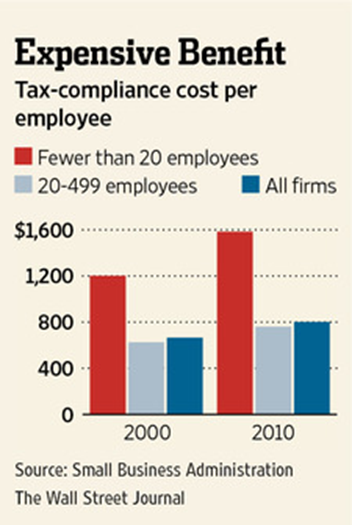
From John D McKinnon’s article in The Wall Street Journal at the above link comes this figure, showing the cost of meeting the requirements for getting Federal tax breaks generally, broken out by company size.

John Raine, CEO of Raine Inc., an Indiana manufacturer of belts and holsters for the military and other customers has an all too typical position about these “breaks.”

I usually avoid these targeted tax incentives, because it costs so much just to be compliant that it’s not worth messing with.  I can’t run a business based on what area the federal government is trying to juice.

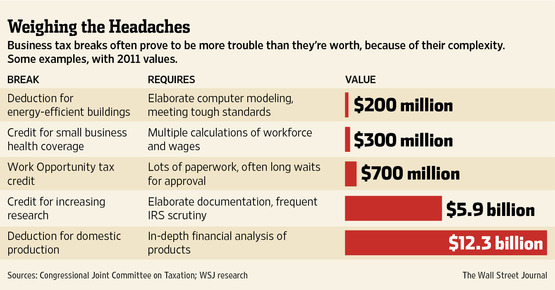
The Federal Work Opportunity credit is another example, and it, too, has a typical response.  The Work Opportunity credit was designed to reward companies for hiring people from any of a number of disadvantaged categories of workers—welfare and food stamp recipients, youths seeking summer jobs, ex-felons, and the like.  The credit is worth up to $2,400 per employee, and for businesses hiring unemployed veterans, it can be worth as much as $9,600 per.

The credit is too much trouble to collect, though.  It requires extensive paperwork for each claimed worker, and incredibly, the paperwork can take a year or more to process.  Assistant Professor of Economics at the University of Florida, Sarah Hamersma, has estimated that the credit is taken for only 20%-35% of all eligible workers.

McKinnon reports

JJ Pledger, Chief Financial Officer for the Twisted Root gourmet burger chain in the Dallas-Fort Worth area, said he spent the better part of a day last year trying to figure out how his company could obtain the credit.  Mr Pledger, a CPA, knew the credit likely would be available for a number of his company’s 200 or so annual hires.  But the more he read, “it seemed like the documentation of the tax credit could be really hard to administer,” he recalled.  One concern was all the personal information needed from job applicants. “So I put it on the back burner….

There are other examples in McKinnon’s article.

Compliance costs for US businesses and individuals have reached 1% of GDP, roughly $150 billion last year.  Out of 1.78 million US corporate tax returns, only about 20,000—just above 1%—claimed any of three dozen main business tax credits, the IRS estimates.  This figure illustrates another aspect of the costs of these “breaks.”

It’s just too hard a thing to do to collect these, never mind the value.

I’ll say it again: flat tax.  No deduction, no subsidy, no credit, no nothing.  Say what your top line income was.  Pay 10% of that.  Be done with it, and all on Governor Rick Perry’s postcard.