
Not the Best Move

According to Spiegel Online International, the European Central Bank intends to introduce a negative rate on cash deposits member banks make into their ECB accounts—a rate of -0.1%. This means that banks would be paying the ECB to deposit their money with the central bank: if a member deposited €100 million with the ECB, the latter would take a €100,000 fee.

The central bank’s motive is to stimulate more lending by those private and commercial banks, to get more money flowing in the EU’s economy. But with loan rates already at historic lows (the ECB itself is only charging 0.25% and intends to reduce that to 0.15%), it hardly seems likely that loan demand is the only impediment to lending—loan quality, borrower quality also are major factors.

Further, with loan rates so low—there’s no room, for instance, for a premium for poor credit risk—the cost to the lender of defaults goes up a lot: only those enormously low rates are there to absorb default losses.

This is a move that can only end badly for the ECB, and at best end indifferently for the banks and the EU’s overall economy. Banks look to make money, not just to let cash sit around twiddling its thumbs. If the ECB is going to charge a fee for making a deposit, look for the member banks to deposit their cash, instead, with each other.

Signs of this will include an increase in the markets for seven-day repurchase agreements, and variations on these. Repurchase agreements are mechanisms whereby banks will lend each other short-term (typically, seven days…) to cover momentary—and expected, even planned—cash flow shortfalls. Repos will make suitable substitutes for deposit accounts in the ECB.

Look, also, for increases in the markets for interest rate swaps—mechanisms whereby banks will trade future interest income streams with each other, typically with one exchanging a variable rate stream for the other’s fixed rate stream. These swaps generally are used to get (slightly) lower interest rates, or because the bank trading for the one stream finds that more useful to it than the stream it’s trading away. But these will make adequate “deposit” arrangements, also.

Look, among other places, for an increase in riskier “deposit” arrangements, too, with the member banks looking again to such instruments as credit default swaps and mortgage-backed securities. These devices aren’t much riskier, if they’re properly constructed and monitored, their negative press during the Panic of 2008 notwithstanding.

All of these, though, will make borrowing at least slightly more expensive, when (if?) borrowing picks up—hence the “at best indifferent” aspect of the ECB’s move from the private market’s perspective. On the other hand, deposits with the ECB are a major source of the funds the ECB loans out. To the extent CDS and MBS (and/or other financial instruments) do go bad, and to the extent the ECB (or its governmental masters) feels constrained to bailout, again, financial instrument market participants, it’ll be hard-pressed to do so. It won’t have the deposited funds to lend on.
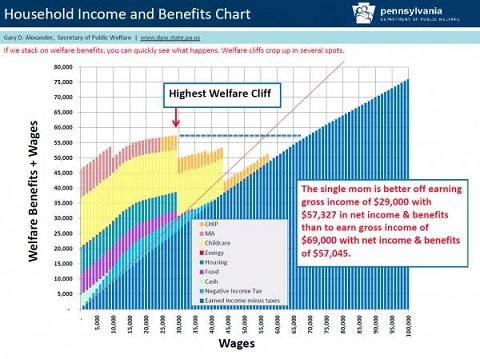
The Welfare Cliff from another Perspective

I, among a number of other folks, wrote about this a short while back.

Following is the money graph from that post, from the perspective of the present post:WelfareCliff

Here’s another perspective on the matter, the point of “present post,” from AEIdeas‘ James Pethokoukis, who cited John Merline’s article for the Richmond Fed.

Writing about the “decline in labor force participation as a result of reported illness or disability,” Merline had this [emphasis added]:

Another driving force, Autor and Duggan found, is the fact that the value of disability benefits relative to wages has risen “substantially” since the late 1970s, because of the way initial benefits are calculated. That’s particularly true at the lower end of the income spectrum. When the value of SSDI benefits and the value of the Medicare benefits that SSDI enrollees qualify for are combined, the share of income replaced by the disability program climbed from 68% in 1984 to 86% in 2002 among lower-income men aged 50-61.

That’s an enormous marginal tax rate that must be paid in order to get a better job.

Demon Oil

…and its evil carbon footprint. Here, courtesy of Mark Perry, writing for AEIdeas, are 10 examples of the destruction demon oil has wrought in North Dakota.

1. … [I]t took almost 58 years for the Bakken oil fields to produce the first 500 million barrels of oil from 1954 to July 2012; and then, thanks to the shale oil revolution, the Bakken oil fields produced the second 500 million barrels in less than two years—from July 2012 to March 2014!

2. In 2004, North Dakota ranked No. 9 for oil production by state, but then thanks to the shale oil boom in the Bakken, the state quickly rose to the No. 6 spot by 2008, the No. 4 spot in 2009, and then surpassed both California and Alaska in 2012 to become America’s second-largest oil producing state, behind only Texas.

3. … At one million barrels of oil every day, the North Dakota Bakken now produces more oil than entire countries like Colombia, Oman, and the UK.

4. In each of the last 69 months since January 2009, North Dakota has recorded the lowest state jobless rate in the country and led the country as the state with the highest rate of private sector job growth. …North Dakota’s jobless rate has been below the US jobless rate by an average of more than 5 percentage points over the last five years. Over the last 12 months through March, private payrolls in North Dakota have grown by…more than twice the national average of 2.25% in private sector job growth.

5. Over the last three years, the jobless rate in Williams County, North Dakota, in the heart of the Bakken oil fields, has averaged less than 1%, and has been as low as 0.7% in six different months.

6. According to the Conference Board, there were more than twice as many advertised online job openings in North Dakota in March (21,900) than there were unemployed workers seeking employment (10,610)…. At the national level…there are more than twice as many unemployed workers (10,486,000) as online advertised job vacancies (4,894,000).

7. The Census Bureau reported recently that three of the five fastest growing micro areas (cities with populations of 10,000 to 50,000) in the country between July 2012 and July 2013 were in North Dakota [including two of the top two].

8. The BEA reported recently that North Dakota led the country last year with the highest growth in state personal income at 7.6%, almost three times the national average of 2.6% growth….

9. North Dakota has boasted a state budget surplus in every year since 2008, when shale oil brought an unprecedented level of new jobs, wealth and prosperity to the state.

10. This might be the most impressive economic fact about North Dakota…: in 2006, North Dakota was America’s 11th poorest state by personal income per person. In just seven years, thanks the shale revolution, the Peace Garden State rose to become the nation’s 2nd most prosperous state in 2013, ranking behind only Connecticut last year for personal income per capita….

Read ’em and weep.

Taxing False Premise, Second Round

In a recent Wall Street Journal op-ed, Senator Ron Wyden (D, OR), Senate Finance Committee Chairman, labored under the same false premise as the international collaboration effort.

While decrying the loss of US companies as they move overseas to avoid the US’ highest in the world corporate tax rate, he insisted

America’s tax base erodes at a cost of hundreds of millions of dollars in revenue, increasing the burden on other companies and individuals. America also loses good jobs, talent, investment, and the ability to compete on a global stage.

Legal or not, this loophole must be plugged.

Once again: it isn’t possible for government to incur a “cost of hundreds of millions of dollars in revenue” when it isn’t government’s…revenue…in the first place. Certainly, government sees a reduction of “millions of dollars” from these moves, if we elide—as Wyden does—the dynamic effects of real tax reform.

However, the right answer isn’t Wyden’s, who demanded

Current law requires that US companies reincorporating overseas must ensure that at least 20% of their stock is owned by their new, foreign partner. As chairman of the Senate Finance Committee, I am committed to raising this floor to at least 50% for all inversions taking place from May 8, 2014, on.

This move is—how shall I put this delicately—brain-dead. Just as companies have found and are finding legal ways around existing tax law, and by the way, leaving profits earned overseas overseas due to our usurious corporate tax rates, they’ll find ways around Wyden’s 50% threshold, too. All Wyden will get out of this is feel-good and frustration, if he’s sincere in his effort, and open-ended political gain from his base if he’s not.

Wyden will not get anything material done regarding his concern for “increasing the burden on other companies and individuals.” Nor will he accomplish anything meaningful for his loss of “good jobs, talent, investment, and the ability to compete on a global stage.”

No, what’s needed is what is the first step in any recovery program: recognize and acknowledge that he has a problem. His notion that taxes are government’s money has to go, to be replaced by recognition that it’s our money, granted to government only for purposes that suit us, not that suit government.

The next step is to lower US corporate tax rates (eliminate corporate taxes altogether, say I, but a sharp reduction is a good early step), and then to make it easier (not harder) to partner with overseas companies (including in those companies’ taxing jurisdictions) and cheaper (free would be good) to repatriate profits earned overseas to the US.

Wyden thought he was addressing tax rates, too, in his op-ed.

A [lower] corporate tax rate that creates a favorable investment climate and reduces the incentive to game the system is critical to successful reform. … Where the rate ends up depends almost entirely on the American business community’s willingness to pitch in by closing loopholes.

There’s that false assumption that it’s the government’s money, again. This time it leads to the false conclusion that tax reform must, somehow, be revenue neutral. That may be useful politically, but it’s useless to true tax reform. There’s no need to “close loopholes” in return for lower tax rates. Loopholes need to be closed, certainly, but in order to reduce government social engineering through our tax code, not in order to preserve revenue that isn’t government’s to begin with. Of course, eliminating corporate taxes altogether would close all those loopholes….

Wyden wants global competition? Let other nations compete with us, beginning with lowering their business tax rates in their resulting newfound need to keep their companies from relocating to the US. With foreign talent coming here, while ours stays here. For good jobs in the US, for investment in the US.

Oh, and the lower tax rates also will decrease “the burden on other companies and individuals.”

There’s competition. It can come only from correcting that premise, though.

Taxing False Premise

The US is about to join an international tax collaboration scheme involving the People’s Republic of China, Australia, Japan, and Great Britain that’s designed to improve tax collections from multinational corporations. It’s also designed to increase government reach into private enterprises and government control over them.

Leave those last two design purposes aside, though.

Australia’s Commissioner of Taxation, Chris Jordan, said this about the scheme:

This collaboration has allowed us to better understand what is happening in our own countries and determine whether what is being represented in one country reflects what is being represented in another.

Fair enough. Nations of laws, as most of these participating nations are, should be able to enforce their tax laws, also, and the taxees ought not be telling conflicting stories to differing jurisdictions.

The Wall Street Journal at the above link cited “some estimates” as claiming that “the world’s governments lose US$3 trillion in tax revenue a year” to multinationals’ moves to adjust their own revenue collections to the most favorable tax jurisdictions.

And therein lies the false premise. In free countries—the US, Great Britain, Australia, and Japan in the present context—it’s not the government’s money; it’s the tax payers’ money, and they only allocate some of their money to their respective governments as tax payments. The governments aren’t losing a dime to legal tax payment minimization or avoidance schemes. It isn’t possible for them to lose what isn’t theirs in the first place.