
Market Disruption

…is what happens in a free market, and one result is wealth redistribution, not by inefficient, politically motivated government mandate, but morally and efficiently by voluntary exchange among market participants—folks like you and me. One example of this is the price of taxi medallions.

…leading cabbies and fleet owners throughout the USA worried that their industry will be decimated if local and state government doesn’t intervene.

In Chicago, which has the country’s second biggest fleet with roughly 7,000 taxis, the median sale price for a medallion hovered around $70,000 in 2007 before reaching a median sales peak of $357,000 in late 2013.

Since reaching that high point more than a year ago, the value of medallions in the Windy City have sharply declined and sales have ground to a near halt—with the city recording only seven medallion transfers in the first quarter of 2015….

(Aside: can you see the bubble in that?)

Now cabbies and fleet owners are worried about the prices of their medallions and want government to “intervene.”

Cabbies around the country complain that drivers for services like Uber, which use a smartphone app to connect riders with freelancers using their own vehicles, are disrupting the market and playing with an unfair advantage.

Not so much of an unfair advantage. Nothing is stopping the “official” cabbies from using the same sort of smartphone application to achieve the same thing: on demand, low cost rides for the customer. It’s certainly true that the price of a medallion is tanking (but really: 70 large for a license to drive a car for hire? What supports that sort of pricing other than a government protected monopoly?)

Let’s look at the wealth redistribution of a medallion-for-sale monopoly and an Uber or a Lyft, in which anyone can play for as long or as briefly as they wish.

With the medallions—especially with their cost—cab fleets charge high prices per fraction of a mile on the trip, with government-mandated price floors (in addition to the monopoly aspect, a need presumably driven by the necessity of recovering the cost of the license to operate represented by that medallion). Wealth is transferred from the customer to the cab fleet owner, and the customer gets a ride to his destination. When the cabbie can, or is willing to, get to the customer’s location.

With an Uber-like operation, a customer can make his wish known via his smartphone, and a ride-share participant arrives promptly (because there are a lot more of these than there are formally licensed cabbies), and the customer gets his ride, at a rate commensurate with the area and the demand for rides in the area, but at a significantly lower price than the medallioned cabbie. The wealth redistribution is at that lower rate—competition, you know—and the money transferred goes directly to the driver (minus some Uber overhead, which isn’t much compared to that medallion, just for starters).

The fact of that lower price, and the ubiquitousness of what are essentially part-time and wholly voluntary drivers (who are driving as an additional thing, not as their day job) demonstrates that the fleet cab pricing is excessive relative to the industry needs: the alternative to the formal fleets simply have a much lower cost structure.

That’s a thing to be celebrated, however disruptive it may be to the establishment. Medallion cabbies and buggy whips….

Lots of folks are getting a service they want at a lower price than heretofore, and lots of folks are getting some extra money—lots more folks than the special few who drive medallion-permitted cabs.
Those Are Some Bills, Bill

“I gotta pay our bills,” says Bill Clinton about his $500k per speech fees. That’s nice work, and I don’t begrudge him a penny of it or the easiness of his earning it.

But is it really just to pay some bills?

Hillary Clinton and former President Bill Clinton earned more than $25 million combined in speaking fees since January 2014, Fox News confirmed Friday.

Hillary, by the way, gets upwards of 200 large for her gigs.

Those are some bills.

Interest Rates and Economic Recovery

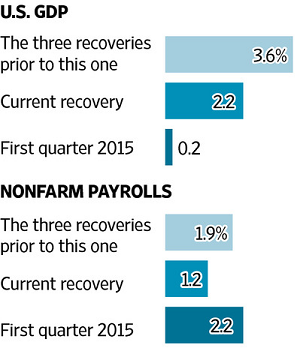
The Fed has been actively suppressing interest rates, keeping them near zero, for a long time. This is in addition to the Obama administration’s economic policies, and the two attitudes have combined to produce an economic recovery from the Panic of 2008 that is one in name only. See this graph, adapted from one in a recent Wall Street Journal to see just how bad the current “recovery” is. The numbers other than the two first quarter 2015 are average annualized rates of increase.EconomicRecovery_Cropped-Resized

Certainly, the Obama policies need to be corrected, but here’s something the Fed can do all by itself: it could let interest rates float, and see them rise to market rates, probably with a temporary overshoot, given the duration of its suppression and separate money printing, but that’s only going to get worse as the Fed delays correcting its own error.

With interest at their more normal level, banks would be more willing to lend, and without lowering their credit standards; businesses would be more willing to borrow, since even though they’d be paying more for their debt, they’d recognize the positive economic indicator; and folks dependent on fixed income sources for their living—widows and orphans—would have more money to spend, even if only on necessities, which would help make that positive economic indicator more concrete.

Special Snowflakes

…gotta be part of the blizzard. That’s the opening lament of a collection of graduate pupils in the University of California’s Master of Arts program in Art and Design. These Magnificent Seven, an entire class of the program and who have completed a year of it, wrote a letter explaining their decision to withdraw en masse from the program and posted it on the Art&Education Web site.

Some high points of their letter follow.

We are a group of seven artists who have been forced by the school’s dismantling of each of these elements to dissolve our MFA candidacies.

No, Dears. No one, including USC, stuck a gun in your ears. You made this decision all by yourselves.

We were fully aware of the scarcity of, and the paucity of compensation for, most teaching jobs…. However, a different funding model was presented to us by the Roski administration upon our acceptance to the program: we would receive a scholarship for some of our first-year tuition; and for the entirety of our second year we would have a teaching assistantship with fully-funded tuition, a stipend, and benefits, upon completion of our first-year coursework. We, the incoming class of 2014, were the first students since 2011 to take on debt to attend Roski, and the first students since 2006 to gain no teaching experience during our first-year in the program.

So, before you signed accepting Art and Design’s appointments of you to their program, you knew the funding parameters which would apply to you, and you knew the nature of the changes made from the status quo ante. And you knew a priori the limited employment opportunities following graduation. Now you’re complaining because after a three year (three whole years) interregnum, reality intruded into the program and the monies available to support it, and you can’t get a free ride for both years—you only get benefits and a “fully-funded tuition, a stipend” for the second year, assuming your scholarship was enough up to snuff for the school to continue you.

Oh! The impermanence of Life! How will you get on in the real world, where change is reality, plans don’t match the world forever, or even for very long?

In a slew of unproductive, confounding, and contradictory meetings with the dean and other assorted members of the Roski administration in early 2015, we were told that we would now have to apply for, and compete with a larger pool of students for, the same TAships promised to us during recruitment.

Having to mingle with the unwashed, actually to compete with those not as good as you for scarce resources? The ignominy of it. Whatever to do? Oh, wait—you’ve decided that. Quit, and run away.

We will continue to hold crits ourselves and be involved in each other’s work. We will be staging a series of readings, talks, shows, and events at multiple sites throughout the next year, and will follow with seven weeks of “thesis” shows beginning in April of 2016. Our collective and interdependent force….

That’s what initiative is all about. That’s what you should have been doing right along during your year in the program. You shouldn’t need—as you’re belatedly discovering—to wait on someone else to tell you what you should do; faculty in a graduate program guides and critiques, they don’t tell or spoon-feed like a first grade teacher must.

RTWT. It’s sad and a tired, played out complaint.

Help, or Watch?

Unfortunately, we already know which President Barack Obama will select, as he’s made clear in another venue.

The cause for concern this time is the economic strait in which Ukraine finds itself.

The contraction in Ukraine’s economy accelerated to 17.6% in the first quarter compared with a year earlier, the State Statistics Service said Friday, hammered by a conflict with Russia-backed separatists in its eastern industrial heartland that has slashed industrial output.

Obama—and Europe, to be fair—have already refused to supply Ukraine with the wherewithal to defend itself militarily against Russia’s invasion and support of the rebels in eastern Ukraine and Crimea. Indeed, his Secretary of State already has surrendered both areas to Russian occupation with his offer to lift economic sanctions against Russia if only they will agree to go no further.

If we—or the Europeans, but they seem even more timid than our own administration—don’t start providing serious economic aid to the Ukrainians, Russia won’t need further military advances in order to gain control over all of Ukraine. Ukraine’s economic collapse will hand what’s left of the nation to the Russians without any further ado.

Instead, we should be arming the Ukrainians and ratcheting up the sanctions on Russia, driving the Russians into economic collapse. It’s anybody’s guess, though, whether Ukraine can hold out for another year and a half at which point we might have a more responsible and capable White House.