
Selling Weapons to the Republic of China

Especially in the face of an aggressively acquisitive People’s Republic of China that’s busily trying to cow the Republic of China, The Wall Street Journal favors our selling the RoC updated F-16s.

Such a sale would be a good start, but it’s only that.

There’s no need to wait on international consensus regarding an F-35B sale to the Republic of China (a concern of the WSJ); we should consider moving unilaterally. Or selling an F-35C that isn’t part of any consortium. The People’s Republic of China already has the F-35 secrets, anyway, courtesy of the Obama administration’s decision to eschew IT security. ‘Course, I think the F-35 is a wasteful pig, and uprated F-15s, F-16s, and A-10s would be better buys.

Aside from that, though, we should be selling the RoC high and intermediate altitude missile defense systems and encouraging Israel to sell the RoC its Iron Dome and Arrow defense systems.

And we should resume active and frequent patrols of the Tawain Strait.

It’s time to stop treating the PRC with kid gloves.  It’s time, also, to stop ignoring the RoC’s needs as a sovereign nation.
“Conflicted”

In a Sunday Wall Street Journal op-ed, Peter Funt opined about the White House Correspondents’ Association dinner’s post-dinner speech that was delivered by Michelle Wolf.

Many pundits were as conflicted about Ms Wolf’s act as they are about how to cover the Trump administration….

Only the pseudo-journalists of the NLMSM would be conflicted about reporting truthfully, whether about a revered administration or a despised one.

Another Mueller Leak

The New York Times has published the questions Mueller wants to ask President Donald Trump regarding Mueller’s “investigation” of Trump, the Trump campaign, Trump businesses, and whatever else blows Mueller’s skirt up.  Never mind that this sort of thing is supposed to be secret, or at least known only to the target and his lawyer until they’re asked, answered, and become part of the public record of an actual trial.

How did the NYT get the questions?  They didn’t send a reporter to steal them.  No, the newspaper was given them.  There’s also no reason to believe the Trump team knew these questions and so would have been in a position to leak them.  Negotiations over the nature of a Mueller interrogation of Trump are supposedly in progress, but Mueller wouldn’t give up the questions until the negotiations have been completed and the interrogation set up.

Only Mueller’s team knew these questions.  In a separate article about the questions, the NYT does assert this:

investigators for Mr Mueller agreed days later to share during a meeting with Mr Dowd [then Trump’s lawyer] the questions they wanted to ask Mr Trump.

But there’s no reason to believe that, since the NYT chose not to identify its source for that claim, making it impossible to believe that the claim is more than just an idle rumor.

And what’s Mueller doing about this leak?  A lot of nothing.  Because if Mueller isn’t the one who leaked, he actively approved others to do it.

The NYT had this about the questions in that separate article:

The questions provide the most detailed look yet inside Mr Mueller’s investigation, which has been shrouded in secrecy since he was appointed nearly a year ago.

Umm, no, no secrecy.  Mueller has been making studied leaks right along.

But Mueller is an honorable man. So are all his team, all honorable men.

Teachers Unions

…and their strikes’ impacts.  Look at the Arizona teachers union strikes, for instance.

Arizona parents scrambled to find alternative arrangements for their children as the state braced for a third day of teacher walkouts.

It’s estimated that at least 800,000 Arizona students have been affected by the strike that started Thursday, with some school districts in the state closed until further notice.

It isn’t only the children that these strikers are holding hostage for their demands.  It’s the parents, too, who must take time off from work to take care of their children with those kids denied access to schools and education.

The teachers unions complain about low pay.  They’re ignoring, though, the even lower pay of many of those parents who are being harmed by these teachers union strikes.  Jennifer Goehring, a nurse, a former teacher, and a union supporter but not of the strikes:

It’s holding the parents hostage because they are having to scramble to find people to watch their kids.  It’s placing an undue hardship on families just trying to stay afloat. I don’t like the kids being used as pawns.

Goehring, by the way, alternates with her husband to watch their children and several others whose families couldn’t take off work during the walkout.  Others, plainly, are trying to fill in to ameliorate, at least a little, the damage the teachers unions are causing.

And this:

Churches, community centers, youth clubs, food banks, and community organizations are offering free and discounted services to help take care of students.

Who’s paying for all of this support for those parents and their children?  It isn’t the teachers unions, who are causing the expenses.  Bet on it: they won’t reimburse these facilities after the fact, either.

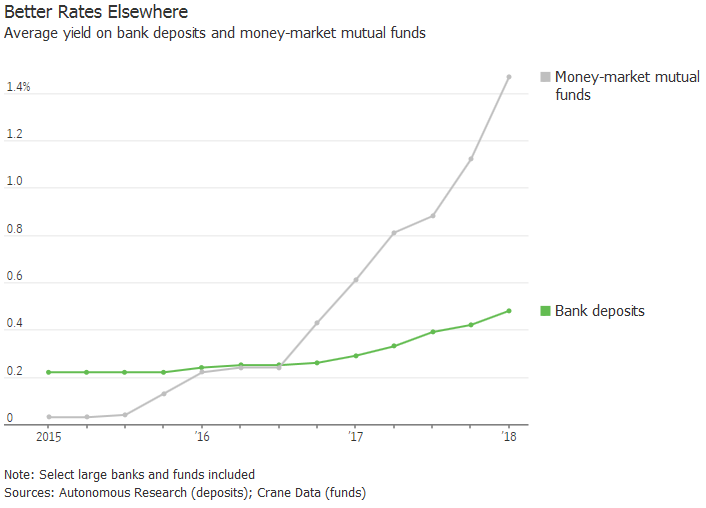
A Graph

The Wall Street Journal had a piece on shifting bank deposits, and in that article was an interesting graph.  The article itself is worth the read, but the graph has, I think, wider import.

The graph illustrates the differing rates between what banks pay on depositors’ accounts compared to what money market funds pay, but look at the rates as indicated on vertical axis.  Plainly, these aren’t the heady days of the early ’90s when money market funds like Dreyfus’ Worldwide Dollar Fund was paying in the region of 6%-8%.  This graph, instead, illustrates the effect of the Fed’s continued suppression of market interest rates, even if they are—slowly—allowing their benchmarks to come up a bit.

Who cares about these rates, besides businesses? Folks on fixed income, folks illustrated by the stereotypical widows and orphans, who have no other sources of income.  More normal market interest rates are in the region of 3%-4%.

The Fed needs to finish getting out of the way.  But they’re not the only ones.  Dodd-Frank suppresses banking competition.  Too big to fail pits large banks against regionals and locals, but Dodd-Frank, by guaranteeing the big banks against failure, has eliminated competition among the big banks.  Congress needs to get rid of Dodd-Frank so all banks will compete against all banks.  And offer higher rates on savings and checking deposits.