A Misunderstanding about (Government) Stimulus

Dr Alan Blinder, in a recent op-ed in The Wall Street Journal, notes that

A debate now rages in Europe over whether fiscal austerity—that is, higher taxes and less spending—helps or hinders growth.  That’s progress of sorts.

He’s right as far as he goes, but then he goes on.

[A] similar debate rages here in the US—with the lone exception that our pro-austerity crowd abhors tax increases.

Here are the beginnings of Binder’s misunderstanding.  I don’t know of a pro-austerity crowd anywhere in the US, at least among Republicans and Tea Partiers.  These folks are plainly pro-growth, and that clearly demands less government spending—and lower taxes.  Contrary to Progressives’ beliefs, it isn’t the government’s money, and the government doesn’t need as much of it as it tries to claim from us in taxes.

…help state and local governments maintain their spending, which has now dropped 6.4% since its 2008 peak[.]

It doesn’t get any clearer than this.  Nor the Feds, nor the states, nor local governments need to “maintain their spending.”  All levels of government need to reduce spending and quit competing with the private sector for goods and services, quit buying for the private sector the goods and services it can—and should—buy for itself.  It’s through private sector economic activity that comes growth, and jobs, which fuel growth.  All government spending can do is substitute for private sector spending—at the expense of taking money out of the private sector to pay for that spending, either in taxes today or taxes tomorrow.

Many Democrats also want to build and repair more roads, bridges, tunnels and the like….  Most Republicans reject that idea, too….

This is just a cynical distortion of the Republicans’ position, and it’s disappointing to see in someone who’s supposed to be a reasonably objective academic.  The need to work on our physical infrastructure is  bipartisanly recognized.  What the Progressives’ programs do, though, and what the Republicans object to, is simply transfer funds to Progressive-favored state and local governments and to union allies.  Honest funding support, that will help—help, mind you, not cover entirely—with actual work, and which funding is itself covered by spending cuts elsewhere, will find Republican support.  Look, for instance, to the 20+ jobs bills the Republican House has passed and that are languishing in the Senate because Blinder’s Democrats won’t even permit them to be debated, much less come to a vote.

He does have some specific ideas:

  •  Budget policy. For openers, as I advocated in these pages last month, we need a two-pronged fiscal package.  In the near term, we need modest stimulus, focused tightly on creating jobs.  But that stimulus should be paired with a vastly larger dose of long-run deficit reduction—perhaps 10 to 20 times as large as the stimulus—over the 10-year budget window.

Economically, this can be done; it’s not even that hard. But if Republicans continue to reject even deals comprised of $10 of spending cuts for each $1 of tax increases, it’s hard to see how we get there politically.

I debunked this here.

  •  Private investment. Republicans are right that business investment is the key to growth. Fortunately, business investment has done very nicely, thank you, despite the sluggish economy—growing 8.4% over the past year and at an annual rate of 10.8% over the past two years.  (The corresponding growth rates for GDP were about 2%.)  So while there’s always room for improvement, business investment is not part of the problem.  The best thing policy can do for private investment is to get the overall economy growing faster.

Indeed.  And the best policy for achieving that is reduced government spending competition with the private sector, lower taxes, and reduced regulatory burden—which has exploded under the present administration.  The EPA’s rules are especially onerous, irrelevant to the economy, and job-destroying.  HHS’ regulations also attack private sector job growth, as well as such minor things as constitutionally protected religious freedom.

  •  Public investment. Unlike private investment, inadequate public investment is part of the problem.  America’s infrastructure needs are so huge, and so painfully obvious, that it’s mind-boggling we’re not investing more.  The U.S. government can now borrow for five years at about 0.75% and for 10 years at about 1.7%.  Both rates are far below expected inflation, making real interest rates sharply negative.  Yet legions of skilled construction workers remain unemployed while we drive our cars over pothole-laden roads and creaky bridges.  Does this make sense?

Public “investment” is, indeed, part of the problem.  “There’s a sale on! Let’s go buy!  Think how much we can save at these prices!”  Think how much more we can save, if we don’t buy at all.  The existence of a sale, whether it’s in a lower price for a good or a lower price for borrowing, is no excuse at all for spending—or borrowing.  Spending and borrowing must have a legitimate purpose, not merely be “cheap.”  All those nickels borrowed today add up to lots of dollars owed—and so taxed for—tomorrow.

Moreover, this administration poured nearly $1 trillion into stimulus—including no small part of infrastructure maintenance buildout and maintenance—in 2009, and it’s been pouring out more since, in the form of loan guarantees, among other routes, for “green” energy infrastructure, among other things.  What have we gotten for all that “investment?” Transfers to unions, transfers to states for their own payoffs, bankrupt “green” energy companies, but no actual infrastructure maintenance buildout or maintenance.  Does this make sense?

  •  Education. Everyone knows that the returns to education, while large, are long delayed.  That means we have no time to waste.  We should be doing a much better job of building a better educated, more productive work force for the future.  A Council on Foreign Relations task force co-chaired by former Secretary of State Condoleezza Rice and former New York City Schools Chancellor Joel Klein recently argued that better K-12 education is critical to American leadership in the world and therefore to our national security.

Indeed, again.  Government needs to stop driving up the cost of education by subsidizing it.  We as a society need to stop stigmatizing those who lack a college degree.  College is not for everyone.  Nor do those in the trades need a college degree; they need a decent VoTech source of education and training—the sort of thing we used to get in our high schools all those years ago, and that could be improved upon by our community colleges—many of which do fill this bill.

Why in the world are we still arguing about this?

Because the Democrats and their Do-Nothing Senate, and the President, are in the way.  If it’s Republican, it’s to be ignored.  It’s all Bush’s fault.  It’s racist.  Pick a Progressive excuse.

Which candidate does that remind you of?

In terms of not understanding the distinction between economic growth and government growth?  That’s pretty clear.
Collapse of the Euro?

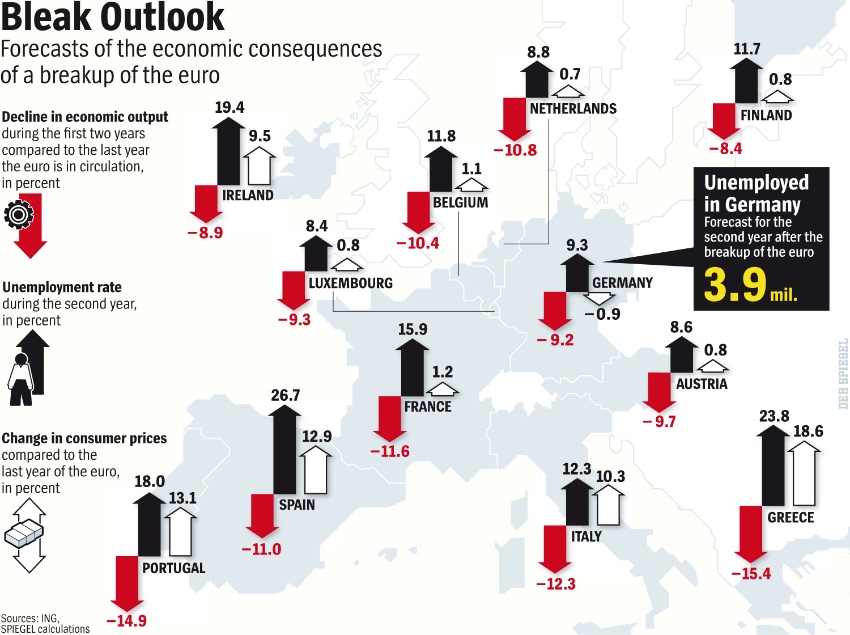
Much is being made of the impending collapse of the euro, and of the disaster this would represent for Europe.  Indeed, a graph published by Spiegel Online can look frightening:

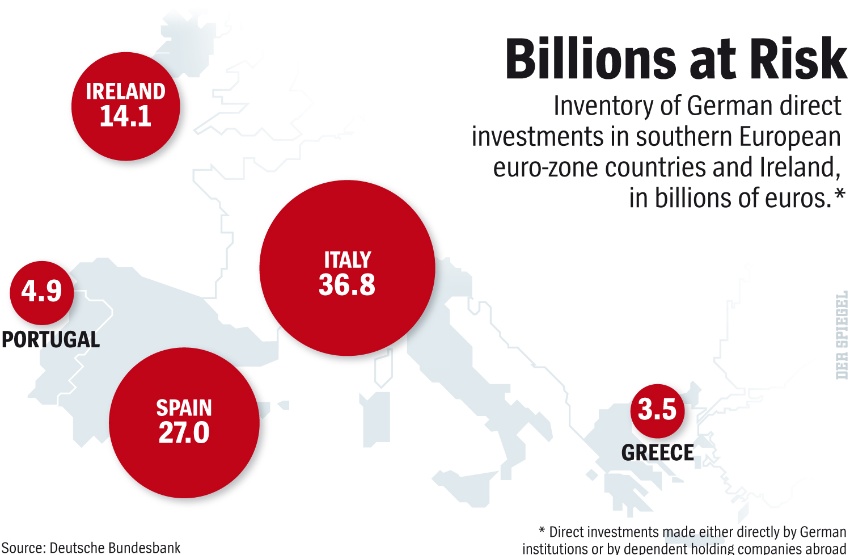
The risk to Germany in particular?  Much is made about the money Germany and Germans have in some of the PIIGS, as the graph below indicates.

But against the German 2011 GDP of €2.57 trillion, this totals to less than 4%.  That will sting, but not much.

As I’ve written before, a breakup would be near-term disruptive.  But what happens after those two years of the first graph above?  There needn’t be a disorderly collapse.  Even this short term disruption (pop quiz: what are the current inflation and unemployment rates in the PIIGS?), the stronger economies will recover, and do so faster without the albatross of the profligate spend-and-borrowers dragging on their wallets.  Furthermore, it’s not too late to realign into a small collection of smaller common currency regions, each with free trade agreements with the others.  Within each smaller currency region, there would be a far larger opportunity for social, political, purpose-of-money homogeneity, and so a far greater chance of success.

The single alternative of every nation for itself with its old currency back is simply the other half of a false dichotomy presented by Spiegel Online—and by Europe’s politicians, who have a personal interest in the continuation of the current, failing, structure.

Hope and Change

The last 3½ years have seen a lot of this slogan.  While the hope—for the better—waned long ago, President Obama has, in fact, achieved quite a lot in the way of change.  Here are some of those changes:

He got Obamacare rammed through, albeit in the dark of night in a wholly, cynically, partisan manner, and he did it without a single Progressive (or Republican, come to that) congressman actually reading the bill prior to voting on it—some proud in their ignorance.  This bill achieves quite a lot: it lets children extend their childhoods and parental dependencies to their 26th year, by staying on mumsy’s and popsy’s health insurance policies.  It adds to the Federal deficit with its trillion-dollar costs.  It lets you, taxpayers, pay for coverage for an additional 20+ million health insurees.  It nationalizes the health care and health insurance industries.

He got Dodd-Frank rammed through in the same manner and with the same level of Congressional ignorance.  And pride of ignorance.  This bill also achieves quite a lot.  It creates a fourth branch of government in the Consumer Financial Protection Bureau and the Financial Stability Oversight Council.  These two agencies are wholly unaccountable to the Congress—and so to us—are not under control of the President, and at least the CFPB’s budget comes, on demand, from the Federal Reserve System.  Yet these two will, single-handedly and without oversight, determine whether financial institutions will be allowed to do business (vis., extend loans or credit of any sort—even at your corner mom and pop grocery store) and the conditions under which they will be allowed to do so.

He’s achieved a trillion-dollar cut in our defense capacity at a time of rising PRC aggressiveness, a soon-to-be-nuclear-armed Iran, and an expansive, grasping Russia.  This includes a shrinking Navy, a gutted Army, and an Air Force with little capacity for anything other than looking pretty in fly-bys.

In an apparent nod to an earlier Secretary of State, Henry Stimson, he’s leaking every cyber-warfare and counter-terrorism secret we used to have to the news outlets.  Apparently, if we have no secrets, other gentlemen have no need to resist the temptation to read ours.  Or he subscribes to the theory that if we tell our enemies everything we have, we don’t need to spend our resources trying to figure out what they know about us (another savings!).  Or both.

He’s instructed his DoD to desist using unpleasant interrogation techniques.  And, since he believes our enemies have no knowledge of anything that’s of intelligence value at all, he’s instituted a program of killing them rather than capturing them and having to figure out how to hold them and question them.  And he brags about personally selecting, by name, the ones that are to be assassinated—a Roman circus thumbs down from the Emperor.

No, Obama has wrought enormous change.  Just all of it has been destructive of our great nation.

We need to fix this.

An Old Dead Guy’s View of National Debt

On this, the 80th day shy of the 215th year since George Washington’s Farewell Address, an anniversary made notable by our present astronomical and exploding national debt, I thought I’d post what that old dead guy had to say about national borrowing and national debt.

The short version is, “Don’t do it, and don’t have it.”  Following are his specific words.

As a very important source of strength and security, cherish public credit.  One method of preserving it is to use it as sparingly as possible: avoiding occasions of expence by cultivating peace, but remembering also that timely disbursements to prepare for danger frequently prevent much greater disbursements to repel it; avoiding likewise the accumulation of debt, not only by shunning occasions of expence, but by vigorous exertions in time of Peace to discharge the Debts which unavoidable wars may have occasioned, not ungenerously throwing upon posterity the burthen which we ourselves ought to bear.  The execution of these maxims belongs to your Representatives, but it is necessary that public opinion should cooperate.  To facilitate to them the performance of their duty, it is essential that you should practically bear in mind, that towards the payment of debts there must be Revenue; that to have Revenue there must be taxes; that no taxes can be devised which are not more or less inconvenient and unpleasant; that the intrinsic embarrassment inseperable from the selection of the proper objects (which is always a choice of difficulties) ought to be a decisive motive for a candid construction of the Conduct of the Government in making it, and for a spirit of acquiescence in the measures for obtaining Revenue which the public exigencies may at any time dictate.

Notice that bit about taxation, too.  Taxes are for paying down the national debt and for the common defence, not for frivolous spending.  But again, the overriding imperative this Founder laid out is that our nation’s debts should be kept small by keeping spending small, and those debts should be paid by the generation that incurred them—not visited on our children’s children.

We citizens bear an additional responsibility in this, too: not to make frivolous demands on government to do for us that which we should—and can—do for ourselves.

Á propos is this remark by David Ricardo in response to Great Britain’s decision to print fiat money in an effort to increase funding for their war against Napoleon (one of those “unavoidable wars” to which Washington would have been referring, and not too far removed in time from Washington’s address):

Why should the mere increase of money have any other effect than to lower its value?  How would it cause any increase in the production of commodities? ….

Money cannot call forth goods, —but goods can call forth money…[.]

Student Subsidies and the Federal Government

I’ve written before about the failure of subsidies, their feel-good and superficial benefits notwithstanding.  The student subsidy that is a Pell Grant is a case in point.

Jenna Robinson and Duke Cheston, of the Pope Center for Higher Education, reported a bit ago on the growing excesses of the Pell Grant program (the full report can be read here or here).  The program consumed some $36 billion in the 2009-2010 academic year, half the Department of Education’s budget.  This also is—surprise—the Federal government’s largest education expenseinvestment.

Here’s what’s been done over the last several years, of which those $36 billion are only the latest, with/to a program that began life 30 years ago as a well-intensioned program to help the poor go to college.

  • In the 2009-2010 academic year, 60% of all college students received a grant—9.6 million students.  Between 2008 and 2010, the number of Pell recipients increased by almost 50%, roughly doubling taxpayer cost (this is a government charity, not a private one).
  • The maximum grant was raised to $5,550 beginning 2011 from 2008’s $4,731 per year.  This further encourages creative accounting: a 2009 study by Christina Chang Wei and Laura Horn (“A Profile of Successful Pell Grant Recipients: Time to Bachelor’s Degree and Early Graduate School Enrollment”) found that 60% of Pell Grant recipients were “financially independent” of their parents, compared with 34% of non-recipients.  Being “financially independent” means the parents’ finances have no bearing on student need or eligibility.
  • Better-off students often take their large Pell Grants and go to more expensive schools.  In that 2009-2010 academic year, 20% of Pell grantees from families making over $60,000 (so much for “financially independent”) went to schools that cost $30,000 or more per year with the aid of those Pell Grants.  Students from lower income families, without that wealthier base underlying their own grants, attended those higher-cost schools at a significantly lower rate—13%.  (By itself, this should be no big deal; people should go where they can afford to go with their money.  But this isn’t their money, it’s our taxpayer money—and our charity should help folks get by, and get a leg up, not help them live large.)

What did we gain from this…government largesse?  The usual subsidy distortions, but no improvement in academic performance or ultimate success.

  • An apparent increase in college enrollment by poor students—from 46% in 1970 to 59% in 2009, but
  • Poor actual performance, at least comparatively: graduation rates were lower for students who received Pell Grants than for those who didn’t.

And, as the WSJ points out, in the manner of all subsidies

  • Pell Grants contribute to the ever-rising tuition spiral: colleges and universities learned long ago how to capture that extra cash, and they adjust their price schedules accordingly.

Hmm….