
Punishing a Legislator

Recall that, in response to scurrilous remarks made in opposition to a Montana legislature bill barring child mutilation gender-related “care” for children, Progressive-Democratic Party State Congresswoman Zooey Zephyr was censured and barred from the House floor for the remainder of the current legislative session.

Now she, along with four constituents, are suing the State and a variety of State officials over the matter. The ACLU, representing Zephyr in the suit, actually makes the claim that her censure and bar from the floor is unconstitutional.

Here’s what Montana’s State Constitution has to say on the matter [initial boldface in the original, emphasis at the end added]:

Section 10. Organization and procedure. (1) Each house shall judge the election and qualifications of its members. It may by law vest in the courts the power to try and determine contested elections. Each house shall choose its officers from among its members, keep a journal, and make rules for its proceedings. Each house may expel or punish a member for good cause shown with the concurrence of two-thirds of all its members.

The courts have no jurisdiction in this matter. The ACLU’s argument is silly, and even those lawyers should know better. Or, perhaps the ACLU prefers that Zephyr be expelled altogether, as Montana’s Constitution explicitly permits.
Time to Stop

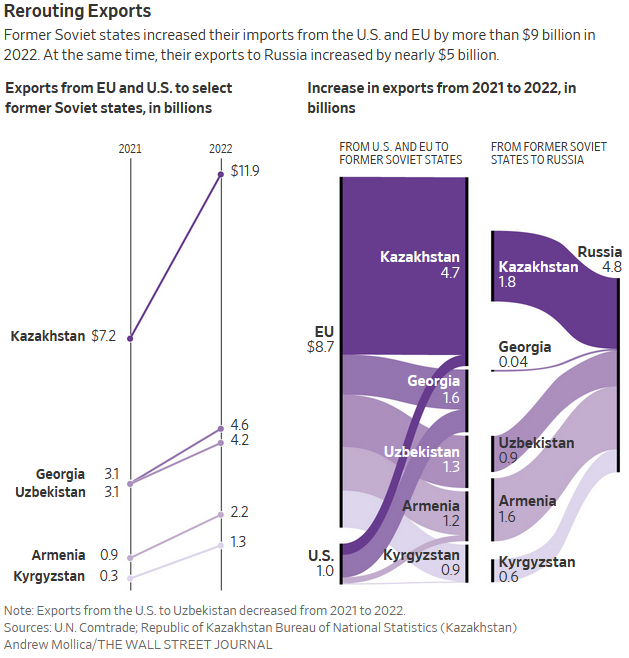
Despite sanctions, Russia is succeeding in importing technical products like computer chips, lasers, and the like, products which are usable in the barbarian’s weapons systems as well as his more general economy. Russia is doing so with the active complicity of a few ex-Soviet republics that remain in the sway of the barbarian.

In total, US and EU goods exports to Armenia, Georgia, Kyrgyzstan, Uzbekistan, and Kazakhstan rose to $24.3 billion last year from $14.6 billion in 2021. These countries collectively increased their exports to Russia by nearly 50% last year to around $15 billion.

They brag about it, too.

Imex-Expert offers to “import sanctioned goods from Europe, America to Russia through Kazakhstan.” Its website boasts: “Bypassing sanctions 100%.”

This graph illustrates the extent of the problem.

It’s time to stop exporting any tech products—all of which are dual-usable—to these nations (Georgia’s complicity is especially disappointing). Not cut sales off company by company; that’s just nickel and dime quibbling. Cut off tech sales to these nations altogether.

Spot On

Ada Lluch is a Spanish lady who frequently posts on Instagram and Twitter. She has this to lead off a recent Instagram profile leads off with this:

It is extremely necessary to bring back traditional values to our society, especially to Gen Z.

She’s talking about Spanish society, but her statement is universal.

She posted this on Twitter [emphasis added]:

Why are people in America called by their race like African-American, Asian-American and Hispanic-American instead of just American?
In my home of Spain we have many different colors of people but everyone is considered Spanish if they were born here.
I could be wrong but I do not think any other countries break their people down by what race they are like America does.
This is why your country has a race problem, because your government perpetuates it with labels.

But this labeling is part and parcel with the Left’s, and their Progressive-Democratic Party’s, deliberately divisive, and openly racist and sexist, identity politics.

“Be more like Europe” goes the mantra of the Left.

Certainly, we would do well to be more like Spain in this milieu.

A Parallel Solution

DoEd Secretary Miguel Cardona (D) wants to enact a rule that would expand Title IX (illegally, but that’s a separate problem) to require State education systems to include transgender athletes in all heretofore women’s sports programs and all on heretofore women’s sports teams. Half of the governors of our States object.

If it comes down to it, Cardona’s move is very likely to fail in the courts. That will be an expensive and time consuming enterprise.

I propose another solution to be pushed in parallel with the lawsuit effort. It also would be expensive and time consuming to put into effect, but I think it would have a more permanent, and more beneficial, outcome.

States should stop taking Federal dollars altogether into their education systems. That would put the States beyond the reach of Title IX, which applies only to those State systems that take Federal dollars.

Not taking the government’s lucre would be expensive, certainly, but only until the States’ budgets adjusted. However, the move would do more than place those States’ education systems beyond the reach of Title IX’s strings, it would free the States from a potful of Federal education strings—and demonstrate that States can get along just fine without those dollars and those strings and so encourage them to decline ever more Federal dollars and reap the increasing value of being free of those strings.

Failure Proofing

The FDIC, in the wake of its own failure regarding the Silicon Valley Bank and Signature Bank collapses (primarily caused by those banks’ managers’ failures, but the FDIC had its role, too, along with the Federal Reserve’s regulators), now wants to excuse failure by making those who failed whole again—and do it at the expense of the rest of us.

Those who failed, in this context, are those with uninsured deposits—deposits larger than the presently insured $250,000—at banks. The FDIC actually is proposing an assessment on larger, successful banks which would be used to…repay…those uninsured depositors who would otherwise be left holding the bag in a bank failure. Even an FDIC bureaucrat knows that such an assessment wouldn’t be paid by any of those larger, successful banks, but by those banks’ customers in the form of higher fees, higher loan interest rates, and lower deposit interest rates.

Ostensibly, the assessment is backward-looking and is only a one time good deal for those bag holders of SVB and SB.

The proposed special assessment would recoup the $15.8 billion paid out from the FDIC’s Deposit Insurance Fund to protect depositors in SVB and Signature who had deposits in excess of the $250,000 insurance threshold. It would do so by imposing a fee of 0.125%—or 125 basis points—on insured deposits at banks with $5 billion in assets or more, which would remain in effect for eight quarterly assessment periods starting in the first quarter of 2024.

If this goes through, though, you can bet your own deposits, large or small, that the assessment will be made permanent and available to all future depositors. The FDIC never should have bailed out those two banks’ uninsured depositors in the first place; now it wants to cover up its mistake by spreading it around.

This is the path to destruction. If there is no failure, there can be no improvement, no progress, only poverty—and not only economic.