
Banks, Government, and Risk

Fed governor Jerome Powell, in remarks prepared for a conference of community bankers in New York, said banks under a certain asset level, “perhaps $10 billion,” should be exempt from Dodd-Frank compensation restrictions. The restrictions, which are being developed by the Fed and other agencies, are designed to remove encouragements for bankers to take excessive risk.

Couple things about this. Why $10 billion? Why not $20 billion? Why not $5 billion? Based on what logic is this limit chosen? Based on what logic is any limit chosen? How is “system risk” from bank failure, the putative rationale for Dodd-Frank at all, a lesser risk than government’s intervention into the market place?

The other thing is “excessive risk.” Based on what criteria? What constitutes “excessive?” Under what circumstance is risk excessive here, but not there? What about government’s excessive risk from the bailouts and “stimulus” package of the 2008-2009 period; risks from which our economy still has not recovered?

How is government—politicians and bureaucrats—better qualified to determine what is excessive than the businessmen and shareholders and investors involved? How are those politicians’ and bureaucrats’ solutions to actual business failure and economic dislocation better than the folks involved—including in the aggregate, the collected citizenry? We still haven’t recovered from those government men’s last set of solutions.
“We are severely concerned….”

Indeed, we are. PRC Deputy Director of Foreign Ministry Information Department Hua Chunying said

We are severely concerned about relevant remarks made by the American side. We believe the American side needs to make clarification on that[.]

That’s in response to SecDef Ash Carter’s remarks that he’d asked his folks to look into potential responses to the PRC’s seizure and occupation of the South and East China Seas. In particular, those responses might

include flying Navy surveillance aircraft over islands and sending US Navy ships within 12 nautical miles of reefs that have been built up in recent months around the Spratly Islands.

We should be severely concerned. Those surveillance aircraft should be accompanied by fighter aircraft, and they should buzz the construction sites. And keeping the Navy a dozen miles away, instead of sailing up close and personal, seems awfully timorous to me.

Those islands, after all, are in international waters, and they’re in the Exclusive Economic Zones of Vietnam, Malaysia, and the Philippines—who have shown a willingness to resolve their dispute without military occupation. Thus, their aircraft and naval ships should be accompanying ours on those close approaches.

Our own action alone, though, would be a good start on a proper response to the PRC’s aggression.

Also creating severe concern—or should be—is this bit:

Privately, many diplomats and leaders in the region say they worry about the potentially destabilizing impact of a confrontation between Washington and Beijing.

No, guys, what would be destabilizing would be letting that PRC aggression go unchallenged.

Overseas Cash Hordes

The [Financial Times] reports that just “five US companies are hoarding nearly half a trillion dollars as the country’s tax code and a tepid global economy deter businesses from spending their overseas cash piles. Apple, Microsoft, Google, Pfizer, and Cisco are sitting on $439bn of cash—accounting for more than a quarter of the total $1.73tn being held by US groups, according to Moody’s Investor Services.”

How to get this money back into the United States? Let’s see: lower the tax rate on foreign money being repatriated? Currently, we tax those funds at existing domestic tax rates; moving to a more territorial system where we tax only domestically earned income would lower the total rate some, giving some encouragement to repatriation of those overseas caches.

But wait. Who is best qualified to put that money to use? How about getting rid of the corporate tax structure altogether? Corporate customers pay the bulk of those taxes anyway in the form of higher prices. Then, with the vast bulk of those half-trillion dollars coming back and staying in the private economy because government isn’t taking a chunk as taxes leaves the money in the hands of the best decision makers: the companies earning the money, and the employees earning their cut with their labor.

Now there’s a half-trillion dollar shot in the economic arm for the US.

The Ex-Im Bank

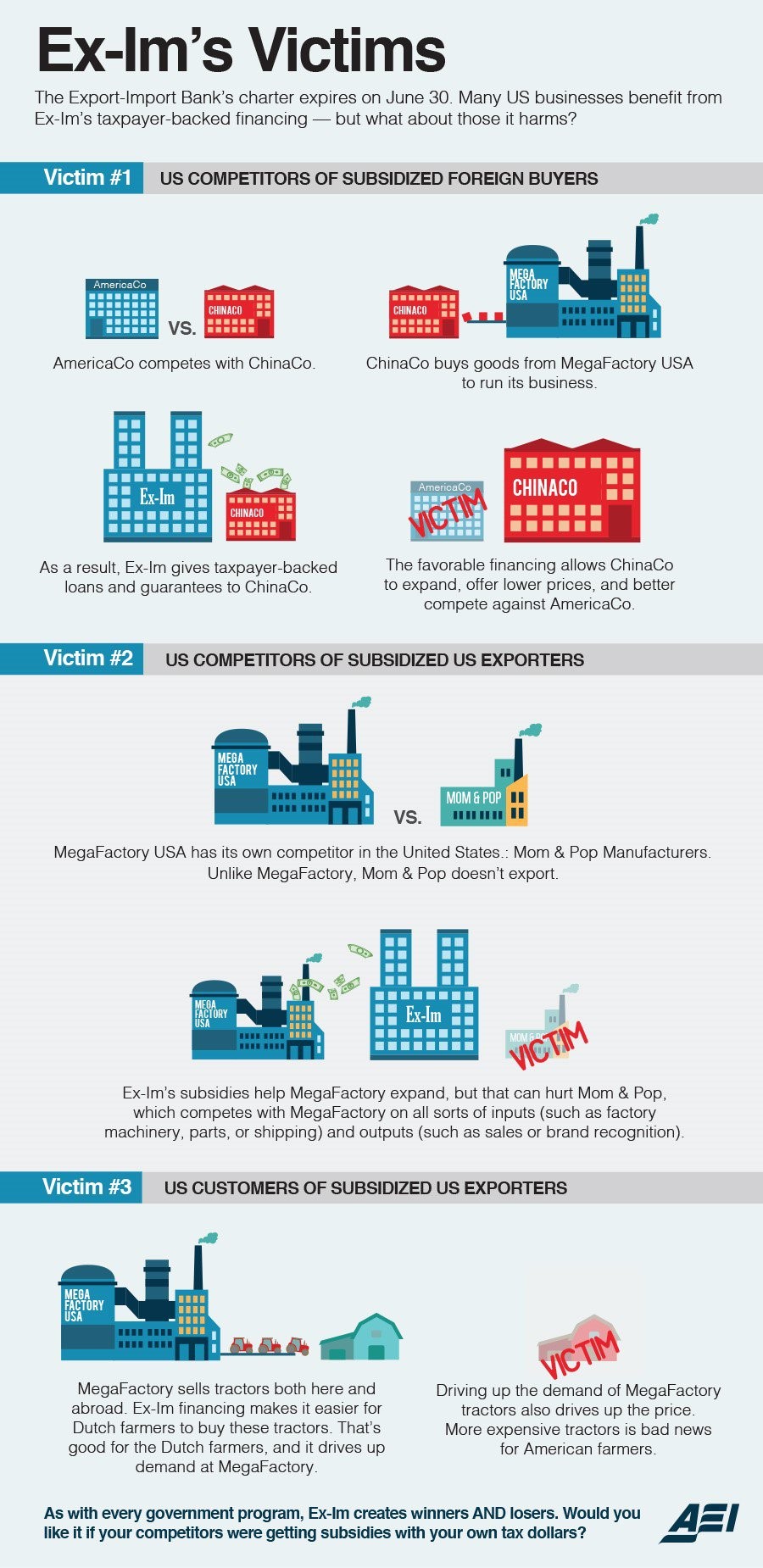
The Export-Import Bank’s charter is up for renewal in our Congress this spring. The bank is alleged to help American companies by lending money to foreign buyers of and American company’s products so that buyer can afford the purchase, which in turns helps the US company, and its employees.

That’s a pretty good deal, right?

Maybe not so much. It’s American taxpayers who are on the hook—not just the one American company and its employees—if the foreign buyer defaults on the loan. But that’s not all. American companies trying to compete with that foreign buyer also are harmed, whether or not that foreign buyer defaults. See the graph below, from AEIdeas:ExImBank

Don’t renew the bank’s charter.

A Foolish Plan

The European Union may accept up to 20,000 refugees a year and set up an automatic redistribution program for migrants overcrowding southern European states, under plans currently being developed in Brussels.

This doesn’t address the problem at all; it just encourages the current freshet to burgeon into a raging torrent.

True enough, as one anonymous EU official said,

We have to start somewhere. Agreeing on refugees outside the EU may be easier, because they are the most in need. Then, we may move on to relocation within the EU.

Indeed, the EU must start somewhere.

How about starting at the source of the refugee flow: here, the “unrest” in Syria and in northern Africa? Resolving the situations there on terms that leave the locals feeling safer and with some chance to prosper would take a lot of work, a lot of time, and a lot of resources in men and money, but it would yield far more permanent and moral results.

But there’s that work part. These EU persons would rather just take the easy way out, a way that gives short term feel-good and prompt personal political benefit. They don’t actually care a farthing about the refugees in their own right.