Budgeting and a Do-Nothing Senate

As a number of us, including Power Line, have been mentioning lately, the Senate-of-No has not adopted a budget in three years.

In the latest sham, we get Senator Kent Conrad (D, ND) feinting to his right with an offer to present a budget proposal and to discuss amendments before the Senate Budget Committee, which he chairs.

[The] standard markup process begins with the committee chairman laying out a proposal, with the chairman and the ranking minority member giving opening statements.  This is followed by an amendment process, in which amendments to the proposed legislation (here, the budget resolution) are offered and voted on.  The markup process concludes with a committee vote on the bill or resolution as amended. In this case, Conrad assured ranking Republican, Jeff Sessions, that amendments would be allowed.

Then Conrad held a presser at which he announced that he’d present his budget proposal, all right, but there would be no amendments allowed, and there would be no subsequent Committee vote on his proposal.

Senator Sessions (R, AL) responded to this shadow box theater noting that this is another demonstration of a

lack of will, courage, or the ability of Democrats to unify behind a plan.

and that they

don’t want to be held accountable for anything.

President Obama also has weighed in in support of his party’s Senate doing nothing.  Through his Acting Budget Director, Jeffrey Zients, Obama threatened House Appropriations Committee Chairman Hal Rogers (R, KY):

Until the House of Representatives indicates that it will abide by last summer’s agreement, the President will not be able to sign any appropriations bills.

Never mind that last summer’s spending agreement was to an upper limit of $1.047 trillion, not a lower limit of that amount.  Obama is simply acting, as Sessions noted, on any excuse he can dream up to not be constrained by a budget.  Again.

Never mind, moreover, that Conrad’s budget [is expected to have] no spending cuts at all from Obama’s present exploded baseline, and that it increases taxes by $2.6 trillion, $700 billion more than even Obama’s budget—which has gotten him zero votes, including zero Democratic Party votes—in two tries over two years.  Indeed, with Conrad’s budget, the national debt increases by $7 trillion.

Never mind that in all of 2011, the Senate Progressives voted down three different budgets, but they didn’t offer anything of their own.  Again.

Is this the level of integrity we want in our Senators?

A Partial Victory

And from the 9th Circuit Court of Appeals, yet.  From an Associated Press article carried by Fox News, we learn that Arizona’s voter identification law has been upheld in important parts; although another important part has been struck down.

A 12-judge panel, rehearing an appeal from a 3-judge panel, upheld that prior panel’s ruling: that Arizona can, indeed, require identification from prospective voters at the polling stations before they are allowed to vote, but that the state cannot hold out for proof of American citizenship before registering to vote and getting that voter ID document.  On the latter, the Court held that the Federal government’s National Voter Registration Act, which does not require proof of American citizenship, overrides Arizona’s attempt to do so.

Arizona’s Attorney General Tom Horne expects that the US Supreme Court ultimately will have to resolve the question of whether Arizona can require proof of citizenship as a condition of voter registration.

The people of Arizona have a right to request that people registering to vote show some evidence they are citizens, and we fully expect the US Supreme Court to uphold that.

Indeed.  Critics argue that the voter ID law violates the rights of those denied registration to Constitutionally guaranteed equal protection.  However, those critics ignore, and the Supremes will have to consider in order to put this question finally to rest, that the equal protection rights of American citizens are violated by allowing non-citizens to vote and thereby dilute—and even override—the votes of those citizens.

Plainly, a state can allow non-citizens to vote in state and local elections, if it wishes.  However, they also can insist that only American citizens be allowed to vote in Federal elections conducted within the state.  They also can insist that only citizens of the state be allowed to vote in state and local elections.  Beyond the 14th Amendment’s equal protections guarantee (which, just by the way, carries its own requirement for voters for “electors for President and Vice-President of the United States, Representatives in Congress, the Executive and Judicial officers of a State, or the members of the Legislature thereof” to be “citizens of the United States”), the state and local choice questions are matters covered under the Constitution’s Article I, Section 10, which is carefully silent on this matter, and under the 10th Amendment.

Taxes and a Do-Nothing President

“At the end of the year, some $500 billion in tax breaks expire all at once, hitting American households with an average tax increase of $3,800—if Congress doesn’t act,” reports Jim Angle of Fox News.

Here are, to channel the late Jack Brickhouse, the unhappy totals:

  • $165 billion increase from the expiration of the Bush tax cuts, pushing tax rates from a bottom rate and top rate of 10% and 35% to 15% and 39.6%, respectively,
  • cut the child tax credit by fully half, from $1,000 a child to $500,
  • the marriage penalty returns,
  • tax on dividends, which many seniors rely on, would soar from 15% to as high as 39.6%,
  • a temporary fix to the alternative minimum tax disappears/expires.  The AMT originally was aimed at millionaires, but now it would hit 34 million taxpayers,
  • separate $124 billion cut in the payroll tax would end.

Moreover, as Curtis Dubay of the Heritage Foundation points out,

Taxmageddon falls 70 percent on middle and low income families.  That’s because 60% of the Bush tax cuts were for middle- and low-income taxpayers.

Thus, the Reid/Obama tax increases are set to hammer all Americans, but especially President Obama’s “non-rich.”

Yet this could have been avoided.  During the debt limit ceiling raise kerfuffle of last summer, President Obama had a golden opportunity to fix these things, but in a Chicago shuffle, he tried to steamroll the Republicans with a last minute (literally) demand for an additional $1 trillion tax increase, and he blew up the negotiations altogether.  Obama and Majority Leader Reid (D, UT) had a chance to fix these things later in the fall, but they demanded tax increases as a quid pro quo for extending an expiring payroll tax reduction.  This winter, Obama and Reid got tax increases in exchange for extending an expiring (again!) payroll tax reduction—the one set to expire at the end of this year along with all those other items.

Obama and Reid have spent all of these last three years demanding tax increases to “pay for” tax reductions elsewhere, and spending cuts anywhere—in the name of “fairness.”

What’s also galling, though, is that payroll tax reduction for which the Republicans held out so zealously.  This is the same gang that insists (rightly) that our Social Security system is bankrupt and desperately needs reform—yet they’re insistent on reducing even further that system’s funding with this payroll tax reduction of theirs.  Ignoring the fact that the Democrats were on record as agreeing that a 2% reduction in (payroll) tax rates was good for Americans, ignoring further that Obama had proposed a 3% reduction for both individual Americans and businesses in those payroll taxes, the Republicans chose not to insist, instead, on a 3% (or even a 2%) income tax reduction for all Americans and our businesses.  They just held out for gutting Social Security.

Now Obama is set to get his tax increases in the name of his concept of fairness.  Happy New Year.

Taxes and Fair Share

At the start of the week, the Senate failed a cloture vote on President Obama’s Buffet Rule by a 51-45 vote, with Senator Susan Collins (R, ME) voting for on the excuse that the measure should be openly debated (never minding that President Obama has been debating it on his latest campaign tours), and Senator Mark Pryor (D, AR) voting against on the theory that such a measure should be part of a debate on general tax reform.

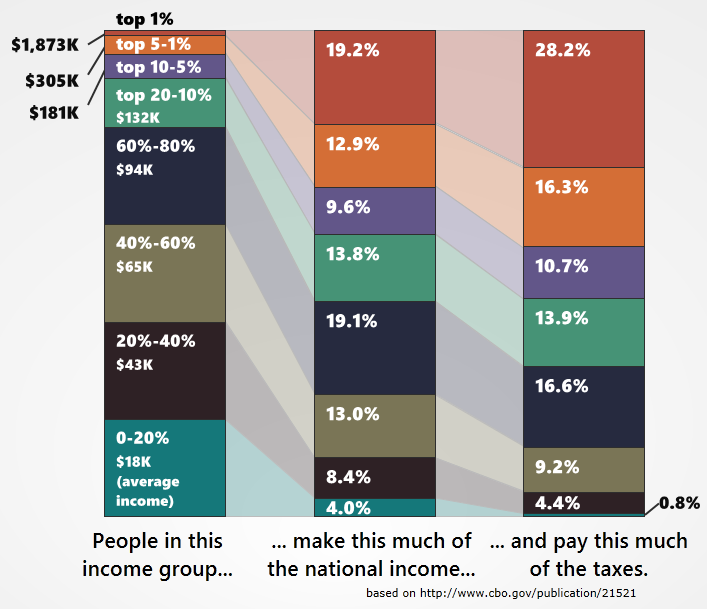
I won’t occupy bandwidth repeating commentary about Obama’s “it’s only fair” mantra.  However, via Villainous Company, comes another view of what’s fair—the following graphic, based on tax rates from 2007 and published in 2010.

Interesting, this.  The only folks paying roughly their “fair share,” if we’re willing to consider what’s fair to be paying a share of the nation’s income taxes roughly akin to the share of national income represented by one’s own income grouping, is those rich folks in the second 10% income group—those whose income puts them in the band of top 10% down to top 20% of income—and the truly destitute—those folks in the very bottom 20%.  The Stinking Rich, those top 10%-ers, are paying far more than their fair share.  And most everyone else below those top 20% are paying increasingly less than their fair share.

But President Obama and his Progressives want to pile on and make his ugly rich pay even further beyond their fair share.  With lots of words about creating yet another entitlement program, a program of transferring tax money from those who pay a lot to those who pay a little.  But with not a word about cutting spending to fit within the revenues already accruing to his administration.  With not a word about reforming existing entitlements like Social Security, Medicaid, and Medicare.

Hmm….

One Can Hope

My post today comes almost entirely from an opinion supporting the DC Circuit Court of Appeals’ opinion upholding a lower court ruling denying a dairy farmer’s objection to milk price regulation as applied to his farms.  From the per curiam (i.e., from the court itself—the majority opinion is unsigned, although dissents and concurrences, if they exist, are signed) opinion in Hettinga v United States comes the summary of the farmer’s beef:

Plaintiff-appellants Hein and Ellen Hettinga appeal the dismissal of their constitutional challenges to two provisions of the Milk Regulatory Equity Act of 2005 (“MREA”), Pub. L. No. 109-215, 120 Stat. 328 (2006) (codified at 7 U.S.C. § 608c). The Hettingas alleged that the provisions, which subjected certain large producer-handlers of milk to contribution requirements applicable to all milk handlers, constituted a bill of attainder and violated the Equal Protection and Due Process Clauses.

The Hettingas’ dairy farms were the only farms in the United States that were affected by the MREA; however, the Appellate Court upheld the application of MREA over the Hettingas’ constitutionally grounded objections.

From Circuit Judge Janice Rogers Brown’s, with whom Chief Judge David B Sentelle agreed (forced) concurrence:

…their consternation at being confronted with the gap between the rhetoric of free markets and the reality of ubiquitous regulation. The Hettingas’ collision with the MREA—the latest iteration of the venerable AMAA—reveals an ugly truth: America’s cowboy capitalism was long ago disarmed by a democratic process increasingly dominated by powerful groups with economic interests antithetical to competitors and consumers. And the courts, from which the victims of burdensome regulation sought protection, have been negotiating the terms of surrender since the 1930s.

More from her opinion:

As the dissent predicted in Nebbia, the judiciary’s refusal to consider the wisdom of legislative acts—at least to inquire whether its purpose and the means proposed are “within legislative power”—would lead to only one result: “[R]ights guaranteed by the Constitution [would] exist only so long as supposed public interest does not require their extinction.” In short order that baleful prophecy received the court’s imprimatur. In Carolene Products (yet another case involving protectionist legislation), the court ratified minimalist review of economic regulations, holding that a rational basis for economic legislation would be presumed and more searching inquiry would be reserved for intrusions on political rights.

The practical effect of rational basis review of economic regulation is the absence of any check on the group interests that all too often control the democratic process. It allows the legislature free rein to subjugate the common good and individual liberty to the electoral calculus of politicians, the whim of majorities, or the self-interest of factions.

She adds [her emphasis]:

…the Constitution created the countermajoritarian difficulty in order to thwart more potent threats to the Republic: the political temptation to exploit the public appetite for other people’s money—either by buying consent with broad-based entitlements or selling subsidies, licensing restrictions, tariffs, or price fixing regimes to benefit narrow special interests.

And

As another court has noted, federal regulation of milk pricing “is premised on dissatisfaction with the results of competition.” Alto Dairy v. Veneman, 336 F.3d 560, 562 (7th Cir. 2003). “M]ilk price discrimination is intended to redistribute wealth from consumers to producers of milk.” Id.

In the end, Judge Brown is quite blunt:

Civil society, “once it grows addicted to redistribution, changes its character and comes to require the state to ‘feed its habit.'”

Are we seeing a pattern begin to emerge?  Is not the Patient Protection and Affordable Care Act the outcome of a similar political temptation to…buy consent with a broad-based entitlement and subsidy?  Is not PPACA a similar attempt to redistribute wealth from healthy consumers to the unhealthy—or those who are timorous about their future after a lifetime of their own health-related choices?

And by extension is not all New Deal and later Commerce Clause regulation similar pandering and playing on dissatisfaction with competitive outcomes in order to preserve the status of incumbents?  After all, the Commerce Clause was intended to regularize the commerce of the several states among each other and to give Federal control over international trade.  And nothing more.

And Judge Brown also is right about the legal argument of “rational basis review.”  There’s nothing at all rational about it.  Arguments for or against any regulation, or any law, must proceed from how well that regulation or law preserves individual liberties and responsibilities, not from how well the regulation or law asserts dominance of any group over the individual.


h/t Power Line, and both a hat tip and a bow to DC Circuit Judge Janice Rogers Brown.