A Thought on Morality

In late February, Archbishop Francis Cardinal George summarized the choices President Obama’s contraceptives mandate presents to Catholic service organizations—and by extension, to all faith-based service organizations.  Under the existing Health and Human Services regulations (which remain unchanged, despite Obama’s promised “accommodation”—an adjustment that only pushes the contraceptives-for-free mandate onto faith-based insurance organizations like GuideStone Financial Services, anyway), the choices are these:

  • abandon church teachings and oversight, or
  • pay annual fines that are “not economically sustainable” [which is the point of the fines—to coerce the organization into contravening its own conscious and religious teachings], or
  • sell their hospitals and charities to non-Catholic groups and local governments, or
  • “close down.”

Thus, Obama’s “decisions about medical care should be made by a woman and her doctor, not a woman and her boss,” thesis, often expressed through his Press Secretary, Jay Carney, doesn’t apply where it contradicts Boss Government’s demands.

But this is the position of the present administration.  Jim Towey, President of Ave Maria University, which is suing the government over Obama’s contraception mandate, describes that position this way:

Democratic and Republican presidents alike—nobody would cross this line until now.  There was always respect for conscience rights, and the fact that maybe government didn’t have the only voice on moral issues like this.

And that’s what it’s come to.  The present administration is presuming to inject the Federal government into fundamental matters of conscience, of morality.  That same administration, an administration of moral equivalence, is insisting that its version of morality is more equivalent than others’, and it seeks to impose its version on all of us.  Not by conversation, or debate, or the President’s bully pulpit—all of which would be legitimate venues for discourse and persuasion—but by Federal fiat.

Where’s the morality in that?

An Economy

President Obama is campaigning heavily, these days, on the strength of “his” economic recovery.  Let’s look at this recovery.

Peter Ferrera, cited in The Wall Street Journal, writes

From 1947 to 2007, the U.S. economy averaged real growth of 3.2% a year. At that rate, our GDP would double every 22 years. … Last year, U.S. real economic growth was a paltry 1.7%. The current quarter will probably not be much better.

and

[T]he American economy catching up to its long term economic growth trend line would mean the economy booming over the next 10 years with average annual real growth of 4.4%, and then continuing on after that at 3.2% real annual growth.  Ten years of 4.4% real growth would leave the American standard of living, and GDP, over 50% higher than today.  That is the boom this economy has in it naturally, with the right pro-growth policies just getting the government out of the way, and freeing the economy to grow.

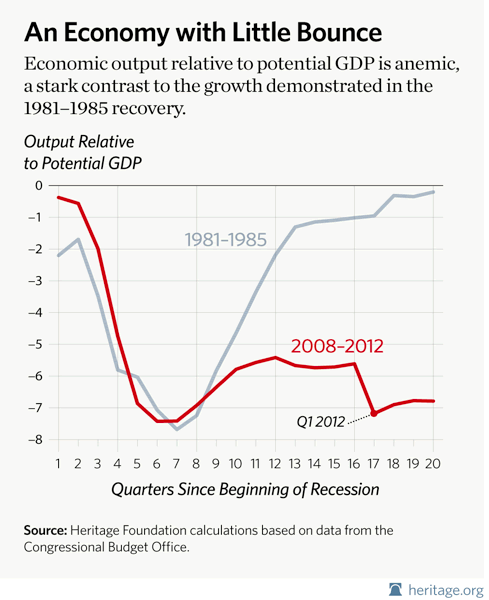
How are Obama’s policies doing?  Typical recession recoveries are faster and higher the deeper the recession from which we’re recovering.  This chart draws a comparison with our nearby history—the recovery from the recession of the ’80s, which was as deep and hard as the present one. The recovery just isn’t there very much.  Unemployment is falling off, and job creation is occurring (more on that below), but it’s anemic.  The zero-line represents full GDP output—our economy is operating on all cylinders—and three years after the ’80s recession’s deepest point, we were at full production.  With the current recession, it’s not even close.  In fact our current growth rate of 2.4% per year since the recession’s formal end in the spring of 2009 is the slowest rate since WWII.
The next three charts look at our labor—our employment—picture in particular.
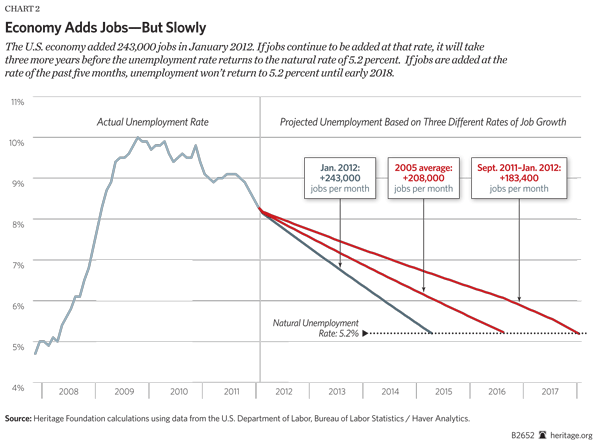
This chart looks at three different growth rates and the time from today to full employment.  If employers continue to add jobs at the same rate they did between September 2011, when unemployment began to improve, and last January—183,400 jobs per month—the unemployment rate won’t reach even 7.8% for another 20 months, December 2013, and will not full employment for five more years: January 2018.  Even if employers add jobs at their 2005 pace, we won’t reach full employment until mid-2016, and if January’s unusual rate is continued, we’re still looking at mid-2015 before reaching full employment.

This next chart gives another look at our future.
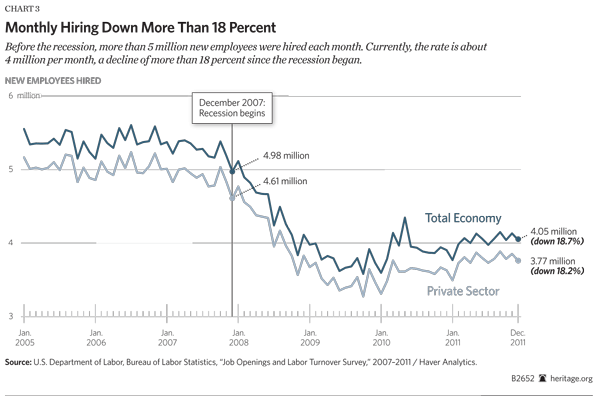
Fewer existing businesses are hiring, and fewer entrepreneurs are starting new businesses; there are fewer jobs for the unemployed.  Moreover, it takes time for startups to grow and to increase their hiring, just as it does existing businesses to recover, resume growing, and increase their own hiring.  Delays now in growth and job creation mean continued delays tomorrow in getting growth going and hiring to increase.

The next chart shows the falling labor participation rate in our current economy.

The present  63.7% of adult Americans active in the labor force (either employed or looking for work) is the lowest participation rate since 1983—when far fewer women were working.  Keep in mind that this historically low participation rate artificially reduces the measured—headline—unemployment rate because folks not looking for work aren’t counted as unemployed.  The Congressional Budget Office estimates that the unemployment rate would be 1.25 points higher—9.45%—if labor force participation were at normal levels.

Finally, how does our current recession…recovery…compare with past recoveries?  This last chart is illustrative.
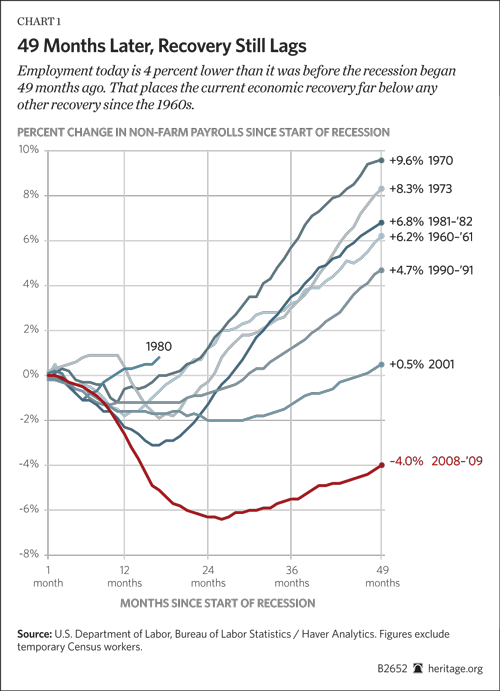
In every prior post-war recession, employment has fully recovered within four years.  As of December 2011—four years after the recession’s onset—payroll employment remains 4.0 percent below the number of workers employed when the recession started in December 2007. Private-sector employment is 4.5 percent below pre-recession levels.  That represents 5.6 million net fewer jobs; 5.2 million of those net job losses occurred in the private sector.

In sum, as The Heritage Foundation points out,

It’s the natural tendency for the economy to grow—and taking credit for its meager improvement is sort of like accepting kudos for the rising and setting of the sun.

We have any sort of recovery at all solely because of that natural tendency to grow.  What are the differences between our current straits and past recession recoveries?  Obama’s policies are of a kind with a prior Progressive President, Franklin Roosevelt.  Both sets of policies centered on expansive, intrusive government, increasingly interfering with the operation of our free market and even going so far as to dictate what individual Americans are permitted—or required—to do in the market place.  All for our own good.  Just as those policies so tragically prolonged the Depression of the ’30s, so are these policies prolonging the current recession’s effects.

On the other hand, when met with shrinking government and reducing personal and business tax rates, as Jack Kennedy (!) and Ronald Reagan, for instance, did, our free market economy responded with rapid, prolonged growth.

I agree with President Obama.  The credit for these three years of historically poor economic performance is entirely his.

The Administration And Free Speech

The First Amendment, as Judge Andrew Napolitano points out,

prohibits the government from infringing upon the freedom of speech, the freedom of association and the freedom to petition the government for a redress of grievances.

But what’s the point if government declines to listen, and/or decides to specify where a citizen might be allowed (which includes a decision to not allow) to speak, even if not speaking to his government, decides to specify where groups of citizens will be permitted (which includes a decision to not permit) to congregate?

We have though, this brand new law, the Federal Restricted Buildings and Grounds Improvement Act of 2011.  This law, as Judge Napolitano says,

permits Secret Service agents to designate any place they wish as a place where free speech, association and petition of the government are prohibited.

Thus, federal agents whose work is to protect public officials and their friends may prohibit the speech and the gatherings of folks who disagree with those officials or permit the speech and the gatherings of those who would praise them, even though the First Amendment condemns content-based speech discrimination by the government.

Our government has forgotten a critical item, and Judge Napolitano has missed it, also.  This item is far more than a “mere” violation of our Constitution.  As out Declaration of Independence acknowledges,

…Governments are instituted among Men, deriving their just powers from the consent of the governed….

Government works for us.  It has no capacity for declining to listen to us (much less to not hear us), or to dictate to us, its employers, where the employee might choose to listen—the conference room is ours, not government’s.  We will gather in the conference room of our choice, gather whom we will in that room—including our subordinate government—and say what we will to that government.  And that government will heed us.

After all, our Declaration of Independence also acknowledges that

…whenever any Form of Government becomes destructive of these ends, it is the Right of the People to alter or to abolish it, and to institute new Government….

and

…when a long train of abuses and usurpations, pursuing invariably the same Object evinces a design to reduce them under absolute Despotism, it is their right, it is their duty, to throw off such Government, and to provide new Guards for their future security.

Our present administration has chosen to ignore all of this.  We have an election coming up, an excellent opportunity to throw off this administration and to institute a new one.

The Regulation of America

We’re becoming a severely regulated country, and it’s coming on the heels of President Obama’s promise to

find rules that put an unnecessary burden on businesses [and] fix them

which he made in his 2011 State of the Union address and which he committed to writing in his Executive Order 13563 the week prior, which requires all executive branch agencies to “identify and consider regulatory approaches that reduce burdens.”

This also is symptomatic of what’s wrong with our present administration.

This exchange between Congressman Corey Gardner (R, CO)  and EPA Assistant Administrator Mathy Stanislaus at a House Environment and the Economy Subcommittee hearing demonstrates just how seriously Obama and his agencies take his promises:

Corey: Is it standard procedure for an economic analysis to ignore the impact on jobs?

Stanislaus: Well, we didn’t do a direct analysis, again we sought—

Corey: So you did not do a direct economic analysis?

Stanislaus: Well we did do an economic analysis on [various areas]

Corey: But not a cost on jobs?

Stanislaus: Not directly.

The entire five minutes of the video consists of variations of this exchange wherein Corey kept trying to pin down Stanislaus on whether the EPA satisfies its statutory requirement to do a jobs impact analysis as part of its rules economic analysis and Stanislaus’ constant evasion and finally admission that the EPA does not.  The rules, as rules, are more important than working Americans, more important than their effects on our country.

As the Heritage Foundation points out, since January 2009, 106 new “major” regulations have been enacted, costing us $46 billion, plus almost $11 billion more in implementation costs: Obama has become the biggest regulator in American history.  Dodd-Frank has generated the most regulations, and with the CFPB, these are the least accountable.  The EPA, though, is enacting the most expensive, with just four rules costing us $4 billion per year.  And this is before the closure of gasoline refineries in the Northeast—which will force New York, for instance, to import expensive foreign gasoline to make up the shortfall—and electric power generating plants throughout the already economic and employment challenged rust belt—which will drive up power costs for those hard-pressed businesses and citizens.

On the financial side beyond Dodd-Frank, the government is reaching directly inside our businesses to dictate to them what they can and cannot do with their own business assets.  Illustrative of this is the Federal Reserve Bank’s decision to not allow Citibank to return capital to its owners through increased dividends and stock buy-backs.  The Fed said Citi couldn’t handle it.  The Fed said that, not the bank’s owners.  The bank’s owners said otherwise but were casually overruled.

There’s a rather naked conflict of interest here for a government as prone to expand our national debt as this one is.  As Alex Pollock, resident fellow at the American Enterprise Institute, and past president and CEO of the Federal Home Loan Bank of Chicago, points out:

…governments promote loans to governments. They have an obvious self-interest in promoting loans to themselves and to other governments they wish to help or influence.  Banks are extremely vulnerable to pressure from governments—the more regulated they are, the more vulnerable.  Employees of government bureaucracies have an incentive to encourage loans to their political employers—an inherent conflict of interest.

But never mind about petty conflicts of interest.  It’s this way because the Progressives don’t believe we’re able to take care of our own affairs.  Instead, we must be told what to do, have our courses of action limited—for our own good—by our Betters.  And for their political gain.

2nd Amendment and the Fifth Circuit

The Wall Street Journal‘s Law Blog has a description of an egregious gun rights case.  It seems that, when Errol Houston was arrested in New Orleans in 2009 on drug and firearm charges, the police seized a properly registered gun that he had.  So far, so good—when the police arrest someone, they’re allowed to disarm him, too.  However, when the charges were dropped, the city refused to return his weapon to him.  He sued for the return, and amazingly, the district court found for the city.  Even more amazingly, the Fifth Circuit upheld the ruling, with this…logic…written by Judge Rhesa Hawkins Barksdale:

Just as some regulation of speech–e.g., of obscenity and defamation–is “outside the reach” of the First Amendment, so, too, is some regulation of firearms outside the reach of the Second.  The right protected by the Second Amendment is not a property-like right to a specific firearm, but rather a right to keep and bear arms for self-defense.

Houston has not alleged defendants prevented his “retaining or acquiring other firearms.”  Therefore, he has not stated a violation of his Second Amendment right to keep and bear arms.

Judge Jennifer Walker Elrod dissented.  In addition to pointing out the degree of legality of the majority opinion, violating as it does the Supreme Court’s prior rulings in similar cases (vis., District of Columbia v. Heller and McDonald v. City of Chicago), she also correctly explains the nature and meaning of the 2nd Amendment:

In the context of other enumerated constitutional rights, an equivalent per se exception for particular exercises of the right at stake (so long as other exercises of that right are permitted) would be intolerable.  Consider, for example, a court holding that the Free Speech Clause affords no protection against the government preventing the publication of a particular editorial in the New York Times because there are plenty of other newspapers that might publish the piece.  Or consider a court holding that the Fourth Amendment is inapplicable to the unreasonable seizure of a specific automobile so long as the government does not prevent the owner from borrowing, renting, or purchasing a replacement vehicle.  These examples should suffice to show the absurdity of courts recognizing categorical exceptions for each particular exercise of those rights.  In carving out such an exception from the Second Amendment, today’s majority impermissibly treats the Amendment as a “second-class right.”

Judge Elrod is right that the accessibility of alternatives is irrelevant—those alternatives are not the item itself, and the item itself remains the legitimate property of the owner.

Both the majority and Judge Elrod miss a larger point, though: the “right of the people to keep and bear Arms” is, indeed, a property right, but it is a different and more fundamental kind that that alluded by Judge Barksdale and accepted by Judge Elrod.  This property is one flowing from the endowment imbued in us by our Creator, a property of our being.  As such, Judge Elrod is right, but she doesn’t go far enough.  It is the regulation of our endowed rights that is the exception, not the possession of this or that particular item in a realization of one or more of those rights.