
Obamacare and Jobs

The results are starting to come in, via three independently done polls by three separate Federal Reserve Banks.

The Federal Reserve Bank of Philadelphia:

  • 78.8% of businesses in the district have made no change to the number of workers they employ as the specific result of ObamaCare
  • 3% are hiring more
  • 18.2% are cutting jobs and employees
  • 18% shifted the composition of their workforce to a higher proportion of part-time labor
  • 88.2% of the roughly half of businesses that modified their health plans as a result of ObamaCare passed along the costs through increasing the employee contribution to premiums, an effective cut in wages

The Federal Reserve Bank of New York asked about the “number of workers you employ.”

  • 21% of Empire State manufacturers and 16.9% of service firms answered “reducing.”

The Federal Reserve Bank of Atlanta:

  • 34% of businesses planned to hire more part-time workers than in the past, mostly because of a rise in the relative costs of their full-time colleagues

And the pièce de résistance:

  • ObamaCare’s labor effects would be concentrated in some industries with relatively low-wage or marginal workers.

Hmm….
Drug Markets and Regulation

With this attitude, we’re not going to have much of a drug development or production industry—to the detriment of our drug market.

“A big part of our concern is not just Sovaldi [a new, and so still very expensive, drug with a near-perfect cure rate for Hepatitis C], but all the other specialty drugs,” said Mario Molina, the CEO of Molina Healthcare that runs Medicaid and ObamaCare plans in nine states, on a July earnings call. He added: “I think that the government needs to step in here and make sure that the market is rational. If we as a health plan want a rate increase, we have to go to our regulators and get it approved. There’s no such thing going on in the pharmaceutical market.

Molina’s last is a valid beef. Health plan providers shouldn’t have to go to government regulators to get permission to set a price, either. Government simply should not have that regulatory power. But a man used to government regulation, indeed who’s dependent on his company’s status as a protected oligopolist, no longer even can conceive of having to compete on price and service.

He concluded his plaint:

Right now, pharmaceutical companies can charge whatever they want, and I think there needs to be a rational basis for all of this.

Of course, there is exactly that rational basis: it’s the supply and demand price setting of a free market.  Again, though, a concept lost on a man of a protected oligopoly.

“Climate” Again

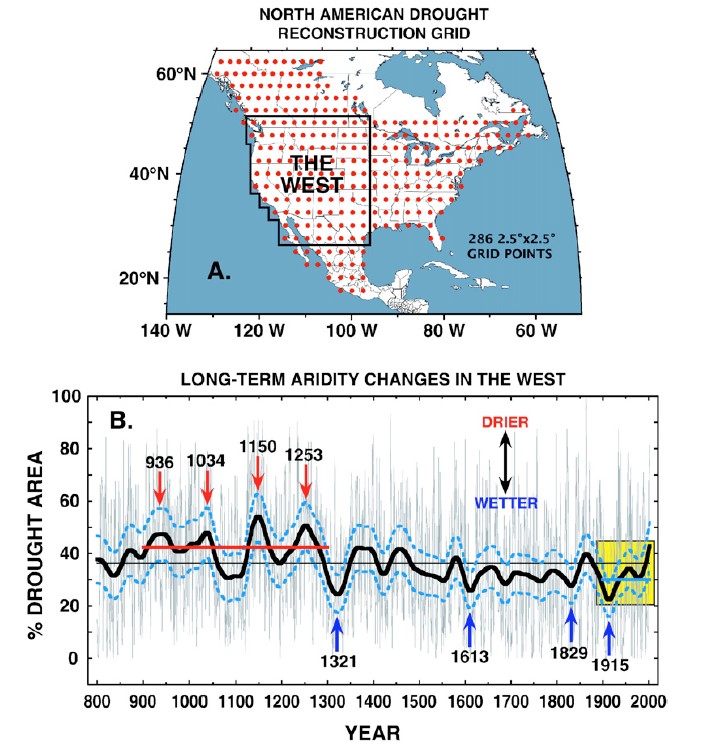
Texas and California are in the middle of droughts. This is, of course, due to man-caused climate change. Or is it? Watts Up With That has a couple of graphs that bear on the matter.

This one gives one idea of the history of droughts and wet periods over the last, oh, say, 1,200 years:NorthAmericaDroughtGrid

The dots in the upper part of the figure give the locations at which measurements were taken. The lower part gives the time history of wet vs dry for the time frame indicated; the dotted lines flanking the solid black line give the error range for the measurements. The shaded yellow area to the right indicates the (limited) time frame of interest to our climate panic mongers. The average dryness for an earlier period (notice that it’s outside the time of interest to our mongers) is shown by the solid red line, and the average wetness is shown by the blue line that’s partially obscured by the yellow shading.

This graph gives a clearer indication of wet and dry periods, including that long time frame so studiously ignored by our mongers. The graph points up California’s strait because Watt’s article was centered on all the nonsense California’s Democrats are spouting about their drought. It pretty much speaks for itself.200YrCaliforniaDrought

The graph’s small text may be hard to read; it says

Evidence from tree rings shows that drought was historically much more widespread in the American West than now, while the 20th century was wetter than normal. Percentage of the West affected by drought from 800 AD to 2000.

Hmm….

A Gun Control Loss

The gun rights sheriff incumbent, David Clarke Jr, defeated his Democratic primary challenger for the Milwaukee (Wisconsin) County job (and he’s in because there’s no Republican challenger for the fall general election). This also had been, among other things, a referendum on ex-New York Mayor Michael Bloomberg’s gun control philosophy, as that one had thrown down $150,000 on TV ads in his own attempt to influence the election.

However, primary challenger Milwaukee Police Lt Chris Moews‘ own justification for gun controls demonstrates the fallacy of the gun control position:

If I have the opportunity to defend myself and my family I will do so to the best of my abilities but I’m certainly also going to call 911 if I have the ability because I need the cavalry to come and help me.

Indeed. Because the cavalry—those police on the other end of that 911 call—are minutes away, plus the time to make the call, the man on the scene is the one who must deal first with the situation.

Moreover, as Moews intimated, it might not be possible for the man on the scene to make the call, leaving him without aid in facing the threat.

And there’s Moews’ implied strawman that an armed man wouldn’t call 911 at all.

Forcing that man to remain unarmed maximizes the danger to him.

A Capital Strike

Here is an argument for not doing business with the Federal government at all. It’s rapidly becoming not worth the cost—in hassle, in dollars, in business’ ability to control over their own operations. This is another of President Barack Obama’s barrage of Executive Orders, and this is how The Wall Street Journal described it over the weekend:

Under the order signed last week, contractors and subcontractors who receive more than $500,000 in federal money will be obliged to report to government agencies any labor-law violations going back three years. The order covers violations of everything from family and medical leave to federal wage and hour laws in the three years before applying for a contract.

And

When unions are in a collective bargaining fight with a company, they typically file complaints with the likes of OSHA, the National Labor Relations Board and the Equal Employment Opportunity Commission. Under the new executive order, the government will have the ability to revoke the contracts of those with violations. That’s punishment above and beyond any remedies meted out by the NLRB.

That would be another finger on the scales to force settlements on terms favorable to the President’s political allies. If you’re a government contractor, any time a union files an unfair labor practices charge, the pressure to settle becomes overwhelming. Choose to fight and you face not only the civil penalties of violating a law but the risk of having your federal contracts revoked or suspended.

And

[T]he executive order includes a transparency provision that requires contractors to provide their employees with information about pay, overtime pay, and deductions as a condition of receiving a federal contract. The plaintiffs bar has complained that inadequate record-keeping is a stumbling block to their litigation. Now, via the Obama pen, they’ll have more data to feed lawsuits over the Fair Labor Standards Act.

Who needs this nonsense, this continued attack on private enterprise? Maybe it’s time for private enterprise to go back to being private and stop being dependent on government contracts. Maybe it’s time for private enterprise to stop doing business with the Federal government.

After all, this EO applies only to government contractors and subcontractors. So far.