
Another Nation-State Kidnaps

The lede says it.

A senior executive at US risk advisory firm Kroll has been barred from leaving mainland China for the past two months, heightening concerns about the risks foreign companies face when doing business in the country.

Then this:

Michael Chan, a Hong Kong-based managing director at the company who specializes in corporate restructuring, traveled to the mainland in July and subsequently informed his employer that he cannot leave….

However, this:

Neither Chan nor Kroll is the target of the investigation….

They’re not targets, but Chan can’t leave, anyway. That’s kidnapping. That he’s free to move about the cabin country in no way means he’s not a prisoner. He’s just locked up in a gilded cage. And like most cages, his contact with the outside world is a tenuous, sometime thing, given the PRC’s communications fire wall.

In the end, the optimal way to mitigate these kidnappings by the PRC is for American businesses to stop doing business inside the PRC, especially given the Biden administration’s reserve price for getting our citizens back. It’s come to this, quite aside from the national security question of our businesses being economically and resource dependent on an enemy nation.
Internet Censorship

The Supreme Court has granted certiori to a suit involving Texas and Florida statutes barring social media from committing censorship.

The Texas law prohibited social-media platforms with at least 50 million monthly active users to censor users based on their viewpoints, thus applying to the most popular sites including Facebook, Instagram and TikTok, as well as X. The Fifth US Circuit Court of Appeals, in New Orleans, upheld the measure.
Similar Florida legislation…was largely found unlawful by the Atlanta-based 11th Circuit.

Thus, a circuit split, which virtually guaranteed a Supreme Court case. Plaintiffs argue for allowing these media to commit censorship as they see fit. Chris Marchese, NetChoice‘s Litigation Center Director:

Online services have a well-established First Amendment right to host, curate and share content as they see fit.

In most cases, that’s true. However, online services that have enthusiastically presented themselves as public squares (vis. Twitter/X) or that have become de facto public squares (vis. Facebook), must act like the public squares that they are, and cannot censor speech made there.

Marchese, though, contradicts his own claim:

The internet is a vital platform for free expression, and it must remain free from government censorship.

You bet. The public squares on the Internet also must remain free from censorship. (State) governments barring these entities from censoring are not themselves engaged in censorship.

Federal Government Shutdowns

I’ve written a few times (the latest here) about the results of Federal government shutdowns. Progressive-Democratic Party politicians always and everywhere are in full-throated panic-mongering about the disaster that is a shutdown. Far too many Republican Party politicians timidly accept the Leftist Party’s claims and seek to do anything, even on bended knee, to avoid a shutdown.

I have a challenge for them, and for all you out there in reader land.

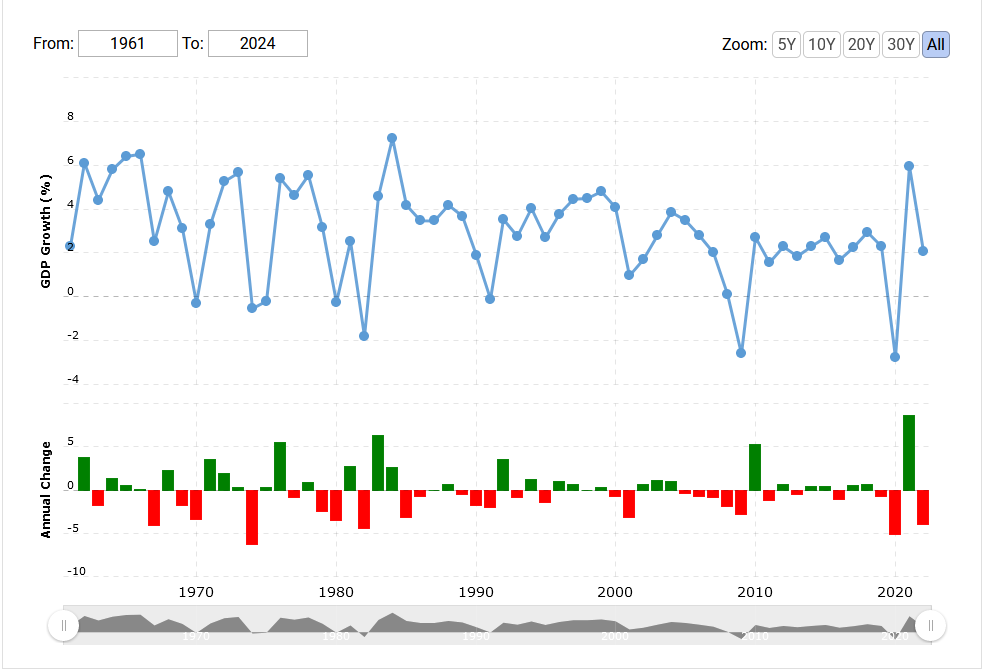
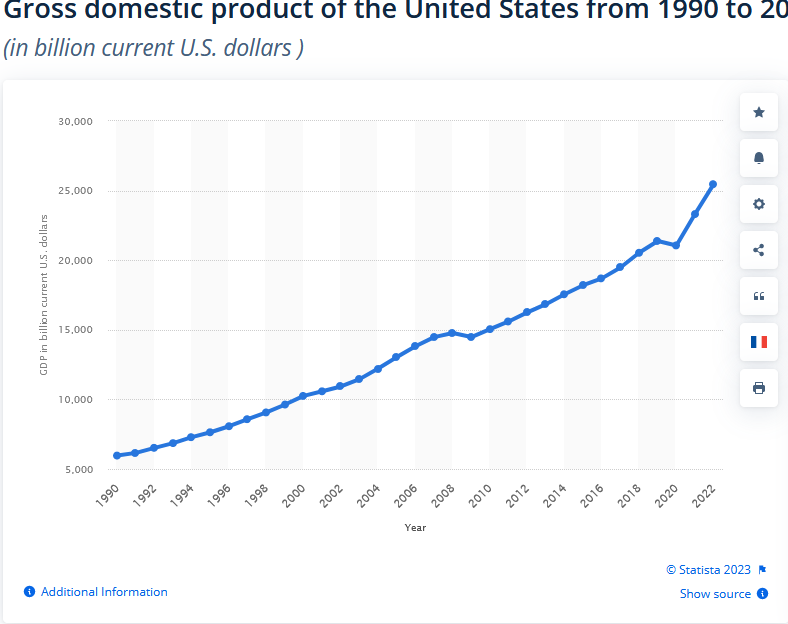
Here are two graphs, the first from Macrotrends showing our GDP growth rate from year to year from 1961 through 2022, and the second from stastica showing GDP levels over the more focused period of 1990-2022.

My challenge is this: find, in either graph, the Federal government shutdowns of 2013, 2018, and 2018-2019.

As an aside, as I write this late Saturday, the House passed a 45-day, keep the government open, funding bill; the Senate then passed the House bill and forwarded the thing to President Joe Biden (D). The bill omitted any spending cuts, steep or otherwise, and dropped any aid for Ukraine.

This, in light of the above, represents a surrender to the Progressive-Democrats forced by the allegedly Republican Chaos Caucus led by Zoo Master Matt Gaetz (R, FL), who have offered nothing beyond “No” to any bill on offer, including the prior Republican-led House stop-gap bill that included significant cuts to spending—which would have given time to work out the remaining appropriations bills with even deeper and broader spending cuts. Gaetz might as well have joined Progressive-Democrat Congressman Jamaal Bowman in deliberately pulling a Congressional office fire alarm in an attempt to stall any House action at all.

Arizona Governor’s Absence

Arizona’s Progressive-Democratic Party Governor Katie Hobbs was absent from duty last Wednesday evening through Thursday mid-morning, and the State’s Treasurer, Kimberly Yee, assumed the duty as Acting Governor for the period.

I have questions.

One question is one that several folks are asking: where was she? Neither Hobbs beforehand nor Yee currently has been willing to say.

Another is what happened to the State’s Secretary of State, Adrian Fontes, another Progressive-Democrat, and the Attorney General, Kris Mayes (also a Progressive-Democrat)? This is what Arizona’s constitution, Article 5, Section 6, Clause C says regarding succession:

If a vacancy in the office of governor occurs with or during a vacancy in the office of lieutenant governor, the secretary of state, the attorney general, the state treasurer or the superintendent of public instruction shall, in the order named, succeed to the office of governor.

(Arizona won’t have a Lieutenant Governor until 2026, which is when a constitutional amendment (Proposition 131) creating the position takes effect.)

And Clause E, to saucer and blow this succession matter:

In the event of the impeachment of the governor, the governor’s absence from the state or other temporary disability to discharge the duties of the office, the powers and duties of the office of governor shall devolve on the same person as in case of vacancy, but only until the disability ceases.

Skipping two levels of succession to get to the Treasurer? Were those two absent from duty, also? If so, why? If not, why were they skipped?

Don’t Take that Federal Money

That’s what Tennessee is considering regarding Federal education funding transfers—$1.8 billion worth, especially since the money comes with mandates and other strings. Breaking the addiction to Federal dollars will sting: Tennessee has collected some $14.85 billion in its own tax revenues through August of this year, which projects to about $22.28 billion for the year; those $1.8 billion represent about 8% of Tennessee’s domestic income.

To see if such a rejection is “feasible,”

Tennessee lawmakers appointed a 10-member panel to determine whether the state can reject $1.8 billion in federal education funding over mandates attached to the money, such as standardized testing.
The group, which consists of five senators and five representatives and includes two Democrats, will “report on the feasibility of the state rejecting federal funds and recommend a strategy to reject certain federal funds or eliminate unwanted restrictions placed on the state due to the receipt of such federal funds if it is feasible to do so[.]”

Tennessee’s House Speaker Cameron Sexton (R, 25th District):

Any time the federal government sends money, there are always strings attached to those dollars, and there is always a possibility that it opens the state up to other regulations or restrictions[.]

The sting would be worth it, though. Any time it’s possible for a State to get its domestic affairs out from under the Federal government’s…thumb…is a good time to do so. I know of no statute, Federal or State, requiring any State to accept Federal transfers. In the event, it’s straightforward for a State to adjust or rescind any State law that applies such a restriction.