
More Thoughts on Minimum Wage

And actual data. Econbrowser pointed out a quasi-controlled study by PhD candidate Michael Wither and Professor Jeffrey Clemens that compared populations of workers in states that had minimum wage laws with higher minimum requirements than Federally passed wage requirements at the time the Federal legislation was enacted with populations of workers in states that did not. They also compared populations of workers starting out with wages higher than the new mandates with populations of workers with wages lower than the new mandates (workers with wages less than $7.50/hr and workers with wages between $7.50 and $10.00 at the time of a then-newly Federally mandated minimum wage of $7.25) over the three years following the Federal mandate.

This figure is from Econbrowser‘s summary of the study:ProbabilityOfEmployment
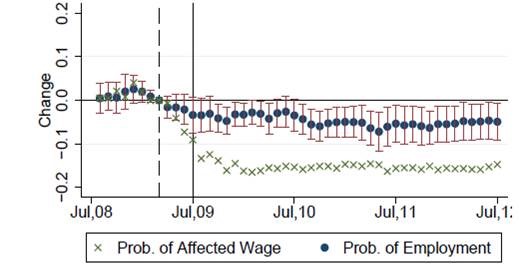
Dynamic estimates of the effects of minimum wage on low-skilled workers. Green x’s denote difference in probability of having a low-wage job between states with low minimum wages and those with high minimum wages. Blue dots indicate difference in probability of being employed between states with low minimum wages and those with high minimum wages, with accompanying 95% confidence intervals. Source: Clemens and Wither (2014).

In other words, a low-skilled worker in a low minimum wage state was more likely to have a job at all than was his counterpart in a high minimum wage state. Moreover, while jobs in high minimum wage states got raises as a result of the Federal minimum wage mandate, workers were less likely to be hired into those jobs.

As Clemens and Wither put it,

Over the late 2000s, the average effective minimum wage rose by 30% across the United States. We estimate that these minimum wage increases reduced the national employment-to-population ratio by 0.7 percentage point.

Clemens and Wither also had this:

We also present evidence of the minimum wage’s effects on low-skilled workers’ economic mobility. We find that binding minimum wage increases significantly reduced the likelihood that low-skilled workers rose to what we characterize as lower middle class earnings. This curtailment of transitions into lower middle class earnings began to emerge roughly one year following initial declines in low wage employment. Reductions in upward mobility thus appear to follow reductions in access to opportunities for accumulating work experience.

But Progressive Democrats know better. Facts are for the little people—you and me.

Maybe That’s The Point

Banks are urging some of their largest customers in the US to take their cash elsewhere or be slapped with fees, citing new regulations that make it onerous for them to hold certain deposits.

The banks, including JP Morgan Chase & Co, Citigroup Inc, HSBC Holdings PLC, Deutsche Bank AG, and Bank of America Corp, have spoken privately with clients in recent months to tell them that the new regulations are making some deposits less profitable

And

The change upends one of the cornerstones of banking, in which deposits have been seen as one of the industry’s most attractive forms of funding….

“Loanable funds.” That’s what those deposits are called in economist circles. The funding in question is a major source of the monies that banks lend on to other customers for the latters’ investment goals—investment in things like capital plant improvement (new factories, new equipment to put in existing or new factories, computers for a company’s IT infrastructure or for employee productivity improvements), R&D, even short term to make payroll until payments for booked sales arrive.

The regulations in question here are intended to make our banking system “safer,” but this is a holdover from the government’s (read: regulators and remaining politicians) stinking…panic…over the Panic of 2008.

And as is usually the case with (especially big) government intrusions into our marketplace, there are unintended consequences.

Or maybe these aren’t so unintended. Recall that, for all the cover “panic” provides for suboptimal behavior, these are extremely intelligent men and women. It’s hard to believe they couldn’t predict these consequences: it’s Econ 101 that if you raise the price of something, you’ll get fewer buyers for it.

Also, keep in mind that the private sector competes with government in the marketplace.

Finally, keep in mind that fundamental tenet of the Democratic Party, the dominant party in American politics during the era when this sort of regulation was proselytized and expanded: Americans are stupid, and it’s OK to lie to us. For our greater good at the hands of our Betters. A step in this is to bring our financial system, beginning with our banks, to heel.

US Defense, Foreign Policies

Russia, China, Iran, and Islamists are waging unconventional warfare around the world, and the United States currently lacks a clear strategy to counter the threat, according to a recent report by the Army Special Operations Command.

“This challenge is hybrid warfare combining conventional, irregular, and asymmetric means, to include the persistent manipulation of political and ideological conflict,” states the Army white paper, Counter-Unconventional Warfare.

Foreshadowed by Iranian actions throughout the Middle East, and by Chinese “unrestricted warfare” strategists in the 1990s, hybrid warfare has now reached its most brazen form in Russia’s support for separatist insurgents in Ukraine.

[“Non-kinetic”] tools…include covert and clandestine special operations commando activities combined with political, intelligence, diplomatic, and financial warfare methods to counter the activities of states like Russia, China and Iran, and insurgent activities by terrorist groups such as the Islamic State.

And

US government “lacks a cohesive [information warfare] strategy to counter adversary [unconventional warfare] campaigns conducted by state and non-state actors….”

Russian examples include

using special operations forces, intelligence agents, political provocateurs, and news media reporters, as well as transnational criminal elements in eastern and southern Ukraine.

“Funded by the Kremlin and operating with differing degrees of deniability or even acknowledgement, the Russian government uses ‘little green men’ for classic [unconventional warfare] objectives,” [according to the white paper].

Examples of the People’s Republic of China’s…techniques…include

unconventional warfare [based on the book,] Unrestricted Warfare…calls for using all means to defeat enemies, including cyber attacks, ecological warfare, financial warfare, and terrorism.

“China will use a host of methods, many of which lie out of the realm of conventional warfare,” [according to the white paper]. “These methods include trade warfare, financial warfare, ecological warfare, psychological warfare, smuggling warfare, media warfare, drug warfare, network warfare, technological warfare, fabrication warfare, resources warfare, economic aid warfare, cultural warfare, and international law warfare.”

Examples include China’s threat several years ago to sell off large US debt holdings to protest US arms sales to Taiwan, and cutting off sales of rare earth minerals to Japan in a dispute over the Senkaku Islands in the East China Sea.

Chinese news outlets also are used in media warfare….

Iran’s techniques are more limited in scope, but no less deadly:

“…Iran provides ‘material support to terrorist or militant groups such as HAMAS, Lebanese Hezbollah, the Palestinian Islamic Jihad, the Taliban, and Iraqi Shia groups,’ [according to the white paper]. “Hezbollah is the primary terrorists’ proxy for Iran working together with a campaign of terror against Israel, the United States, and other western nations.”

It’s entirely possible that an administration more interested in American global interests would have missed this, also. It’s virtually certain, though, that this administration, bent as it is on American withdrawal from the world, wouldn’t have cared even had it recognized any of this.

The Free Beacon‘s article is well worth reading in its entirety, and so is the USA SpecOps’ white paper on the matter.

Talk, But Don’t Act

Now the White House policy is hitting the State Department’s ability to keep secrets from our enemies.

Weeks before the State Department’s Nov 16 shutdown of its unclassified email system in the face of unprecedented hacking attacks, auditors took the department’s management to task for ignoring warnings about their lax security habits and chronic failure to enact protections against high-tech intruders.

The situation was so bad, the auditors say in a highly censored report, that they “identified control deficiencies across a total of 102 different systems reviewed over five years, yet many of the same deficiencies have persisted.”

State’s leadership, though, claims it’s no big deal, and certainly not as bad as the auditors say.

The State’s bureaucracy disputes the audit’s finding that State’s info-tech weaknesses amount to a “significant deficiency” in its security….

And anyway, according to State’s Chief Information Officer Steven Taylor,

[W]e have created a foundation for correcting several existing weaknesses and an ability to address new issues as they arise.

Talking about talking. Never mind that the auditors noted that

OIG [State’s Office of the Inspector General] has reported deficiencies related to risk management since its FY 2010 audit. Many of the same deficiencies remained uncorrected in FY 2014.

And

[W]e identified control deficiencies across a total of 102 different systems reviewed over 5 years, yet many of the same deficiencies have persisted.

These all are highly intelligent people, professionals in their field, who surely know what they’re doing—and not doing. I have to wonder about the motivations behind their decision to talk, but not act.

The audit can be read here and here.

Iran’s Nuclear Weapons

The US has agreed to extend “negotiations” over Iran’s nuclear weapons program into June.

Iran is expected to continue receiving some $700 million in oil export revenues that has been stuck overseas because of US sanctions.

Yet Iran gave nothing in return for the extension. Regarding those $700 million, the US gets nothing; Iran gets that for free, and they are free to use the money to expand its centrifuge program, continue its plutonium reactor program, develop its missile delivery program, and so on.