
Soros Puts His Money in a Tax Shelter

And Stephen Moore’s knickers are in a twist.

Congress is still scrambling to find ways to pay for its tax cut, so perhaps it should pay closer attention to last month’s news that George Soros had transferred $18 billion of his fortune to a private charity that he controls. There it will be sheltered from the Internal Revenue Service forever. This may be the single biggest tax dodge in US history, yet no one on the right or left seems to have raised an eyebrow.

How is it a tax dodge, exactly, to take legal steps to protect one’s assets from the taxman?  Why would anyone “on the right” object to a man moving to hang on to more of his money?

I don’t question these billionaires’ right to do with their money as they wish. I’m simply arguing that Congress shouldn’t let the rich and politically powerful use private foundations to escape taxation.

This is disingenuous. Private foundations are a completely legal way in which to shelter funds and to escape taxation.  I applaud Soros’ effort to keep his money, even as I decry his politics.  Had I billions of dollars—or even thousands—I’d try to protect it from the Revenooers, too.  Government doesn’t need as much of my money as it tries to claim; as long as it’s legal, there’s nothing wrong with keeping out of the Feds’ paws.

What Congress should be doing is finding ways to allow those of us with less money than Soros, or even less than the 20% or 30% or 50%, shelter more of our money, too.  One way to do that would be via a single low, flat income tax rate applied to all income regardless of source by a tax code devoid of carve-outs, deductions, credits, froo-froo.  Failing that, the tax reform plan on offer from the House and possibly (subject to the whims of three or four Republican Senators’ egos) on offer from the Senate would be a good start.
Another Reason

…to push for lowered State tax rates, empirically observed.

There are signs home buyers in metropolitan New York are pausing to consider the effects of proposed federal tax law changes, setting the stage for a possible chill in the market, brokers say.

The changes, in versions of bills in both the House and the Senate, likely would increase the cost of home ownership and reduce after-tax discretionary income for many mostly affluent home buyers in New York and other states with high state and local income and property taxes, brokers and analysts say.

This isn’t entirely true, though.  The reduced deductibility of mortgage interest will lead to lowered house prices (and through that, downward pressure on rents, even in rent-controlled New York City) through two pathways.  One is reduced demand for house ownership.  The other is through a lesser interest deduction being factored into a house’s price—this one will impact primarily, the high-end houses bought with jumbo mortgages, contra those brokers and analysts.

Or a high-tax State can do nothing and suffer the consequences.

One couple, who looked for homes in the area last year, is coming down to see a house on an island off Miami Beach listed for $22.5 million over the summer, Mr [Jeff, a Miami broker] Miller said.

“People I have been working with were on the fence,” he said. “Now they want to move [to Florida]. The new tax bill was the nudge they needed to push them over.”

These are exactly the high-income, high-asset folks whose pockets high-tax States like New York want to pick.

Death Panels?

The Affordable Care Act required Medicare to penalize hospitals with high numbers of heart failure patients who returned for treatment shortly after discharge. New research shows that penalty was associated with fewer readmissions, but also higher rates of death among that patient group.

Because sometimes readmission is necessary for quality care—whether that readmission was driven by later complications, by too-soon original discharge in the Medicare (which is to say Government) pressure to hold down costs first, or by some other factor—but that Government pressure to push the patient out the door also pushes against the patient’s return.  Even when necessary.

Here are a couple of numbers from a study soon to be published in JAMA Cardiology:

One in five heart failure patients returned to the hospital within 30 days before the ACA passed. That dropped to 18.4% after the penalties. Mortality rates increased from 7.2% before the ACA to 8.6% after the penalties….

In other words, an 8% drop in readmissions is associated with a 19% rise in death rates for heart patients.  That’s not a favorable trade-off.

There is a legitimate interest in improving the quality of care for all patients, including those for whose care us taxpayers are paying, but readmission rate is not an accurate measure of that quality.  Readmission rate can only measure…readmission rate.  That metric addresses neither the reasons for readmission nor the reasons for the prior discharge.

Government pressure to hold down readmissions doesn’t quite amount to death panels, but the outcomes seem dismayingly similar.  To be clear, the results of the study do not establish a causal relationship, for heart patients, between the lowered readmission rate and the higher death rate.  However, the magnitude of the apparent association between the two desperately wants further investigation.

The Tax Proposals on Offer

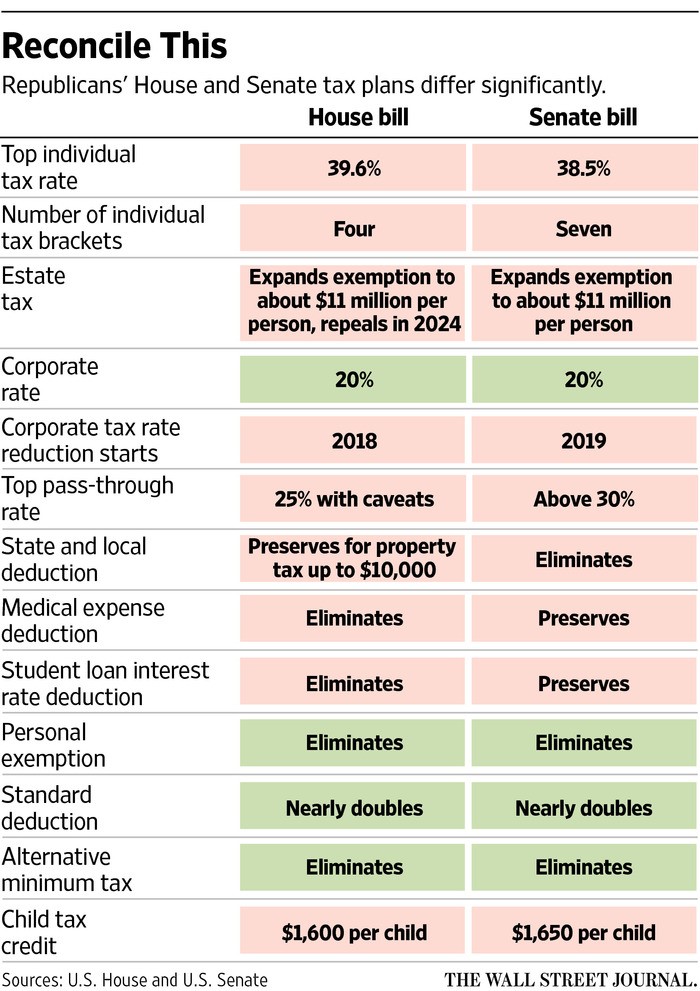
The House has one, and the Senate has one.  The Wall Street Journal, oddly, is making out like the differences between the two are enormous.  Yet, here’s the WSJ‘s own chart illustrating these humongous differences.

The big differences the WSJ singles out are these:

The big ways the Senate version breaks with the House plan: the level of top individual tax rates, the number of individual tax brackets, the timing of a corporate tax-rate cut and the particulars of estate tax changes[.]

How big are these differences, really?  The top level doesn’t even differ by a per centage point, and the number of brackets only differ in how finely income should be subdivided.  The timing of the corporate tax-rate is a matter of a year, again a small difference: put it in place in 6 months, rather than immediately; cut the rate to 27% this year and 20% next; and on and on—even trading this year vs next for something else.  Estate tax changes differ only in repeal or not—in 6 years, a lifetime in politics, a complete Senate election cycle.

Even the differences the paper elides, keeping or eliminating deductions for SALT, medical expenses, and student loan interest, is tiny.  Most folks don’t itemize, which is the only place these deductions even exist, and with the standard deduction doubled all around (personally, rather than a single/married standard deduction, I’d rather see the standard deduction keyed to the then-current year Federal Poverty Guideline, but that’s a trivial difference at present, too) and lowered personal income tax rates, the value of those deductions shrinks even further, especially for those who still would itemize.

No, the two versions blatantly, firmly, agree on the principles and the degree to which those principles should be satisfied in the tax reform effort underway.  They differ on numbers and timing—all small things that are easily resolved, except to the extent the Republican Snowflake Three in the Senate get in the way and to the extent the My Way of the Highway collection of House members let their egos get in the way.

Disrespect

The House of Representatives held a moment of silence Monday out of respect for and sympathy with the victims and surviving family members of the Texas church shooting.

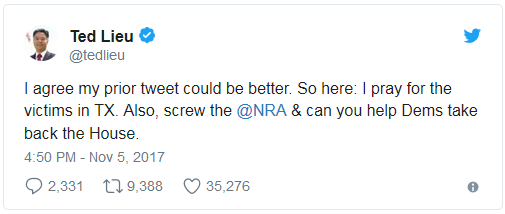
Congressman Ted Lieu (D, CA) walked out on that moment, and he’s proud of his disrespect, posting a video of his excuse on the Internet.  That excuse centered on his crocodile tears over not being able to get knee jerk gun controls enacted.

Then he added empty rhetoric:

Because his feelings are more important than a respectful moment of silence.  And he’s paraphrasing Rahm Emanuel’s remark about crises: Lieu isn’t letting a tragedy go to political waste.