
When I Get Around to It

Senator Al Franken (D, MN) announced on the Senate floor—where, among other things, nothing he said would be actionable in a court of law—that he would resign from the Senate as a result of the plethora of women’s accusations of him sexually abusing and assaulting them.

When will he resign?  When he feels like it (my words).  In the coming weeks (his words).

Franken also said he appreciated the

irony that I am leaving while a man who bragged on tape about his history of sexual assault sits in the Oval Office, and a man who preyed on young girls runs for Senate with the full support of his party

With a couple minor details that give the lie to everything Franken says.  We have hard evidence of Franken’s assaults, and we have his confessions, and we have in his own words what he thinks about his own apologies.  What we have on Franken’s tape is Trump’s bragging about the ability to assault women, not about any actual assaults.  Franken knows this.  Franken also knows full well that Ray Moore, the candidate he was afraid to name, has been accused, but there’s no evidence of wrong-doing—only the unseemliness of a 30-year-old man dating teenaged girls, after first asking and receiving the parents’ permission.

The Progressive-Democratic Party members of the Senate (and of the House, come to that) know this, full well, too.  We’ll see in short order how soon or far away that Party’s leadership thinks “in the coming weeks” should really be.
Why Not All of Them?

President Donald Trump wants Congress—which is to say, Republicans, since the Progressive-Democrats in Congress want nothing to do with any Trump or Republican generally proposal—to take up welfare reform as the next major Government revamp after tax reform goes through (assuming, of course, a few Republican ego-riven snowflakes don’t blow that up).  However, Louise Radnofsky, who wrote the WSJ piece at the link, seems not to understand the scope of the problem.  Commenting on a speech concerning the matter that Trump gave in Missouri a bit ago, Radnofsky wrote this:

The president didn’t offer specifics about which of the dozens of welfare programs he was seeking to change….

How about all of them, Madam?

As Trump put it in that speech,

I know people that work three jobs and they live next to somebody who doesn’t work at all.  And the person who is not working at all and has no intention of working at all is making more money and doing better than the person that’s working his and her ass off….

Now, it’s certainly true that there are welfare queens who are too lazy or too greedy to do actual work when they can get OPM for free.  They’re a small majority, though; most folks have enough self respect to want to work for their living and earn their way.  However, it far too often makes no economic sense whatsoever for them to do so.

Too many folks are trapped in the Progressive-Democrat welfare cage because they don’t have the skill sets needed to get jobs that pay as well as their aggregated welfare checks—and those that would work anyway are steadily being priced out of the low-skill jobs they would take by spreading minimum wage laws that require employers to pay more than the work available is worth.

Then there’s the welfare cliff.  Far too often, getting a job or a better job than the one currently held, or even simply accepting a pay raise, would put the person into a high(er) income bracket that would result in a cut in welfare payments greater than the value of the job, the better job, or the pay raise.  This net reduction in income would be lunacy, except for its effect on keeping folks trapped and voting for the politicians who control the handouts.

Reform all of the welfare programs, reform our welfare system as a system, and reform it extensively.  Go down, Trump and Congress, and let these people go.

How Close Are the House and Senate Tax Reform Bills?

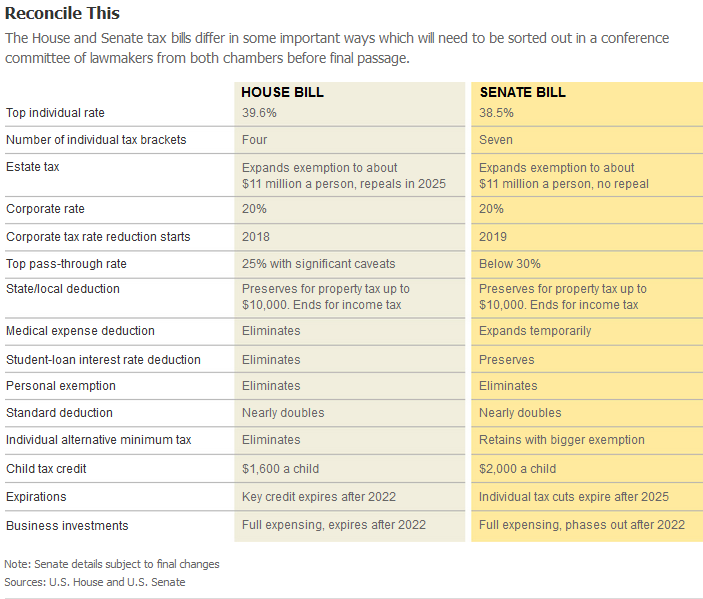
See the table below, from The Wall Street Journal.  While the Left and its NLMSM emphasize the differences, and the Progressive-Democratic Party denizens rail at the claimed iniquities in their manufactured dudgeon, the tax reform bills on offer from the House and the Senate are remarkably similar.  The agree right down the line on the goals of tax reform, and they agree right down that same line on the means of achieving those goals.  The differences between the two bills are matters of degree, details bordering on trivial.

Tax rates and brackets differ only slightly, even the Senate’s seven brackets only amount to a finer parsing of income.  In both bills, the death tax disappears for at least eight years—four House election cycles, a Senate election cycle, and two Presidential election cycles.  It’ll be tough, even for the Progressive-Democratic Party, to let the death tax reappear after that amount of time, and the same difficulty will exist for letting the individual tax cuts disappear.

The biggest difference is with the Medical Expense deduction, but that effect on our general taxes or on Federal revenues flowing from the tax code reform is minor; settling it entirely in favor of one house or the other, without compromise, should be easily doable.

The House-Senate Conference should be able to settle these minor differences quickly.  Whether the Conference Bill passes both houses then will depend in large part on the egos of a very few snowflake Republican Senators.  Keep their votes in mind come primary season.

Tax Reform and SALT

The Wall Street Journal Friday opined that a House-Senate conference on the tax reform bills passed by the House and then-on offer by the Senate (since passed, with some changes to the on-offer version) could improve on the two bills and produce a better one for final passage and President’s signature.  The Editorial Board is right as far as it goes.

Notably in the context of their piece and this post, one of those changes to the Senate’s version that was included in what finally was passed was a change to their complete removal of State and local taxes: the Senate-passed version now includes the House’s deductibility of up to $10,000 in property taxes paid.

But the Editorial Board included this in their piece:

…the bill’s biggest flaw, which is a lousy individual tax reform that raises taxes on many Americans in high-tax states. Eliminating the state-and-local income tax deduction, as both bills do, is sound policy. But the bills don’t offset that with a corresponding reduction in the top marginal tax rate.

This is disingenuous because the editorialists know better. It’s certainly true that, with SALT deductions severely restricted (only that $10k max deduction), citizens of Progressive-Democratic Party-run States likely will pay more in State and local taxes. But to call this a raise in taxes on those Americans is obviously false. Those (excessively) high State and local taxes were already in place, and the House and Senate tax reform bills do not, cannot, touch them.

The “offset” needed is not a “reduction in the top [Federal] marginal tax rate;” although such a reduction would be optimal in its own right.  No, the offset actually needed is for State and local politicians, with encouragement from those States’ Congressional delegations, to reform their own tax codes and reduce their own States’ spending.

It would seem that some members of the “Editorial Board” reside in New York and New Jersey while others phone it in from California.

Law Be Damned

The city of Seattle passed a law earlier this year that levied an income tax on the city’s wealthiest—all in the name of equality of outcome and so…fairness.

It turns out that tax was contrary to the State’s law, which said that only the State can levy an income tax and, explicitly, cities cannot.  The question also was raised regarding whether the Seattle law was even contrary to the State’s constitution—illegitimate—as well as illegal, but the judge avoided the constitutional question.

King County Superior Court Judge John Ruhl ruled in a Wednesday that Seattle did not have the authority to impose the tax because state law prohibits tax on net income.

Seattle’s City Attorney Pete Holmes and Mayor Tim Burgess demurred.

We are also living in a time of extreme income inequality that corrodes our social compact and causes many to wonder whether wealthy individuals are paying their fair share[.]

Because their goal is worthy, so the law should be disregarded.  And

Councilmember Kshama Sawant told Fox News in July that the need for the tax is “crystal clear.”

Again, goals, but let’s skip the inconvenience of law or of adjusting particular ones.

It just doesn’t matter what the law requires.  Never mind, either, that the State’s voters have repeatedly defeated such a tax on State referendums.  The Left demand to do what they want, when they want it, because that’s all that’s…just.

As an aside, it should be noted that Holmes and Burgess, in demanding the rich pay their fair share, carefully decline to say explicitly what level of wealth constitutes “the wealthy,” although the level is implied by the erstwhile tax’s threshold, and they carefully decline to say what that “fair share” would be: what per centage of the city’s taxes should be paid by “the wealthy,” especially in comparison with what the “fair share” of the city’s taxes paid by the various levels of the non-wealthy would be.