House 2013 Budget Blueprint

This is, indeed, a contrast in visions.  We are in the middle of a struggle for the future of our country, and the budget blueprint lays out the parameters of that struggle.

This table, from the House’s Committee on the Budget’s Web site, lays out the contrast pretty clearly.


The President’s Budget

House Blueprint

pending

Net $1.5 trillion increase relative to current policy Cuts spending by $5 trillion relative to President’s budget

Taxes

Imposes a $1.9 trillion tax increase; Adds new complexity and new hurdles for hardworking taxpayers, making it more difficult to expand opportunity Prevents President’s tax increases; Reforms broken tax code to make it simple, fair, and competitive; clears out special interest loopholes and lowers everybody’s tax rates to promote growth

Deficits

Four straight trillion-dollar deficits; Breaks promise to cut deficit in half by end of first term; Budget never balances Brings deficits below 3 percent of GDP by 2015; Reduces deficits by over $3 trillion relative to President’s budget; Puts budget on path to balance

Debt

Adds $11 trillion to the debt – increasing debt as a share of the economy – over the next decade; Imposes $200,000 debt burden per household; Debt skyrockets in the years ahead Reduces debt as a share of the economy over the next decade; Charts a sustainable trajectory by reforming the drivers of the debt; Pays off the debt over time

Size of Government

Size of government never falls below 23 percent of the economy, making it more difficult to expand opportunity Brings size of government to 20 percent of economy by 2015, allowing the private sector to grow and create jobs

National Security

Slashes defense spending by nearly $500 billion; Threatens additional cuts by refusing to specify plan of action to address the sequester; Forces troops and military families to pay the price for Washington’s refusal to address drivers of debt Prioritizes national security by preventing deep, indiscriminate cuts to defense; Identifies strategy-driven savings, while funding defense at levels that keep America safe by providing $554 billion for the next fiscal year for national defense spending

Health Security

Doubles down on health care law, allowing government bureaucrats to interfere with patient care; Empowers an unaccountable board of 15 unelected bureaucrats to cut Medicare in ways that result in restricted access and denied care for current seniors, and a bankrupt future for the next generation Repeals President’s health care law; Advances bipartisan solutions that take power away from government bureaucrats and put patients in control; No disruption for those in or near retirement; Ensures a strengthened Medicare program for future generations, with less support given to the wealthy and more assistance for the poor and the sick

A couple of comments are in order (I’ll ignore the political hype in the characterizations in both sides of this table and address only the actual data provided).

First, notice that President Obama’s budget (about which neither he nor his Senate Democrat minions are serious; this is just a campaign speech) both increases Federal spending an enormous amount and increases taxes even more.  This certainly is one way to balance the budget (IFF the tax revenues resulting from those increases actually occur; however, raising taxes actually lowers tax revenue flowing by reducing the economic activity that produces those revenues), but it does so at the expense of our economy’s ability to function.  It constitutes $3.4 trillion dollars taken away from individual Americans and our businesses, either directly—those taxes—or indirectly by taking our spending decisions away from us and putting them into the hands of the Federal government.  It says that we Americans are utterly incapable of making our own money allocation decisions; we must yield those to our Betters in government.

The House budget blueprint, though (it’s certainly true that it could serve as a campaign speech, but it has the added—and critical—advantage of being an actual, workable budget blueprint), recognizes two fundamental things: the money involved is ours, not government’s; we only allocate some of our money to government to spend on our purposes (and not on government’s purposes).  Secondly, the government does not need the money, it does not need those taxes; government does need to spend less.  Period.  It really is that simple.

My second comment concerns the two plans’ attitude toward the appropriate size of government and from that their attitudes toward us Americans.  Obama wants to expand government, not only in size but in authority over our lives.  Government is the answer to our problems, and so the Progressives seek to increase our dependency on government.  Moreover this increase in dependency is not limited to those of us who already are government dependents.  Progressives want to make us all government wards.  We cannot be trusted to work out our own solutions, to make our own decisions.  We’re just not good enough at it.

The House blueprint, in stark contrast, shrinks the size and power of government.  This blueprint respects and trusts us Americans to make our own decisions, and to do a better job for each of us individually, as well as for any groups of us, than government can ever hope to do.  After all, at best, government is limited either to a one-size-fits-all solution (which perforce actually fits no one) or to a collection of “solutions” tailored to groups of us (groupings defined by government, mind you, not by us) that demands an army of bureaucrats to administer and another army of lawyers to interpret and defend.

The choice, then, is clear: whom should we elect this fall?  A collection of politicians who don’t trust us with our own lives, or a collection of politicians who are looking actually to reduce government’s—and their—power over us?
JOBS

Who wants any of these?  Plainly not Progressives and their supporters.

The House of Representatives passed the Jumpstart Our Business Startups Act on 8 March by a vote of 390-23 (yes, that’s 158 Democrats in the House that also voted for this bill.  Apparently not all Progressives are anti-JOB).

But now that it’s in the Democratic Party-controlled Senate, where is it?  Senate Majority Leader Harry Reid refused to allow it to be debated and voted on unless he got his approved judges voted up in his “jobs for judges” debacle.

Others, Progressives and turf-protecting bureaucrats and unions, also have weighed in in opposition.

SEC Chairman Mary Shapiro, whose regulatory empire would be reduced, however slightly, objects to a provision to exempt companies with annual revenues less than $1 billion from a variety of regulations like Dodd-Frank’s executive compensation rules and duplicative Sarbanes-Oxley audits of internal controls.  Senate Majority Whip Dick Durbin joined this particular fray arguing that the agency that watched, while doing nothing, Allen Stanford and Bernie Madoff is somehow needed to oversee the next Bill Gates or Steve Jobs or Mark Zuckerberg.

The accounting firms that stood around and watched Enron and WorldCom are objecting to a reduction in the mandate (i.e., guaranteed business and fees) for their “services”  stemming from an exemption for new companies from critical parts of SOX.

Unions, worried about their own loss of power in a free market environment, object because—well, just because.

Senate Progressives (other than Reid) object because it came from a Republican House.

The Senate vote will be interesting to watch.

An Economy

President Obama is campaigning heavily, these days, on the strength of “his” economic recovery.  Let’s look at this recovery.

Peter Ferrera, cited in The Wall Street Journal, writes

From 1947 to 2007, the U.S. economy averaged real growth of 3.2% a year. At that rate, our GDP would double every 22 years. … Last year, U.S. real economic growth was a paltry 1.7%. The current quarter will probably not be much better.

and

[T]he American economy catching up to its long term economic growth trend line would mean the economy booming over the next 10 years with average annual real growth of 4.4%, and then continuing on after that at 3.2% real annual growth.  Ten years of 4.4% real growth would leave the American standard of living, and GDP, over 50% higher than today.  That is the boom this economy has in it naturally, with the right pro-growth policies just getting the government out of the way, and freeing the economy to grow.

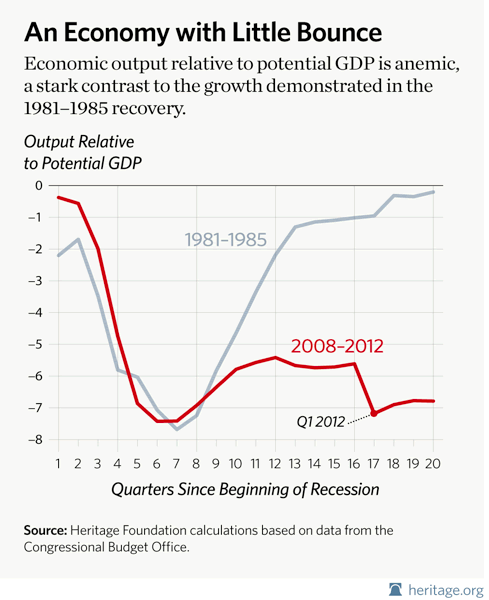
How are Obama’s policies doing?  Typical recession recoveries are faster and higher the deeper the recession from which we’re recovering.  This chart draws a comparison with our nearby history—the recovery from the recession of the ’80s, which was as deep and hard as the present one. The recovery just isn’t there very much.  Unemployment is falling off, and job creation is occurring (more on that below), but it’s anemic.  The zero-line represents full GDP output—our economy is operating on all cylinders—and three years after the ’80s recession’s deepest point, we were at full production.  With the current recession, it’s not even close.  In fact our current growth rate of 2.4% per year since the recession’s formal end in the spring of 2009 is the slowest rate since WWII.

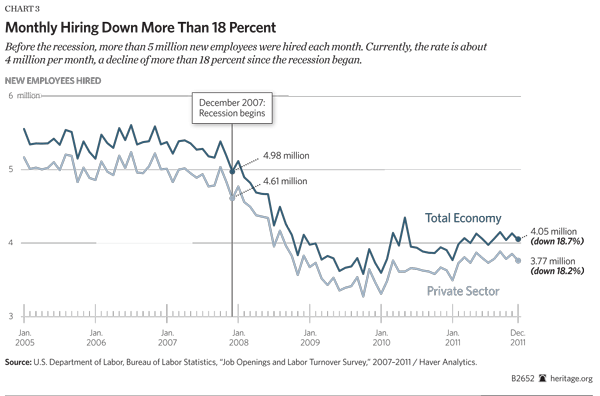
The next three charts look at our labor—our employment—picture in particular.

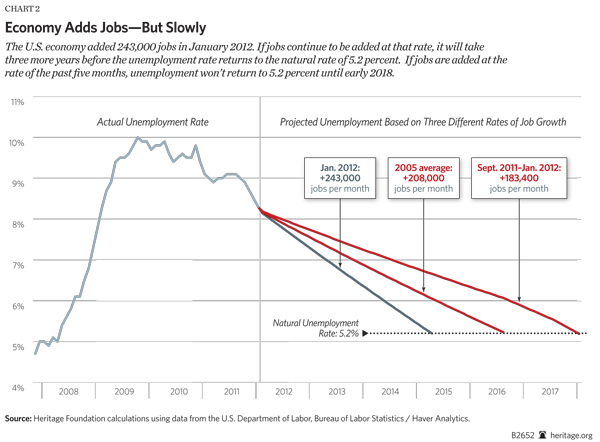
This chart looks at three different growth rates and the time from today to full employment.  If employers continue to add jobs at the same rate they did between September 2011, when unemployment began to improve, and last January—183,400 jobs per month—the unemployment rate won’t reach even 7.8% for another 20 months, December 2013, and will not full employment for five more years: January 2018.  Even if employers add jobs at their 2005 pace, we won’t reach full employment until mid-2016, and if January’s unusual rate is continued, we’re still looking at mid-2015 before reaching full employment.

This next chart gives another look at our future.

Fewer existing businesses are hiring, and fewer entrepreneurs are starting new businesses; there are fewer jobs for the unemployed.  Moreover, it takes time for startups to grow and to increase their hiring, just as it does existing businesses to recover, resume growing, and increase their own hiring.  Delays now in growth and job creation mean continued delays tomorrow in getting growth going and hiring to increase.

The next chart shows the falling labor participation rate in our current economy.

The present  63.7% of adult Americans active in the labor force (either employed or looking for work) is the lowest participation rate since 1983—when far fewer women were working.  Keep in mind that this historically low participation rate artificially reduces the measured—headline—unemployment rate because folks not looking for work aren’t counted as unemployed.  The Congressional Budget Office estimates that the unemployment rate would be 1.25 points higher—9.45%—if labor force participation were at normal levels.

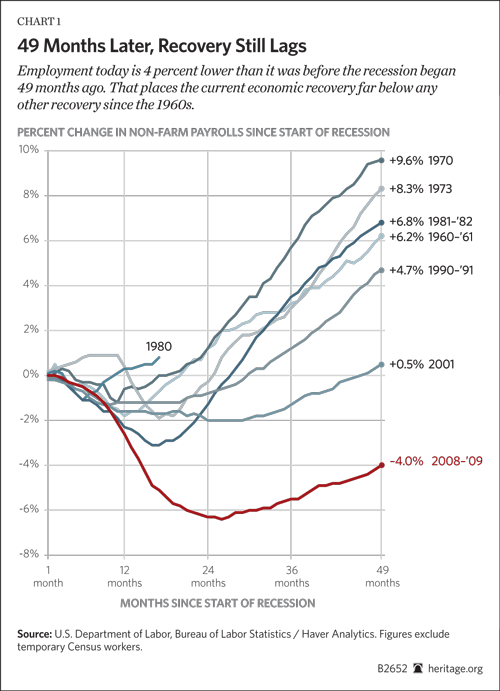
Finally, how does our current recession…recovery…compare with past recoveries?  This last chart is illustrative.

In every prior post-war recession, employment has fully recovered within four years.  As of December 2011—four years after the recession’s onset—payroll employment remains 4.0 percent below the number of workers employed when the recession started in December 2007. Private-sector employment is 4.5 percent below pre-recession levels.  That represents 5.6 million net fewer jobs; 5.2 million of those net job losses occurred in the private sector.

In sum, as The Heritage Foundation points out,

It’s the natural tendency for the economy to grow—and taking credit for its meager improvement is sort of like accepting kudos for the rising and setting of the sun.

We have any sort of recovery at all solely because of that natural tendency to grow.  What are the differences between our current straits and past recession recoveries?  Obama’s policies are of a kind with a prior Progressive President, Franklin Roosevelt.  Both sets of policies centered on expansive, intrusive government, increasingly interfering with the operation of our free market and even going so far as to dictate what individual Americans are permitted—or required—to do in the market place.  All for our own good.  Just as those policies so tragically prolonged the Depression of the ’30s, so are these policies prolonging the current recession’s effects.

On the other hand, when met with shrinking government and reducing personal and business tax rates, as Jack Kennedy (!) and Ronald Reagan, for instance, did, our free market economy responded with rapid, prolonged growth.

I agree with President Obama.  The credit for these three years of historically poor economic performance is entirely his.

Private vs. Government Economic Stimulus

The New Orleans writer Douglas McCollam, in a recent The Wall Street Journal op-ed, described a New Orleans organization that is having an impact on that city’s economic welfare.  The nonprofit organization, Idea Village, it seems, has in its 10 years of existence helped raise $2.7 million

in seed capital for more than 1,100 local entrepreneurs, creating more than 1,000 jobs and $83 million in annual revenue—and these days helping the city’s unemployment rate stay about a point to a point-and-a-half below the national average.

That’s money raised from private sources and voluntarily paid in, not tax money collected by a government.  In addition to Idea Village’s efforts, health care and education are benefitting from private enterprise efforts, rather than government handouts:

Today about 80% of the city’s public schools, formerly among the nation’s worst, are charter schools competing on performance to attract students.  The city’s antiquated Charity Hospital will soon be replaced by a state-of-the-art medical center, part of a larger, 2.4-square-mile medical corridor anchored by a new cancer research facility and BioInnovation Center.

With tax incentives (read tax cuts), New Orleans is about to replace New York City as the second largest venue for making feature films (Los Angeles remains No. 1).

Look again at Idea Village.  In its 10 years, it’s returned on those $2.7 million 30 times that amount in annual revenue.  And those jobs have cost $2,700 per each.

How does that private stimulus money raising and spending compare with government stimulus money taxing and spending?

President Obama and Vice President Biden are constantly claiming that Obama’s Stimulus spending has “created or preserved” millions of jobs in just three years.  They have steadfastly refused, though, to provide any evidence that that’s true, or that jobs created or preserved are the result of that trillion-dollar spending spree in 2009 and not the result of a struggling, otherwise ordinary, business recovery cycle—beyond anecdotal claims from state agencies beholden to the Obama administration for that money and for other billions they each hope to get in the future.

Let’s accept arguendo that the Obama claims are reasonably accurate, though.  $1 trillion dollars from the Stimulus Bill of three years ago has created or saved 3.2 million (the most frequently tossed about number) jobs in these last three years.  That works out to $312,500 per job created or saved.  Sorting out only the created jobs (were that possible) would drive that cost per job even higher.

And the return on those trillion dollars isn’t at all positive.  Meanwhile, the unemployment average remains, three years after Obama’s promise, above 8%.

Hmm….

Pause for Commercial

My book, A Conservative’s Manifesto: A Brief Discussion of some Principles, has been published, and it can be found, among other places, at Amazon.com (paperback, Kindle, or hardcover) and at Barnes & Noble (paperback, Nook, or hardcover). Links also can be found nearby in the column to the right and on the newly added Books page.

The book lays out, in so many words, a set of (modern) Conservative principles that are tied back to the 18th Century Liberal principles that guided our Founding Fathers in developing our American social compact.  I begin with a description of those 18th Century Liberal principles and continue with a description of our drift away from them over the last 80 years, beginning with FDR’s administration.  I also describe a modern Conservatism that is those 18th Century Liberal principles brought forward to today, and I apply those principles to a number of critical aspects of American life: faith, citizenship, the nation, our economy, and our government.  I close by contrasting modern Liberal/Progressive concepts with these modern Conservative concepts and offering a path back to those modern Conservative tenets that made our country so exceptional and so great.

I hope you find it both enjoyable and useful.