Collapse of the Euro?

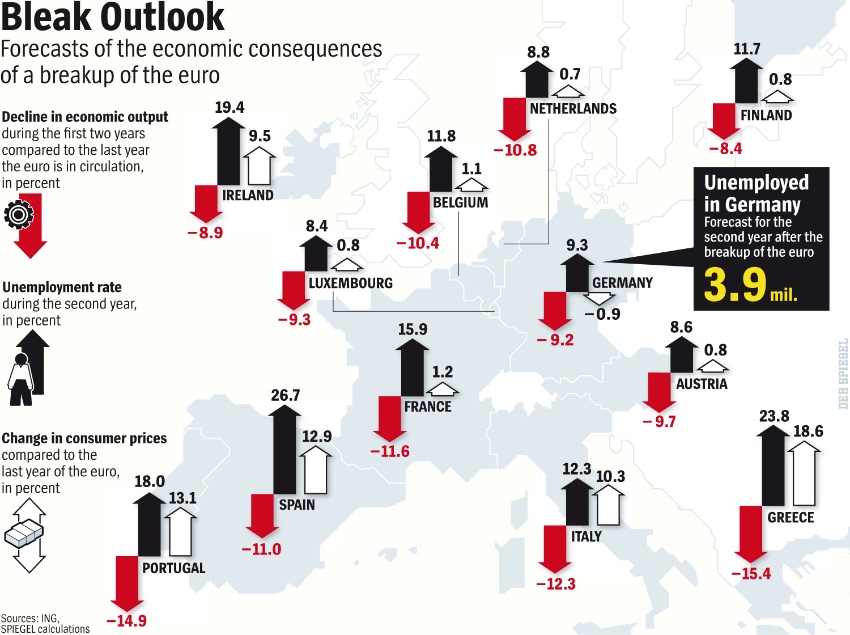
Much is being made of the impending collapse of the euro, and of the disaster this would represent for Europe.  Indeed, a graph published by Spiegel Online can look frightening:

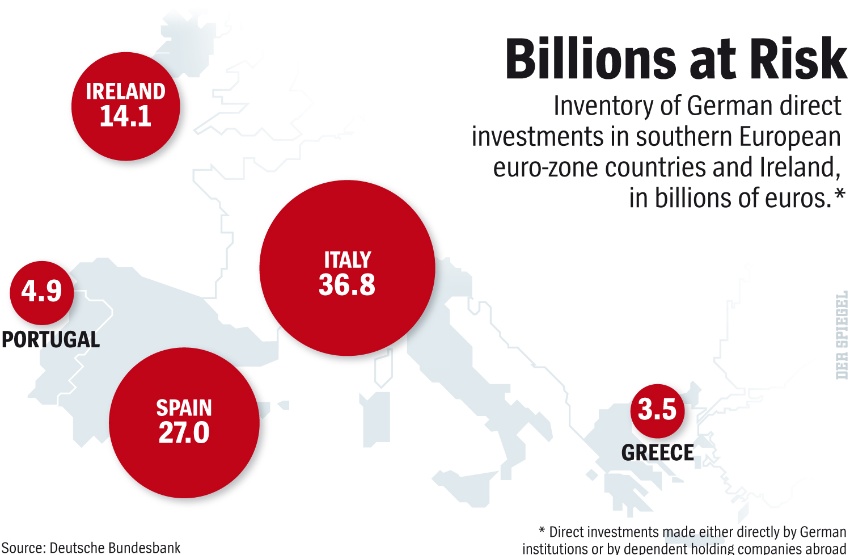
The risk to Germany in particular?  Much is made about the money Germany and Germans have in some of the PIIGS, as the graph below indicates.

But against the German 2011 GDP of €2.57 trillion, this totals to less than 4%.  That will sting, but not much.

As I’ve written before, a breakup would be near-term disruptive.  But what happens after those two years of the first graph above?  There needn’t be a disorderly collapse.  Even this short term disruption (pop quiz: what are the current inflation and unemployment rates in the PIIGS?), the stronger economies will recover, and do so faster without the albatross of the profligate spend-and-borrowers dragging on their wallets.  Furthermore, it’s not too late to realign into a small collection of smaller common currency regions, each with free trade agreements with the others.  Within each smaller currency region, there would be a far larger opportunity for social, political, purpose-of-money homogeneity, and so a far greater chance of success.

The single alternative of every nation for itself with its old currency back is simply the other half of a false dichotomy presented by Spiegel Online—and by Europe’s politicians, who have a personal interest in the continuation of the current, failing, structure.

An Old Dead Guy’s View of National Debt

On this, the 80th day shy of the 215th year since George Washington’s Farewell Address, an anniversary made notable by our present astronomical and exploding national debt, I thought I’d post what that old dead guy had to say about national borrowing and national debt.

The short version is, “Don’t do it, and don’t have it.”  Following are his specific words.

As a very important source of strength and security, cherish public credit.  One method of preserving it is to use it as sparingly as possible: avoiding occasions of expence by cultivating peace, but remembering also that timely disbursements to prepare for danger frequently prevent much greater disbursements to repel it; avoiding likewise the accumulation of debt, not only by shunning occasions of expence, but by vigorous exertions in time of Peace to discharge the Debts which unavoidable wars may have occasioned, not ungenerously throwing upon posterity the burthen which we ourselves ought to bear.  The execution of these maxims belongs to your Representatives, but it is necessary that public opinion should cooperate.  To facilitate to them the performance of their duty, it is essential that you should practically bear in mind, that towards the payment of debts there must be Revenue; that to have Revenue there must be taxes; that no taxes can be devised which are not more or less inconvenient and unpleasant; that the intrinsic embarrassment inseperable from the selection of the proper objects (which is always a choice of difficulties) ought to be a decisive motive for a candid construction of the Conduct of the Government in making it, and for a spirit of acquiescence in the measures for obtaining Revenue which the public exigencies may at any time dictate.

Notice that bit about taxation, too.  Taxes are for paying down the national debt and for the common defence, not for frivolous spending.  But again, the overriding imperative this Founder laid out is that our nation’s debts should be kept small by keeping spending small, and those debts should be paid by the generation that incurred them—not visited on our children’s children.

We citizens bear an additional responsibility in this, too: not to make frivolous demands on government to do for us that which we should—and can—do for ourselves.

Á propos is this remark by David Ricardo in response to Great Britain’s decision to print fiat money in an effort to increase funding for their war against Napoleon (one of those “unavoidable wars” to which Washington would have been referring, and not too far removed in time from Washington’s address):

Why should the mere increase of money have any other effect than to lower its value?  How would it cause any increase in the production of commodities? ….

Money cannot call forth goods, —but goods can call forth money…[.]

Food Stamps and Poverty

John Hinderaker, at Power Line, notes that the Progressives in the Senate have voted down even a modest (some might say trivial) reduction in Federal spending on food stamps—using your tax money.  (Note, by the way, that 100% of the spending on food stamps is by the Feds; no state spends one red cent of state monies on these.)  The offered reductions were in the form of three  amendments, two put forward by Jeff Sessions (R, AL):

  • establish a federal asset test to ensure that food stamps aren’t going to families that may not have an income but have tens of thousands of dollars in savings or may even live in a million-dollar home
  • prevent states from waiving federal eligibility requirements for the program
  • eliminate the bonuses that the federal government now pays to states that deliberately swell the ranks of food stamp recipients.

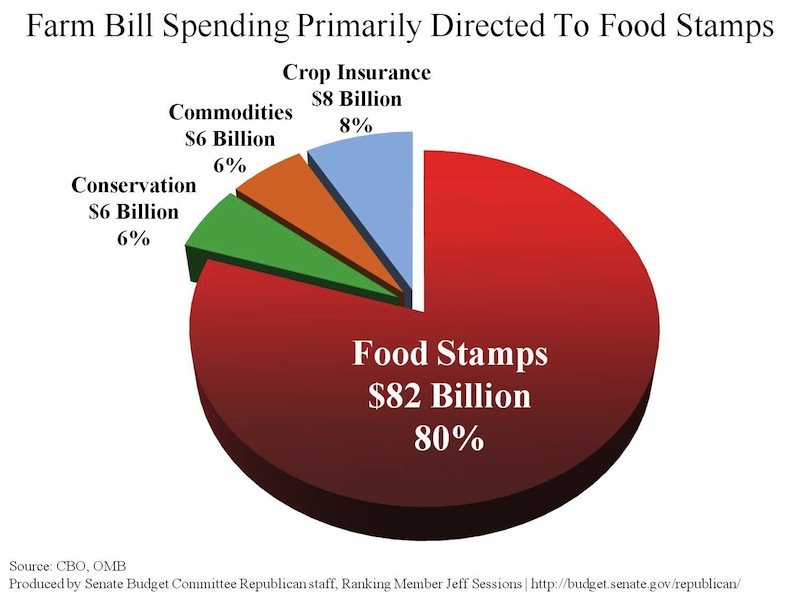
The spending mandated by the Farm Bill to which these amendments were to be attached is shockingly weighted, as this graph shows: There are a couple of other aspects of this Progressive demand to spend your money on their food stamps.  Forty-six million Americans currently live below the poverty line as a result of President Obama’s failed economic and social welfare policies.  Thirty-nine states have no limits at all on the fiscal well-being of a family in determining that family’s eligibility for food stamps—anyone who applies qualifies—and twenty-eight states have limits that are more than 130% above the Federal Poverty Guideline (which differs in a trivial way from the Federal Poverty Threshold that the Census Bureau uses to determine the number of Americans living in poverty).

Of those 39 states (the full list can be seen in Table 1 of the Congressional Research Service’s “The Supplemental Nutrition Assistance Program: Categorical Eligibility“), California, Illinois, and New York alone account for 70.5 million Americans.

Under Federal law, which the Progressives have refused to alter in any meaningful way, vastly more Americans are eligible for food stamps than are actually living in poverty.  Food stamps no longer are a program to help the needy; they’re a program to get and keep Americans dependent on a Progressive-run government for their welfare.  They’re a Progressive Incumbency Welfare program.

Failure of the Euro—a False Fear from Moral Hazard

“The euro is in trouble and only Germany can fix it.”  That’s the meme—and the fear—described in a recent Spiegel Online piece.

Much of the euro zone and EU “leadership” is pushing for a “bank union,” a “debt repayment fund,” a communalization of (southern Europe) debt across Europe in the form of euro bonds.  Without one or more of these, goes the plaint, there is no way to stop the debt crisis.

But these worthies make no coherent case for why the taxpayers of one country should be held liable for the debts of other countries’ governments—or of other countries’ private institutions.  Indeed, this amortization across the sound and responsible can only damage, if not break, the sound and responsible economies and create an enormous moral hazard by indemnifying the irresponsible from the consequences of their profligacy.  This indemnification can only encourage yet more of the same.

Subsidizing anything only produces more of that thing, without making it any more accessible to the originally targeted population, and the schemes above only subsidize borrowing.  This is the way to prolong the debt crisis, it is not a solution to it.  These proposals do not even pretend to an imposition of fiscal discipline, either from within the fiscally irresponsible nations themselves or from without by the sound nations withholding further lending.  The courses proposed will only have the effect of punishing the sound for their soundness and they will reduce those sound nations’ own willingness (much less their ability) to maintain their own fiscal responsibility.

If euro bonds were introduced, goes one claim, countries like Italy and Portugal could take on large amounts of new debt without having to fear effective monitoring of their government spending.  Yet this is an aspect of moral hazard.  Jens Weidmann, President of the Deutche Bundesbank, the German central bank, points out that if debts were shared, “liability and control would have to be in conformity with one another.”  Indeed.  But if such unity were achieved, the empirical evidence demonstrates that it would be by loosening the discipline of the responsible countries, the direct opposite of the needed outcome.  The profligate borrowers, bailouts in hand, will have no incentive to mend their own ways, to seek discipline.

Italy, for instance, has a debt-to-GDP ratio of 120 percent. The proposed courses of action would mean that Rome could transfer a significant fraction of its debt to a shared euro debt fund, for instance.  The Italians thus would have even less incentive to introduce necessary structural reforms.   There’s that moral hazard.

For all this, Sabine Lautenschläger, Vice President of the Deutche Bundesbank, points out that when there is a crisis in a national banking system, “it may be necessary to use the money of taxpayers in other countries.”  This is moral hazard carried to the point of naked freeloading.  “I exist, and you have money.  Therefore, you owe me.”

The matter is emphasized by the current bailout of Spanish banks, long resisted by Prime Minister Mariano Rajoy, and the market’s recognition of the failure of such a thing: following news of the loaning of €100 billion ($126 billion) to Spain’s larger banks, the financial markets pushed Spanish borrowing costs to recent year record levels.  And of course the markets reacted badly: they correctly recognized this as simply adding debt to a debtor who has said he’s unable to repay existing debt.  Rajoy was correct to resist the bailout for as long as he did, and he was wrong finally to accept it.  He has only increased the danger to Spain.

That’s the moral hazard; now we get the Chicken Little act: “senior officials” in Berlin are openly discussing the possibility that the euro could fall apart, and Christine Lagarde, Managing Director of the International Monetary Fund, insists with a straight face that there remain only “three months” to save the euro.  A senior euro-zone diplomat in Brussels bleats, “If Germany doesn’t make a move, Europe is dead.”

There’s more: Germany already has billions of euros invested in preserving the currency zone says Spiegel.  And so they must pony up yet more, or lose the sunk investment.  This, though, is the amateur investor’s error: being married to a failed position.  Insisting on holding to that failure, even adding money to it, in the hope that the investment will, eventually, finally, turn around and the losses be recouped is a fool’s hope.  In reality, the losses continue to mount as the failure deepens, and the final bankruptcy is that much more expensive, because the amateur investor will have lost that much more.  The best move for a failed investment is to cut the losses by terminating the investment, painful as that may be.  So it is with the nations’ sovereign debt.  Cut the losses.  They’ve already demonstrated they cannot repay—adding to their debt burden only makes their inevitable bankruptcy that much more disastrous.

Yet the fear of dissolution is both unfounded and misdirected.  After the inhomogeneity of social, political, money purpose imperatives of the euro zone nations, the next greatest risk to the euro is this moral hazard.  Eliminating the moral hazard would strengthen the EU and the euro zone, not destroy it.  Let the bankrupt go bankrupt, stop propping them up with more debt funded with OPM.  Fiscal discipline—as the northern European countries, especially Germany, have demonstrated—is the road back, to the extent there is one, with that inhomogeneity barrier in the way.

Indeed, that inhomogeneity demonstrates another aspect of the crisis.  Each PIIGS’ problem and situation is unique, beyond the general theme of irresponsible spending and borrowing.  Each solution must be unique, beyond the general theme of no bailouts from outside.

As Churchill once said, these folks are killing the wrong pig.

Whither Responsibility?

The financial crisis threatening the Spanish government deepened Thursday as its borrowing costs hit a new euro-era high, touching levels that previously forced other euro-zone countries to seek sovereign debt bailouts.

So writes Jonathan House in a recent Wall Street Journal article.  Emese Bartha echoed the sentiments in her own WSJ article.

The Italian government’s borrowing costs soared at a bond auction Thursday, a development that will make it more difficult for Prime Minister Mario Monti to avoid having to seek financial help from other euro-zone members.

And just what are these nose-bleed borrowing costs that send whole nations scurrying for OPM?  They’re in the range of 6.0%-7.5% interest rates.  The Spanish 10-year bond, for instance, now runs for 6.96%, “a new euro-era record,” while the Italian 10-year bond goes for 6.23%.

What were the interest rates in another one-among-twenty or so nations (which august club includes these nations of the EU), the US at  the end of the Carter/beginning of the Reagan era?  In 1980, the US 10-year bond rate peaked at 12.84%; in 1981, it got as high as 15.32%.  Our 10-year bond rates had been above 6.96% since early 1974, and they didn’t fall below that level again until mid-1992.

Who bailed us out when we had such trouble?  We did.  We handled our own problems.

But there was a sense of responsibility in those days.  Today, it’s all OPM, and that’s a bottomless piggy bank from which every nation should be able to draw.