More Regulatory…Foolishness

Gordon Crovitz identified some.

The Obama administration’s standard reaction to technological innovation has been to block change via regulation….

Federal regulators are also putting the brakes on self-driving cars, which are closely related to the Uber innovation—enabling riders to order a car service using their smartphone app. If fast-moving technology hadn’t collided with slow-moving regulators, this might have been the last summer you’d have to drive your own car.

And

US regulators won’t let car manufacturers go much beyond what Mercedes now offers [active cruise control, automatic braking and lane-keeping technologies]. That means car makers can’t roll out technologies they already have, and auto makers in Europe, which has fewer regulations limiting technology, have surpassed their US competitors.

The National Highway Traffic Safety Administration has warned states not to allow fully self-driving cars, like the one Google is developing, except for testing purposes. The agency says it’s working on a study that will take at least until 2017. Regulators say they’ll release performance metrics for self-driving features, then run the tests, then issue regulations, and only then permit sales. Meanwhile, the agency has delayed a plan by Tesla to replace traditional side mirrors with more effective cameras.

In the end, it doesn’t matter whether or not this technology works as well as advertised. Existing liability law will deal with failures. This is Big Government regulating for no other reason than that it can. This produces the opposite of what government is required to do; one aspect of this requirement being clearly laid out in Art I, Sect 8, of our Constitution: To promote the Progress of Science and useful Arts….

Because, Big Government. Now shut up, and quit arguing.

Federal Strings

…and Federal arrogance.

No police department should get federal funds unless they put cameras on officers, Senator Claire McCaskill (D, MO) said today.

“It seems to me that before we give federal funds to police departments, we ought to mandate that they have body cams,” McCaskill said.

Body cameras on cops may, in fact, be a good idea. However, that’s a thing to be determined by the locals for themselves. This is another example of how the Federal government seeks to control State and local governments in the place of the State’s citizens and the local community members.

Police departments and the communities that employ them would be well served to reject these Federal funds and all other Federal funds that come with strings attached. They would be well served to do so even if they already meet, of their own accord, the criteria mandated by any Federal string—accepting such funds would be nothing less than the camel’s nose in their tent.

Another Look at Tax Inversion Mergers

Burger King Worldwide Inc is in talks to buy Canadian coffee-and-doughnut chain Tim Hortons Inc, a deal that would be structured as a so-called tax inversion and move the hamburger seller’s base to Canada.

After all, Canada’s corporate tax rate is competitive even with Ireland’s 12.5% rate, at least from the lofty perspective of our own 35% top corporate rate: Canada’s rate is 15%. This inversion isn’t just the fiscally sound thing to do, it satisfies the company management’s fiduciary duty to control costs and maximize profits for the company’s owners.

BK isn’t alone in moving to Canada:

Valeant Pharmaceuticals International Inc, which had been based in California, combined with Canada’s Biovail Corp in 2010 and redomiciled in Canada. The company now has a tax rate less than 5%.

And there are others.

Naturally, the Progressives in Congress and the White House—and no few captured Republicans—are demanding a stop to the inversions. Not in any sensible way, though. Treasury, for instance, is looking at a range of “options to deter or prevent” inversions.

No, BK’s pursuit of an inversion deal only illustrates the distorting, anti-competitive nature of our current tax code, and Treasury’s “options” will only make the thing worse. The right answer is to lower US corporate tax rates to competitive levels. When it becomes more attractive to be in the United States, to invest in the United States, to have a chance actually to turn a profit in the United States, not only will the BKs, the Valeants, and the AbbVies and Covidiens, et al., stay, foreign companies will look to come to the United States, bringing their ideas, their money, and their jobs here.

Even Canada, right next door (the convenience…), is becoming host to these things. But (even) Canada has been improving its tax structure for some years, lowering its corporate tax rate since 2005 from over 22% (still lower than the US’ then) to just 15%. Indeed, here’s a hint:

Tim Hortons [originally a Canadian company until its acquisition by Wendy’s] initially kept its headquarters in Delaware after it was spun off by Wendy’s in 2006. The chain moved back to Canada in 2009, shortly after the Conservative government in Canada lowered the nation’s corporate tax rate.

Obamacare and Jobs

The results are starting to come in, via three independently done polls by three separate Federal Reserve Banks.

The Federal Reserve Bank of Philadelphia:

  • 78.8% of businesses in the district have made no change to the number of workers they employ as the specific result of ObamaCare
  • 3% are hiring more
  • 18.2% are cutting jobs and employees
  • 18% shifted the composition of their workforce to a higher proportion of part-time labor
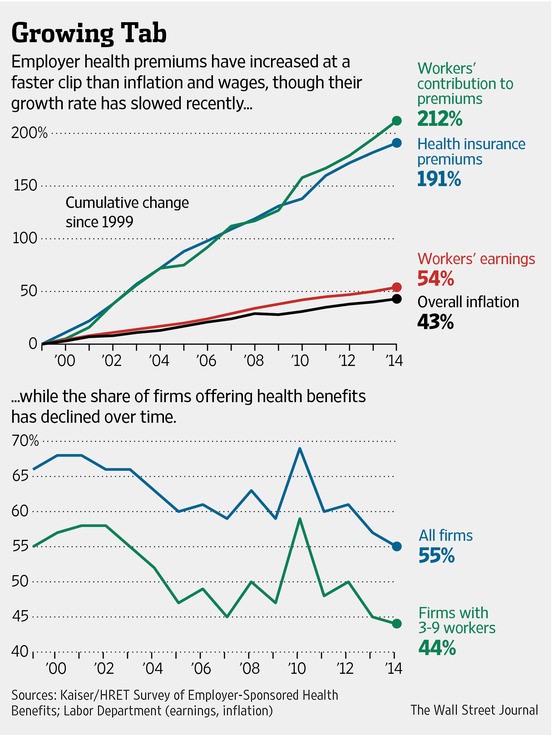
  • 88.2% of the roughly half of businesses that modified their health plans as a result of ObamaCare passed along the costs through increasing the employee contribution to premiums, an effective cut in wages

The Federal Reserve Bank of New York asked about the “number of workers you employ.”

  • 21% of Empire State manufacturers and 16.9% of service firms answered “reducing.”

The Federal Reserve Bank of Atlanta:

  • 34% of businesses planned to hire more part-time workers than in the past, mostly because of a rise in the relative costs of their full-time colleagues

And the pièce de résistance:

  • ObamaCare’s labor effects would be concentrated in some industries with relatively low-wage or marginal workers.

Hmm….

Drug Markets and Regulation

With this attitude, we’re not going to have much of a drug development or production industry—to the detriment of our drug market.

“A big part of our concern is not just Sovaldi [a new, and so still very expensive, drug with a near-perfect cure rate for Hepatitis C], but all the other specialty drugs,” said Mario Molina, the CEO of Molina Healthcare that runs Medicaid and ObamaCare plans in nine states, on a July earnings call. He added: “I think that the government needs to step in here and make sure that the market is rational. If we as a health plan want a rate increase, we have to go to our regulators and get it approved. There’s no such thing going on in the pharmaceutical market.

Molina’s last is a valid beef. Health plan providers shouldn’t have to go to government regulators to get permission to set a price, either. Government simply should not have that regulatory power. But a man used to government regulation, indeed who’s dependent on his company’s status as a protected oligopolist, no longer even can conceive of having to compete on price and service.

He concluded his plaint:

Right now, pharmaceutical companies can charge whatever they want, and I think there needs to be a rational basis for all of this.

Of course, there is exactly that rational basis: it’s the supply and demand price setting of a free market.  Again, though, a concept lost on a man of a protected oligopoly.