Inflation is Upon Us

…or is it?

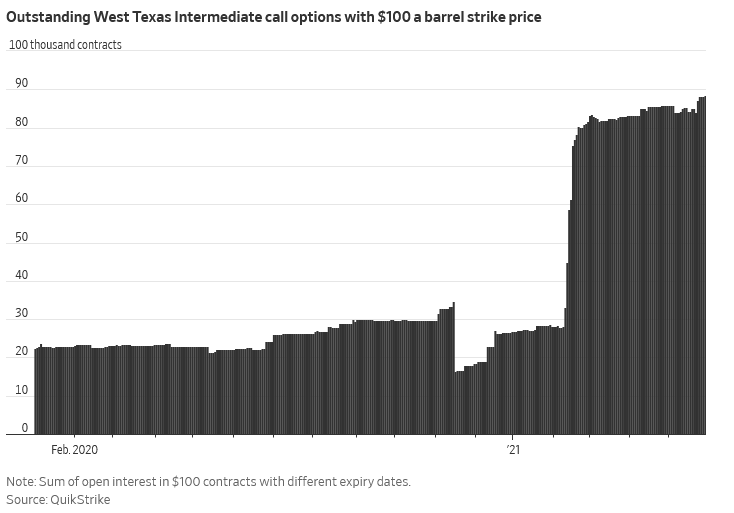
The editors at The Wall Street Journal worry that the current rise in inflation might not be as “transitory” as Fed Chairman Jerome Powell thinks it will be. It’s a concern worth taking seriously. As the editors cite Milton Friedman as saying,

inflation is always and everywhere a monetary phenomenon

and the Feds—and the Fed—have been pumping lots of tons of cash into our economy.

Couple of things, though, on this inflation…spike.

The current inflation is impacted by all the “stimulus” checks coming from the Federal government, and money is the source of demand, not how much folks want things. It’s money that pays the prices, not folks.

The current inflation also is impacted by the return to more normal pre-Wuhan Virus situation demand levels being faster than producers can ramp back up to meet that recovering demand.

That slower production ramp-up is itself impacted by producers’ inability to get employees back to work. So much of the value of those “stimulus” checks makes not working more valuable than working, and recipients, far from being lazy, are making the economically rational decision to not return to work yet.

Underlying all of this is that 2020 was an aberrational year. The economic drop was caused by politics, not a confluence of economic forces, and the present interference with recovery also is politically caused; a slowing unwinding of that confluence isn’t a factor. Inflation comparisons with 2020 are themselves distorted.

A better inflation measure would be against 2019.

Bipartisanship Progressive-Democrat Style

President Joe Biden (D) and his Co-President Kamala Harris (D)—it is, at Biden’s behest, the Biden/Harris administration—held an infrastructure meeting last Wednesday with Senate Majority Leader Chuck Schumer (D, NY), House Speaker Nancy Pelosi (D, CA), Senate Minority Leader Mitch McConnell (R, KY), and House Minority Leader Kevin McCarthy (R, CA) in which he pushed for acceptance of his $2.3 trillion version of an infrastructure bill along with his commensurately large tax increase plan with which he claims he’ll pay for his infrastructure plan.

Shortly after the meeting, Biden gave an interview to MSNBC, in which he said,

I want to know what we agree on and let’s see if we can get an agreement to kick start this, and then fight over what’s left, and see if I can get it done without Republicans if need be[.]

Since he’s going to pass his stuff along strictly party lines, anyway, what was the point of the meeting?

Plainly, Biden Bipartisanship—Progressive-Democratic Party Bipartisanship—means Republicans go along quietly or be kicked to the curb.

It’s Party’s version of republican democracy: Progressive-Democracy.

Necessary Corrections

Two, in fact, for a recent Wall Street Journal article concerning the blacklisting of People’s Republic of China smartphone manufacturer Xiaomi Corp. The blacklist barred US investors from investing in Xiaomi, and Biden is backing away from that.

The first correction is the article’s headline. Pentagon Backs Off Xiaomi Blacklisting After Legal Challenge s/b Biden’s Pentagon Backs Off Xiaomi Blacklisting After Legal Challenge.

It’s misleading to imply that the Pentagon did this on its own, without President Joe Biden’s (D) instruction, especially with the body of the article making it plain that the Pentagon, in its original action, was acting on then-President Donald Trump’s (R) instruction.

The second is this one. The retreat comes two months after Xiaomi won a key victory in a federal lawsuit challenging the listing… s/b Biden’s retreat comes two months after Xiaomi won a key victory in a federal lawsuit challenging the listing….

Biden didn’t even have the courage to challenge the DC trial court’s ruling in the DC circuit or, potentially, the Supreme Court. Overruling the trial court, even at the circuit level, would have been a distinct possibility.

Let’s Make Lots of Money

Sounds like a lyric from a Pet Shop Boys song.

The hackers who assaulted Colonial Pipeline, ostensibly for ransom, claim they

only want[] to make money, not disrupt society….

Never mind that their attack on a major oil pipeline does precisely that disruption.

Never mind, either, that these hackers aren’t total idiots—they knew their assault would disrupt a major segment of our economy and so our society. That was the purpose of the attack; this was no petty criminal act. Demanding to be paid by their victim is simply a distraction.

They claimed this, also:

From today we introduce moderation and check each company that our partners want to encrypt to avoid social consequences in the future.

Right. And they have some bridges across the Reka Vop’ to sell us, also. All illegal behavior, much less terrorist behavior, if left unanswered has social consequences.

No, these…personages…have simply applied a Willy Sutton tenet to their terrorism:

Go where the money is. Go there often.

Our Federal government, actively aided by our State governments, need to get aggressive with active responses to such attacks. The time for passivity, for merely acting defensively after the fact, is long past. Terrorists, physical or cyber, network entities or state-sponsored, need to be burned to the ground.

The negligence of company CEOs, COOs, and CIOs, including those officers at Colonial Pipeline, in not being serious about hardening their systems, also badly wants sanction.

Rule Making and Rule Enforcement Pauses

Commerce has a regulation, enacted in 2019 with effect last March (!), that

allows the government to block foreign telecommunication-gear imports and other business deals deemed a security threat[.]

There’s a clump of US businesses and trade groups that are pressing the Biden administration to “pause” enforcement while it

reviews the best path forward to working with industry on securing the [information and communications] supply chain[.]

There’s a larger problem here.

The objectors raise, entirely legitimately, let’s stipulate, concerns about this telecommunication-gear rule’s supposed excessive breadth of reach. However, willy-nilly cessations of enforcement just because this or that business or group gets a new administration to whom to object, is badly counterproductive. They are disruptive, they reduce predictability of the business environment impacted by that rule/regulation, and they raise the costs of doing business and through that costs to the end buyers.

If a business entity (or anyone else, come to that) has reason to object to a rule or regulation that’s in effect, that entity should take the matter up in a court of law. Appealing to the chief law enforcement facility—the White House—for selective enforcement is not the way to go.

Also: this is another reason for Congress to take back most of its delegation (of rule-making) authority to Executive Branch facilities, and enact—or not—its own, specific, laws that need very little rule making authority by unelected persons.