You Can’t Build This, Either

Paul H Rubin, Professor of Economics at Emory University, had some thoughts on President Obama’s “You didn’t build that” oratory.  After giving Obama the benefit of the doubt and allowing that he really meant, without denigrating the accomplishments of entrepreneurs and other businessmen, that government needed to help private enterprise with infrastructure, Professor Rubin added a few items of interest in the infrastructure milieu.

  • the Obama administration, in its first three years, adopted 106 major regulations that cost over $100 million, compared with 28 such regulations in the Bush the Younger administration, and it has 144 more in the pipeline.

Of more immediate impact, with regard to the infrastructure of roads and bridges, the administration’s attitude toward other necessary components of our transportation infrastructure is clear.  It has

  • refused to allow a private company to build the Keystone XL pipeline
  • reduced permits for offshore drilling
  • slow-walked permits for drilling on Federal land
  • increased EPA regulation of pollutants, well past the point of diminishing returns, yet
  • committed to spend billions on California’s riderless bullet train to nowhere

Concerning another area of necessary infrastructure, access to capital, there’re these:

  • regulations needed to implement Dodd–Frank are not even being written, negatively impacting business’ ability to reasonably predict their fiscal future—so some won’t lend, and others won’t borrow.
  • increased minimum wage discourages hiring entry-level workers, or older workers into low-value jobs
  • Obamacare increases uncertainty regarding future labor health-related costs

And so on.  RTWT.

You Didn’t Build That

Now President Obama has an ad out in which he tries to walk away from his earlier comments that business owners—especially small business owners—didn’t build their businesses, that they owed government for their success.

Now he’s insisting that what he was talking about was Big Government “investing” in education and training, roads and bridges, research and technology.  And more:

Somebody helped to create this unbelievable American system that we have that allowed you to thrive.

No.  Today’s successful schools are charter and other schools to which parents send their children by choice.  These schools are run by private businesses; they’re not government organs, as today’s public schools are.

Private enterprises built the roads and bridges; Big Government didn’t send in the Seabees or the Army Corps of Engineers to build our transportation network, or to maintain it, except in the direst of localized emergencies, like post-Katrina.  Even then, though, the government’s constructors have been adjuncts to the private construction companies.  It’s true that Big Government funded significant portions of those build-out and maintenance projects, but the Government’s “investment” was heavily inflated: the privately run construction companies were—and are—required to pay “prevailing” union wage rates; the companies are not allowed to bid competitively.

It was Xerox that built the Internet, for instance, not Government, as Obama claims, and Xerox built it so they could share internal data on internal computer networks more easily, not “so that all the companies could make money off the Internet.”

And that “unbelievable American system that we have?”  That’s our free market economy that private individuals, singly and in groups, built up since our inception as a nation.  Big Government had no role in that.  Little Government had the important role of staying out of the way of our private, free enterprise, only enforcing laws against cheating and the like.

As an aside, President Obama had a closing refrain in his “You Didn’t Build That” speech: Americans often work together to do things they can’t do, or do as efficiently, alone.  But who was he talking about in this “working together” of his?  Not Americans working together on their own initiative—forming companies or charitable organizations, for instance—oh, no.  Obama was talking about Big Government as the “together,” a Government that does things for us.  Not at all anything about Americans working together without government…help.

Yet More Thoughts on Immigration

I want to comment a bit about one leg of our immigration policy, that of what to do about the illegal aliens currently present in the US.

Roberto Suro has a recent piece in The Washington Post that bears on this; although he talks primarily about a second leg of our immigration policy, one that also must be solved: how we let aliens into our country (an immigrant is someone who intends to settle permanently, so I’ll stick to aliens in this post).  All three legs (entry, border security, the existing population of illegal aliens and immigrants), though, must be handled together, or the totality of our immigration policy will continue to be the failure that it is today.

Suro noted,

Along with the many [immigrants] looking to make a permanent home in the United States came those who had no intention to stay, and who would make some money and then go home.   Between 1908 and 1915, about 7 million people arrived while about 2 million departed.  About a quarter of all Italian immigrants, for example, eventually returned to Italy for good.

Today, we are much more rigid about immigrants. We divide newcomers into two categories: legal or illegal, good or bad. We hail them as Americans in the making, or brand them as aliens fit for deportation.

And

To start, we can recognize the new birds of passage, those living and thriving in the gray areas. We might then begin to solve our immigration challenges.

If we accept that there are spaces between legal and illegal, then options multiply.

The second part, though, is simply wrong.  There can be no gray area between legal and illegal; that would only perpetuate the limbo in which the illegal aliens currently exist.  Instead, we need to broaden what constitutes legal, and make it easier for these folks to comply.

Who are these folks living this shadow existence?  They are crop pickers, violinists, construction workers, entrepreneurs, engineers, home health-care aides and particle physicists.  These folks are active participants in a global economy driven by the flow of work, money, and ideas; they wish to come and go as opportunity calls them. They manage to have—they often are forced to have—a job in one country and a family in another.  Thus, they are forced to straddle—or avoid—the laws of multiple jurisdiction, with particular emphasis in this context US law on the part of the worker.

Nevertheless, we need them in the US being productive while they’re here, and it’s unnecessary to force them to choose to be here permanently, or to lie about their intent to be here permanently as a precondition for being here legally at all in order to achieve that.

Thus, I propose the following for the current population of illegal aliens.  I’ve proposed a general idea elsewhere, and Congressman Luis Gutierrez (D, IL) and Senator Marco Rubio (R, FL) have ideas that bear on this.

We should issue a “green card lite” for those who come and go at a relatively high rate—migrant workers, for instance, but not exclusively.  Such a card would be good for an extended number of years, allowing the holders to cross the border multiple times as their (seasonal, perhaps) work requires, without having to go through the entry bureaucracy—or risk coyote depravations—each time they want to reenter.  The folks who are here already and want such a card, though, must provide documentation to support their claimed work history.

Additionally, in support of that documentation requirement, I suggest a one year amnesty for employers of (potentially, from their perspective; I assume the good intentions of the vast majority of employers) immigrants, illegal or legal, so those employers can provide their documentation supporting the (illegal) immigrant’s application without fear of government reprisal.

Moreover, a regular green card, for those who aver a longer duration/steadier residency should be far more easily requestable and far more quickly issued, with a similar requirement for work history documentation from those who are already here and want to come out of the shadows.  The employer amnesty should be extended to employers of this group for the same reason.

Note, though, that I’m not proposing amnesty for the illegal aliens themselves.  As many have suggested, these must pay a penalty, variously including a fine and/or a requirement to leave the country and then to reenter legally.  I believe that both penalties should be applied.  The fine, though, must be sized to the illegal alien’s ability to pay, and it must be large enough to sting but not so large as to be an impenetrable barrier.  The requirement to leave the country and return, though, I hold can be satisfied by traveling to the nearest consulate in the US, paying their fine, and applying for their green card from within that consulate.

On the other hand, those who’ve used falsified or stolen documentation (e.g., a false or stolen social security number) to facilitate their getting hired must pay a sterner penalty.  These must leave the US voluntarily for some period of years before applying for a green card (lite), and they must apply as though they have no work history to claim (they’d a first-time immigrant, now).  Failure to leave voluntarily should result in deportation, never to be allowed back in.

Finally, notice that there is nothing in this that presupposes the now legal immigrants wanting to become citizens.  Nor need there be.  As demonstrated by those immigration statistics at the beginning, when folks are in our country openly and freely, our country sells itself.

Let’s not forget, though, the other two legs of our immigration problem.  We also need to look at the difficulties we inflict on those who want to enter our country for legitimate purposes—to settle here, for instance, or to “make some money and then go home.”  And we also need to get serious about securing our borders so that we do a better job of filtering out the ones who come here with nefarious purposes so that only those who want to come here to settle and contribute, perhaps (but not necessarily) to become citizens, or to be here for a time and then go home, can do so.

Outsourcing

Outsourcing isn’t necessarily bad, when it’s done for appropriate reasons—that is to say, for sound business purposes.  Outsourcing lets a company lower its own costs, so that it can prosper.  That prosperity both facilitates customers’ ability to get their needed products at lower cost and it facilitates the company’s ability to grow—and so to hire more labor.  This is true whether the outsourcing is to another company that uses American labor or whether the outsourcing is to an overseas company.  A lot of  the difference between those two types of outsourcing depends on labor costs and on government regulatory and taxing costs in those two areas.

Moreover, potsful of American businesses have global reach and need facilities in other countries: sales staffs, managers, production, and so on.  This is business in the 21st (and 20th) centuries.  Likewise, potsful of European, Asian, South American companies do business in the US, with salesmen, managers, production, and so on here; many of their employees are Americans.  Are those companies “outsourcing?”  Should they take their marbles and go home?

But what happens when it’s Federal dollars—your and my money collectively—and not private enterprise’s that are being spent, and that are claimed to be getting spent on jobs promptly available for Americans?  As Governor John Sununu pointed out in a recent interview with Andrea Mitchell,

When you’ve sent $500 million to Fisker and it goes to Finland immediately. When you send the solar money and it goes to Mexico. When you send the turbine money and it goes to Denmark. And we can go on all day. There is $29 billion worth of purchases that came out of this administration, outsourced jobs to foreign countries. Mitt Romney outsourced zero. Obama outsourced 29 [billion dollars].

Here are a couple of examples, albeit from a Republican-sponsored Web site, among other sources:

The People’s Republic of China:

North Carolina-based LED maker Cree Inc got $39 million in stimulus money in January 2010 and opened its first plant in the PRC.  Over half of the company’s employees are in the PRC and Cree’s CEO Says the company’s strategy is “Cree Chip, China Heart.

Sempra got a $337 million loan guarantee for an Arizona solar plant, putting American taxpayers on the hook for the loan.  However, the solar panels will be supplied by SunTech, a Chinese solar panel manufacturer.  While it’s true that SunTech has built a solar panel plant in Arizona, it will supply, at its peak, 10% of the panels for the Sempra project.  The other 90% will come from factories in the PRC.

Japan:

According to a 2010 report from American University, Eurus Energy America, a subsidiary of the Japanese company Eurus Energy, got $91 million in stimulus monies to build a wind farm in Texas, but the wind farm was built with 180 wind turbines built by the Japanese company Mitsubishi.

There are lots of others in those $29 billion.

The Administration’s Monthly Jobs Report Interpretations

Don’t let the fact that the following are from a political campaign presser bother you.  The data are straight from the horse’s mouth—the White House’s own The White House Blog.  Thus, these are President Obama’s words, albeit posted by his Council of Economic Advisers Chairman, Alan Krueger.  It’s a long, repetitive list; feel free to skip to the bottom of my post when you get bored.

June 2012: “Therefore, it is important not to read too much into any one monthly report and it is informative to consider each report in the context of other data that are becoming available.” (LINK: http://www.whitehouse.gov/blog/2012/07/06/employment-situation-june)

May 2012: “Therefore, it is important not to read too much into any one monthly report and it is helpful to consider each report in the context of other data that are becoming available.” (LINK: http://www.whitehouse.gov/blog/2012/06/01/employment-situation-may)

April 2012: “Therefore, it is important not to read too much into any one monthly report and it is helpful to consider each report in the context of other data that are becoming available.” (LINK: http://www.whitehouse.gov/blog/2012/05/04/employment-situation-april)

March 2012: “Therefore, it is important not to read too much into any one monthly report, and it is helpful to consider each report in the context of other data that are becoming available.” (LINK: http://www.whitehouse.gov/blog/2012/04/06/employment-situation-march)

February 2012: “Therefore, as the Administration always stresses, it is important not to read too much into any one monthly report; nevertheless, the trend in job market indicators over recent months is an encouraging sign.” (LINK: http://www.whitehouse.gov/blog/2012/03/09/employment-situation-february)

January 2012: “Therefore, as the Administration always stresses, it is important not to read too much into any one monthly report; nevertheless, the trend in job market indicators over recent months is an encouraging sign.” (LINK: http://www.whitehouse.gov/blog/2012/02/03/employment-situation-january)

December 2011: “Therefore, as the Administration always stresses, it is important not to read too much into any one monthly report.” (LINK: http://www.whitehouse.gov/blog/2012/01/06/employment-situation-december)

November 2011: “Therefore, as the Administration always stresses, it is important not to read too much into any one monthly report.” (LINK: http://www.whitehouse.gov/blog/2011/12/02/employment-situation-november)

October 2011: “The monthly employment and unemployment numbers are volatile and employment estimates are subject to substantial revision. There is no better example than August’s jobs figure, which was initially reported at zero and in the latest revision increased to 104,000. This illustrates why the Administration always stresses it is important not to read too much into any one monthly report.” (LINK: http://www.whitehouse.gov/blog/2011/11/04/employment-situation-october)

September 2011: “Therefore, as the Administration always stresses, it is important not to read too much into any one monthly report.” (LINK: http://www.whitehouse.gov/blog/2011/10/07/employment-situation-september)

August 2011: “Therefore, as the Administration always stresses, it is important not to read too much into any one monthly report.” (LINK: http://www.whitehouse.gov/blog/2011/09/02/employment-situation-august)

July 2011: “Therefore, as the Administration always stresses, it is important not to read too much into any one monthly report.” (LINK: http://www.whitehouse.gov/blog/2011/08/05/employment-situation-july)

June 2011: “Therefore, as the Administration always stresses, it is important not to read too much into any one monthly report.” (LINK: http://www.whitehouse.gov/blog/2011/07/08/employment-situation-june)

May 2011: “Therefore, as the Administration always stresses, it is important not to read too much into any one monthly report.” (LINK: http://www.whitehouse.gov/blog/2011/06/03/employment-situation-may)

April 2011: “Therefore, as the Administration always stresses, it is important not to read too much into any one monthly report.” (LINK: http://www.whitehouse.gov/blog/2011/05/06/employment-situation-april)

March 2011: “Therefore, as the Administration always stresses, it is important not to read too much into any one monthly report.” (LINK: http://www.whitehouse.gov/blog/2011/04/01/employment-situation-march)

February 2011: “Therefore, as the Administration always stresses, it is important not to read too much into any one monthly report.” (LINK: http://www.whitehouse.gov/blog/2011/03/04/employment-situation-february)

January 2011: “Therefore, as the Administration always stresses, it is important not to read too much into any one monthly report.” (LINK: http://www.whitehouse.gov/blog/2011/02/04/employment-situation-january)

December 2010: “Therefore, as the Administration always stresses, it is important not to read too much into any one monthly report.” (LINK: http://www.whitehouse.gov/blog/2011/01/07/employment-situation-december)

November 2010: “Therefore, as the Administration always stresses, it is important not to read too much into any one monthly report.” (LINK: http://www.whitehouse.gov/blog/2010/12/03/employment-situation-november)

October 2010: “Given the volatility in monthly employment and unemployment data, it is important not to read too much into any one monthly report.” (LINK: http://www.whitehouse.gov/blog/2010/11/05/employment-situation-october)

September 2010: “Given the volatility in the monthly employment and unemployment data, it is important not to read too much into any one monthly report.” (LINK: http://www.whitehouse.gov/blog/2010/10/08/employment-situation-september)

July 2010: “Therefore, it is important not to read too much into any one monthly report, positive or negative.  It is essential that we continue our efforts to move in the right direction and replace job losses with robust job gains.” (LINK: http://www.whitehouse.gov/blog/2010/08/06/employment-situation-july)

August 2010: “Therefore, it is important not to read too much into any one monthly report, positive or negative.” (LINK: http://www.whitehouse.gov/blog/2010/09/03/employment-situation-august)

June 2010: “As always, it is important not to read too much into any one monthly report, positive or negative.” (LINK: http://www.whitehouse.gov/blog/2010/07/02/employment-situation-june)

May 2010: “As always, it is important not to read too much into any one monthly report, positive or negative.” (LINK: http://www.whitehouse.gov/blog/2010/06/04/employment-situation-may)

April 2010: “Therefore, it is important not to read too much into any one monthly report, positive or negative.” (LINK: http://www.whitehouse.gov/blog/2010/05/07/employment-situation-april)

March 2010: “Therefore, it is important not to read too much into any one monthly report, positive or negative.” (LINK: http://www.whitehouse.gov/blog/2010/04/02/employment-situation-march)

January 2010: “Therefore, it is important not to read too much into any one monthly report, positive or negative.” (LINK: http://www.whitehouse.gov/blog/2010/02/05/employment-situation-january)

November 2009: “Therefore, it is important not to read too much into any one monthly report, positive or negative.” (LINK: http://www.whitehouse.gov/blog/2009/12/04/employment-situation-november)

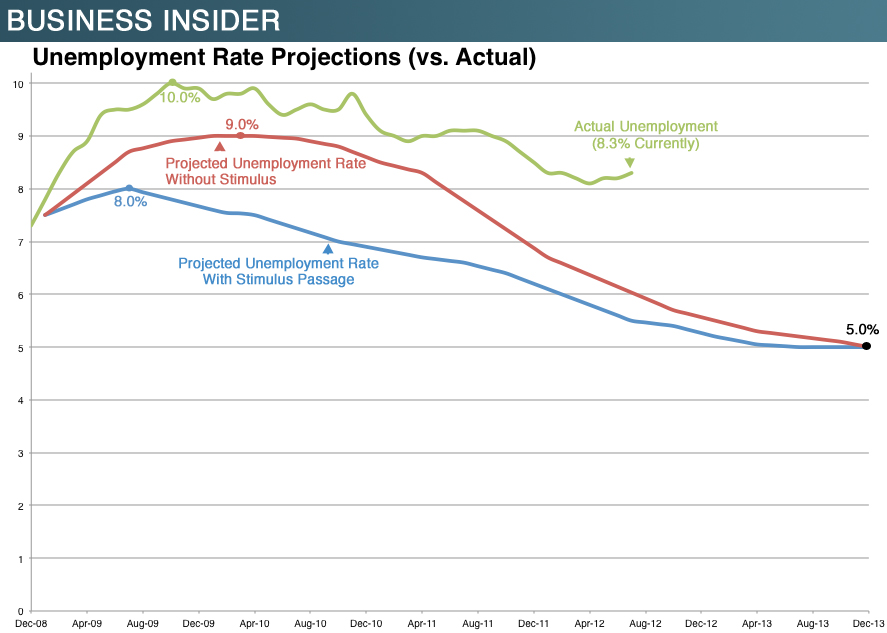
Hmm….  Apparently all Obama has to say about his dismal unemployment record for all of these three and-a-half years is either, “Therefore, it is important not to read too much into any one monthly report,” or “Given the volatility in monthly employment and unemployment data, it is important not to read too much into any one monthly report.”  Oh, and the “Administration always stresses” this importance.

The problem, though, is that not only are Obama’s words about those dismal reports repetitive, the reports themselves are repetitive—with bad news for unemployed Americans.  So—should we also “not read too much into” all those unemployed Americans?


h/t Power Line