Democracy and the Senate

Here are some interesting statistics and behaviors, courtesy of Brian Reardon and Eric Ueland in a recent Wall Street Journal op-ed.  They quote a Politico article:

[S]ince Democrats seized power in fall 2006, Republicans have turned to the filibuster far more frequently. The majority has averaged about 140 cloture motions in both the 110th and 111th Congress. And Democrats are on pace to repeat that feat again this Congress.

Then they look behind those numbers.

Consider this example.

On March 19, Robert Menendez (D, NJ) introduced legislation (S2204) to promote renewable energy with the cost offset by a tax hike on large oil producers.  The normal process would have been for this legislation to be referred to committee for action.

Majority Leader Harry Reid bypassed the committee process, however, and using something called Rule 14 had the bill placed directly on the Senate calendar.  Two days later, he started the process to call up the bill by moving to “proceed to it” and immediately filed a cloture petition to end debate on that motion.

The following Monday, the Senate then voted 92-4 to curtail debate on the motion to proceed to the bill.  The next day, as soon as the bill was before the Senate, Mr Reid offered five consecutive amendments and one motion in order to effectively block the consideration of any competing amendments or motions.

He then filed a cloture motion to close out debate on the bill.  Two days later, the Senate rejected cloture on a party-line vote and moved on to other business, leaving the Menendez bill adrift.

They continued:

The very first bill considered by the Senate after the election of President Obama and a filibuster-proof Democratic majority was adopted under exactly the same truncated process used for S2204—Rule 14, cloture, block out any competing amendments, cloture.  Since that time, the Senate has voted on cloture repeatedly, yet has very little to show for it:  by some measures, 2011 was the least productive session in modern congressional history.

And 2012 is shaping up the same way.  Meanwhile, there are 27, or so, jobs-related bills passed by the House that Reid won’t even let his cloture system bring to the floor to be voted down by his fellow Democrats.

Hmm….

Walking Small

With apologies to Sheriff Pusser; but the disrespect comes from the administration.  Why are we so timid in front of the People’s Republic of China?  Where did that timidity get us vis-à-vis the Soviet Union prior to President Reagan?

At the Shangri-La Dialogue conference, a gathering of the Asia-Pacific region’s national defense officials to discuss regional security questions, Defense Secretary Leon Panetta ought to reassure the PRC that the new US military strategy focusing on Asia was not designed to contain them, saying

Some view the increased emphasis by the United States on Asia-Pacific as a challenge to China; I reject that view entirely.

Never mind that the PRC is an aggressive and growing threat to the US and to our friends and allies.

A PLA representative asked Panetta

My question is, sir, could you enlighten me a little more how the US plans to develop military-to-military relations with China?

Panetta responded with a list of American planned initiatives: plans to cooperate on cyber and space, creating teams to work on these difficult issues, exchanges between military commanders, and a visit to China later this summer by the secretary himself.  (And I thought President Obama had all the self-importance in the administration.  [/snark])  Notice that, though: the PRC asks what are we going to do to please them; they have no plans at all to approach us.

As Senator John McCain (R, AZ) noted after the conference,

Realities are we are retiring ships.  We are having the smallest navy since World War II.

There is great reluctance on the part of this administration to confront China’s aggressiveness toward us and our friends and allies, and shrinking capability being left to subsequent administrations who might have a greater interest in the region’s security.

Yet this timidity is part and parcel with our government’s performance in another part of the world.  While thousands of Syrians die at the hands of the Assad regime, our government sits around clucking its collective tongue and shaking its finger very firmly at Assad—and does nothing of substance.

Senator Joe Lieberman (I, CT) notes that while he thinks the administration is making progress toward a halt in the bloodshed in Syria, it “is moving too slowly.”

Lieberman went on, saying that Panetta had assured him that DoD has a series of plans that they can implement, yet:

I don’t think anybody expects that [Panetta’s claimed plans] would include American troops on the ground in Syria nor will they require the US to take on the fight against Assad alone.

So even those little vaunted and lightly touted “plans” involve nothing more substantive than continued Obamatalk—idle chit-chat and finger waving, with no intension of doing anything serious.

Then Lieberman summed up this administration’s behavior:

If we to continue to say that we won’t do anything to help the Syrian people unless there is UN Security Council authorization, that is essentially saying to the Russians, ‘you can block the world from coming to the aid of these people in Syria against your ally Assad,’ and that is exactly the wrong thing to do.

Senator McCain got right to the point:

I can’t think of a time in the many years that I have served this country in many ways that I have been more embarrassed about my country and their failure to carry out our fundamental principles.  It is shameful because the countries in the region say that they need American leadership, not American unilateral action….  It is patently obvious that this president does not believe that America leads.

And Iran.  After three years of Obamatalk, Iran now is just months away from obtaining nuclear weapons.  Even today, the administration is just sitting around talking with the Iranian “negotiators.”

We’re not even carrying Teddy Roosevelt’s big stick—nor are we prepared to use one, should one magically appear, like that McNairy County sheriff was.

Some Thoughts on Government Surveillance

Here’s the nose of the camel, courtesy of (here’s a surprise) the EPA, as reported by Fox News.  The EPA is flying drones over private property in order to “inspect” that property for government averred purposes.  Apparently, the EPA has been doing this for nearly 10 years over, among other regions, an area the EPA calls Section 7 (an area containing Nebraska, Iowa, Kansas, and Missouri).

A large concern has to do with jurisdiction.  Nebraska, for instance, has the responsibility for environment questions in its part of Section 7 through its Department of Environmental Quality; the EPA has only an oversight role.  Nevertheless, the EPA insists on conducting this surveillance with its own airborne resources—ostensibly as a cost-efficient way for it and state governments to reduce the number of on-site inspections and focus on “areas of the greatest concerns.”  Hmm….

Nebraska Congressmen Adrian Smith, Jeff Fortenberry, and Lee Terry (all Republicans) and Nebraska Senators Ben Nelson (D) and Mike Johanns (R) sent a letter expressing concerns about this hidden searchsurveillance to the EPA by that said, in part

Farmers and ranchers in Nebraska pride themselves in the stewardship of our state’s natural resources.  As you might imagine, this practice has resulted in privacy concerns among our constituents and raises several questions[.]

There’s another concern, also, though.  It’s better for us to have the on-site inspectors.  At least then the property owners/lessors know when the government’s surveillance is occurring and can accompany the government’s men.  And they can make sure, at least on the particular trip, that the government’s inspection is limited to the claimed purpose.

The convenience of the government can never be an excuse for abridging our individual liberties.

Expanding Government Dependency

Who benefits from government benefits?

This is what we have today:

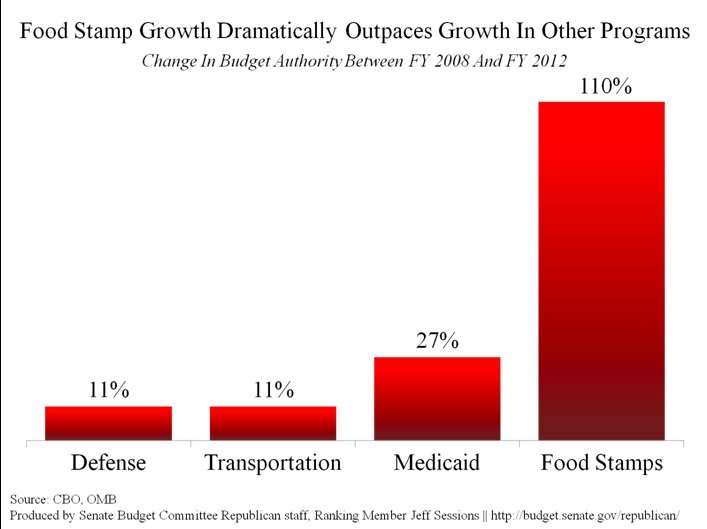
  • 49.1% of the American population lives in a household where at least one member received some type of government benefit in the first quarter of 2011.  This is an increase of two-thirds since the end of the Reagan era:
  • 45 million people in 2011 received Supplemental Nutrition Assistance Program benefits, a 70% increase from 2007 according to a CBO report.  That report also  said that the number of people receiving the benefits, the food stamps, would continue growing until 2014 and would not, in the foreseeable future, revert to anything like the Clinton/Bush era lows.
  • The median number of weeks before someone unemployed leaves the labor force is 21.4.  That’s about five months—a long time.  But then it seems to be final.  Out of work too long, and employers view that person as damaged goods.  Out of work too long, and skills are eroded, and employers are less interested.  That person needs more government benefit payout.

Again, I ask: who benefits from this?  The answer is: follow the money to the source.

Some Thoughts on Freedom

The Archdiocese of New York, headed by Cardinal Timothy Dolan; the Archdiocese of Washington, DC, headed by Cardinal Donald Wuerl; the University of Notre Dame; and 40 other Catholic dioceses and organizations around the country announced on Monday that they are suing the Obama administration for violating their freedom of religion, which is guaranteed by the First Amendment to the Constitution.  The problem, as described on the DC Archdiocese’s new Web site PreserveReligiousFreedom.org, is this:

It is not about whether people have access to certain services; it is about whether the government may force religious institutions and individuals to facilitate and fund services which violate their religious beliefs.

President Obama’s Health and Human Service’s mandate, which is intended to facilitate his Patient Protection and Affordable Care Act and is the proximate object of the suit, forces religious organizations, against their most fundamental beliefs, to provide access to, or to make access available through their insurance programs, contraceptives, abortifacients, and sterilization procedures.

These drugs and services, and many of the behaviors that “need” these drugs and services, are held by a host of religions (Catholicism and Baptist congregations are only the most well-known) to be sinful.  It is, then, not only morally wrong for a religious entity holding these beliefs to provide these things, it is impossible for that entity that is true to its beliefs to do so, or to wink at their insurance programs that do so.

Take careful note: this problem is not about whether such things are, in fact, sinful.  This problem is not about whether Catholic women, by regularly going to Mass and then to their neighborhood pharmacy for contraceptives, seemingly give the lie to Catholicism’s position.  (Indeed, the existence of sin is a raison d’être for churches of all types—to help those sinners.)  This problem is not about “free” access to these services. (In fact, they are not free: by the government’s mandate, if the recipient isn’t paying for them, you and I are—whether it violates our religious teachings or not—through higher prices to us to pay for the subsidy.)

No, this problem is about whether government can define for religious entities what is sin.  It is about whether government can dictate to a religious entity what its religious tenets are.  It is about whether government can dictate to a religious entity what its practices in furtherance of its fundamental tenets are.  It is about whether government can dictate to us individually what our beliefs, what our private decisions, must be, and whether we must sin at government’s behest.

As a practical matter, which patients are being “protected” under the Act of that name?  Plainly only those of whom Obama approves.  Certainly not those with beliefs with which he disagrees.

As a matter of freedom, what is being protected by this government diktat?  Certainly not the fundamental freedom of conscience that Christian religions teach.  Certainly not the fundamental freedom of religion—a part of our Creator’s endowment—that is codified in our Constitution.