
German Intransigence

Last Tuesday, the British Parliament voted to send Prime Minister Theresa May back to Brussels to renegotiate the status of Great Britain’s Northern Ireland border with the Republic of Ireland, which is part of the Brit-EU exit agreement that the Parliament had earlier rejected.  The same day, the Parliament also rejected an attempt by Labour to delay by nine months the actual departure of Great Britain from the EU, leaving the date set at 29 March.

European Council President Donald Tusk said through his spokesman

The backstop is part of the Withdrawal Agreement, and the Withdrawal Agreement is not open for renegotiation.

That’s standard fare for the EU, which never has negotiated in good faith and which has all along faced a negotiator, in May, whose heart never has been in leaving the EU.

It’s Germany, though, that not only refuses outright to renegotiate a small aspect of that failed departure agreement, now is directly interfering in the domestic affairs of Great Britain.  The nature of the current “agreement” would

keep Northern Ireland (and by extension the UK) in the EU customs union in order to avoid a hard border on the island of Ireland.

A hard departure would take all of Great Britain (and by extension Northern Ireland) out of the EU and its internal free trade/free movement of goods and people zone altogether.  That might necessitate customs checks and border entry stations.

Germany’s Foreign Minister Heiko Mass:

We will not allow Ireland to be isolated on this issue.

Never mind that the only ones isolating the Republic of Ireland on this issue are Germany and the EU.  It gets worse, though.  Jürgen Trittin, Co-Chairman of Germany’s Green Party’:

It’s clear that we won’t accept a militarized border in Ireland[.]

Leaving aside the cynically constructed straw man nature of this claim—no one is talking about militarizing any border, only of the possibility of setting up customs stations—whether Great Britain chooses to “militarize” any of its borders is strictly a domestic matter for the Brits to decide.  They cannot, after all, station troops anywhere along any of their borders except on their side of them.  Trittin knows this.  (Beyond that, this ban also is a blatant interference in the internal affairs of the Republic of Ireland for the same reason.)

Aside from that, Trittin’s bar would result in…what, exactly?  What does Germany, or the EU, propose to do were the Brits to decide to “militarize” its border with the Republic of Ireland?  What concrete steps is Germany implying it, or the EU, would take to enforce its bar on the “militarization?”

Plainly, it’s an empty threat, intended only to intimidate and, worse, to meddle in the internal affairs of a sovereign nation—and so vindicating that nation’s decision to leave such an entity as the EU.
Facebook and Trust

…seem, increasingly, a contradiction in terms.

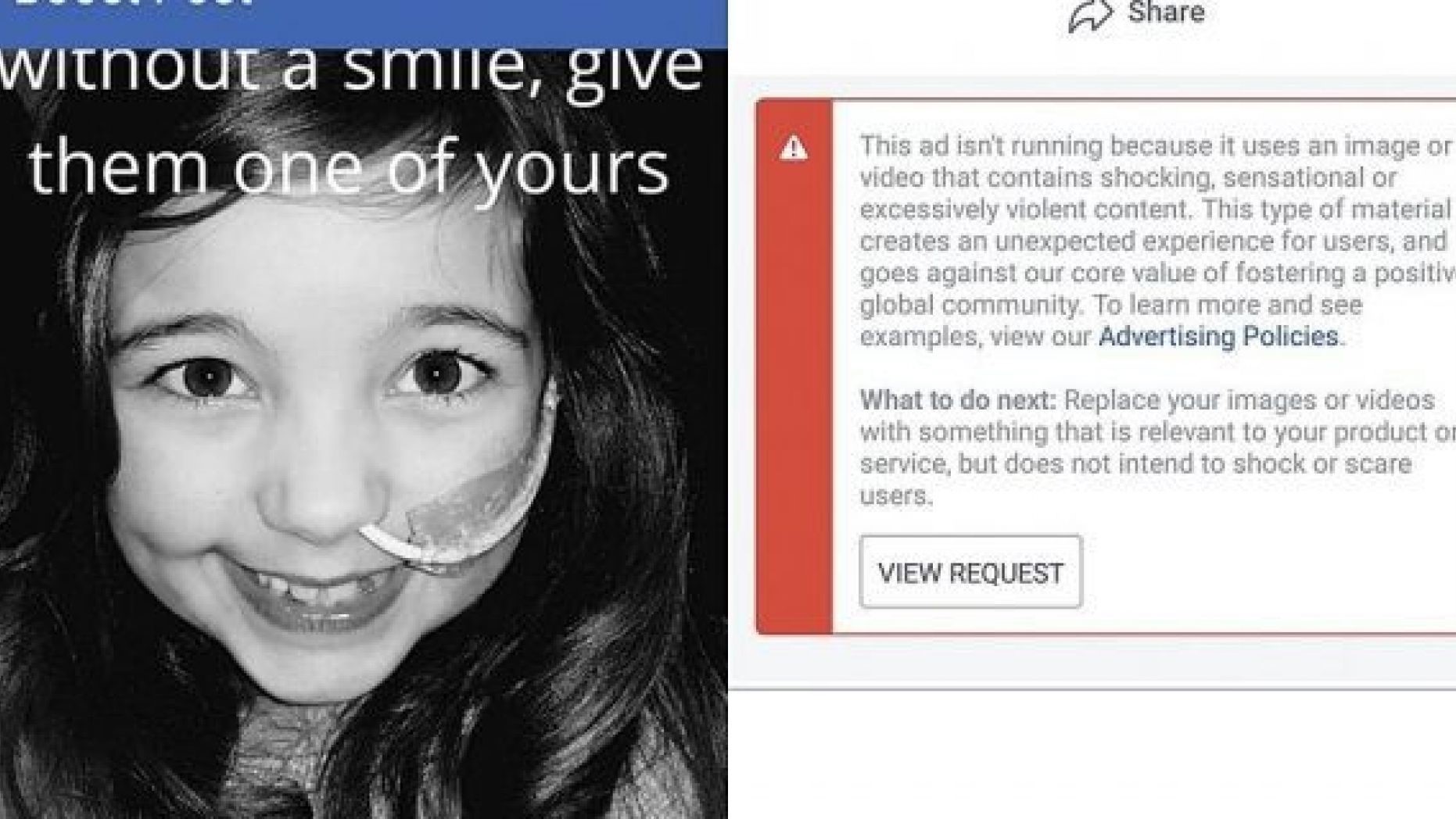
See this image, from The Sun via Fox News, below.

The girl pictured has a laryngeal cleft, a hole between her larynx and her esophagus, which means she can’t eat normally; food or drink can pass into her airway.  The tube through her nose passes down her esophagus, bypassing that hole; it’s the only way she can take sustenance.

The girl’s mother tried to post the image on Facebook, not to garner sympathy, but to raise general awareness of the hassles and hazards of laryngeal clefts, and to raise money for her daughter’s necessary surgery.

Facebook barred the image, for the reasons listed in the text to the right of the image.  The text is hard to read; the money rationalization is this: the image

contains shocking, sensational or excessively violent content.  This type of material creates an unexpected experience for users, and goes against our core value of fostering a positive global community.

Because a smiling little girl, albeit with a tube in her nose, is shocking, sensational, or excessively violent.  Because Facebook has such contempt for its users that it considers them such snowflakes that unexpected experiences—surprises—would excessively disturb them.  Because Facebook’s view of positivity overtly excludes attempts to bring those apparent snowflakes’ attention to an uncommon medical condition so that that attention might foster increased medical research into ways of alleviating or correcting such a condition.

The mother successfully appealed the bar, but questions remain: with this sort of ban being Facebook’s kneejerk, initial action, how can Facebook be taken seriously?  How can Facebook’s management be trusted?

In the Liberal Stock

Neomi Rao is in one, now that she’s a nominee for the DC Circuit Court.  She’s currently serving as the Office of Information and Regulatory Affairs Administer, which means she’s already been vetted by the Senate—bipartisanly.  The Senate already knows who she is and what her abilities and qualifications are.

Well, never mind.  It seems, according to BuzzFeed—you remember the purveyors of a Cohen false news story so dishonest that even Mueller had to go public with the BS flag—Rao “wrote inflammatory op-eds in college.”  The horror.

Here’s an example of that inflammatory writing:

It has always seemed self-evident to me that even if I drank a lot, I would still be responsible for my actions.  A man who rapes a drunk girl should be prosecuted. At the same time, a good way to avoid a potential date rape is to stay reasonably sober.

Victim blaming?  Rational people wouldn’t think so, but….

The Progressive-Democrats on the Senate Judiciary Committee actually are taking Buzzfeed seriously.  The idiocy.

As The Wall Street Journal put it in their editorial at the first link above, none of that

is relevant to how she might rule as a 45-year-old judge with adult life experience.

The WSJ misunderstands, though.  Rao’s not the life experience of a wise Latina, so it’s irrelevant.  The intervening years don’t exist.

And that’s a tool wielded by those Progressive-Democrats and their NLMSM arm in their efforts to smear another conservative jurist.

Germany’s Cost of Going “Green”

Germany is moving decisively to eliminate coal-fired plants as a source for its economy’s energy.

Germany has already banned nuclear power, which was a singularly stupid thing to do—that source of energy already had no CO2 emissions. Nevertheless, the destruction of that industry already is ongoingly expensive.

Merkel’s decision in 2011 to dump nuclear energy by 2022 and to accelerate the build-out of renewable sources such as wind and solar power is already costing them €27 billion [$31.8 billion] each year in the form of a renewable-energy tax.

Despite that, Germany’s Commission on Growth, Structural Change and Employment has laid out the requirement, and the Merkel government seems willing to take it up.

[T]he coal commission advised the government to pay around €50 billion [$57 billion] to the three regions hit by the shutdown of lignite mines to make sure new jobs are created. It also recommended that the government should pay €32 billion [$36.5 billon] to compensate consumers and business for higher electricity prices [annually] and an unspecified amount to indemnify coal power plant operators for the lost value of their assets.

That’s just the inner bound of the cost of “green.”  With black coal mining already shut down—at a cost of €240 billion ($273.7 billion)—this will put coal-fired energy plants out of business.  It’s not just the immediate coal-based energy industry that will suffer.

Biblis, in the Hesse State, used to have a nuclear power plant.  The closure of that plant cost the city 50% of its corporate tax base.  That cascades up the political jurisdiction hierarchy and across the nation.  The increased cost of energy also is hammering German industries that are users, not producers, of energy.

Manufacturing companies, from chemicals maker BASF to carbon fiber producer SGL Carbon, have shifted investments abroad, where energy costs are often a fraction of Germany’s.

Consumers have to pay the higher energy prices, too, and that’s money they can’t spend on other goods and services—which hurts producers of those other goods and services.  All of that is lost revenue for Government, and it’s lost jobs and German prosperity.

What’s the value of changing energy sources if the energy becomes prohibitively expensive and so stunts economic growth and development?

Some Tax Data

These are via the Tax Foundation and are from 2016, which happens to be the last year of the Obama administration and so represent the culmination of Obama’s tax policies.

  • The share of income earned by the top 1% of taxpayers rose to 20.6% in 2014. Their share of federal individual income taxes also rose, to 39.5%.
  • In 2014, the top 50% of all taxpayers paid 97.3% of all individual income taxes while the bottom 50% paid the remaining 2.7%.
  • The top 1% paid a greater share of individual income taxes (39.5%) than the bottom 90% combined (29.1%).
  • The top 1% of taxpayers paid a 27.1% individual income tax rate, which is more than seven times higher than taxpayers in the bottom 50% (3.5%).

Progressive-Democrats argue, and they’re actually serious, that this isn’t enough.  The rich still aren’t paying “their fair share.”  Cynically, those same Progressive-Democrats refuse to say how much, or what per cent, is the rich’s fair share, beyond saying, “More, more, more.”

Progressive-Democrats’ only principle, when it comes to OPM, is Gimme, Gimme, Gimme.  They have no limiting principle.

It’ll be interesting to see how those data compare with the data for 2019, the first year of the Republicans’ tax cuts and reform.