The Value of Debt

There seems to be little in the People’s Republic of China, at least with respect to government and government-backed debt.

Bond investors who put their faith in Chinese state-owned enterprises are swallowing another bitter pill, just two months after an earlier wake-up call.
This week, the province of Qinghai persuaded a narrow majority of investors holding dollar debt with a face value of $850 million to sell their holdings for as little as 37 cents on the dollar….
The tender came two months after a similar debt purchase and exchange deal involving bonds issued by Tewoo Group, a commodity trader based in the northern port city of Tianjin.

As someone else once said, I am altering the deal. Pray I do not alter it further.

Maybe It’s Time

The just-concluded Munich Security Conference has illustrated the growing disconnect between the US and central and western Europe regarding European security.

German President Frank-Walter Steinmeier opened the conference—one of the largest annual gatherings of political leaders, military chiefs and top diplomats from around the world—by accusing the Trump administration of “rejecting the idea of the international community.”
“Every country should fend for itself and put its own interests over all others … ‘Great again’—even at the expense of neighbors and partners,” Steinmeier said….

That’s a cynical distortion of our position, coming as it does on the strenuous efforts the Trump administration has made to get these nations to increase their commitment to NATO, and coming as it does on the heels of Germany’s naked duplicity in promising—on its own initiative, mind you—to increase its spending on NATO to 2% of its GDP, and then welching on that commitment.

And this:

French President Emmanuel Macron, speaking at the forum for the first time, echoed Steinmeier the next day, noting that “what Europe wants is not quite the same as the US.”

That’s certainly true, with France—and Germany—toadying up to Russia as enthusiastically as they are. But Macron, at bottom, is as duplicitous as Steinmeier. Poland, Lithuania, Latvia, Estonia, all NATO members, and Ukraine, are much more closely aligned with the US on matters of their (and our) national security. Macron, for all his ego, does not speak for “what Europe wants,” only for what Germany and France want. To claim they are Europe is not hubris, it’s just dishonest.

Maybe it’s time to move decisively toward a mutual defense treaty among the US, the eastern European nations fronting Russia, and the UK, and let central and western Europe do what they’re so evidently desperate to do: to go their own way.

After all, at least the former, in evident contrast with the latter, care about their security.

Buying An Election

…by buying access to and advertising on private, personal social media accounts.

Michael Bloomberg’s presidential campaign is hiring hundreds of workers in California to post regularly on their personal social-media accounts in support of the candidate and send text messages to their friends about him.

It’s the Bloomberg way. And it’s what we can expect from a Bloomberg administration: circumventing laws, unethically and amorally, if not strictly violating them, at convenience, along with going around the parameters laid out by private enterprises, again unethically and amorally if not openly violating them, for personal political gain.

It’s also illustrative that Bloomberg doesn’t even believe his own words, his own message, his own policies; he feels constrained to pay strangers to tout them, rather than persuading them with the legitimacy of his offerings to do so.  After all,

Most campaigns encourage their supporters to post on social media about their candidates, but paying them at this scale to express support on their personal accounts is unusual, experts say.

Contradictions

Japan raised its sales tax—consumption tax/value added tax—and promptly saw a 6.3% year-on-year drop in GDP in the last quarter of 2019. Consumer spending (did I mention that the tax was a consumption tax?) fell by 11.5% that quarter.

Color me—and hosts of others much smarter than me—unsrurprised.

Now come the contradictions, from the just US Congress-revived IMF, yet.

The International Monetary Fund thinks the consumption-tax rate will have to rise to 15% over the next decade, and to 20% by 2050. But first the fund’s wizards say Tokyo must expand its Keynesian spending to make the economy “strong” enough to bear the tax hikes to pay for the spending.

Increasing government spending, which is tax increases now or later, reduces consumption by a number of paths: it takes money out of consumers’ hands directly via those taxes; by competing for the same goods and services as consumers’, it drives up the prices of those goods and services to consumers, which reduces consumers’ purchase of them; by competing for the same resources that private enterprises need to produce it drives up the price of the resources, which drives up the prices of the end-product goods and services to consumers, which….; and it crowds out many private enterprises and consumers altogether.

And so, of course, it’s necessary to raise even further the taxes on all that reducing consumption.

Business is falling off. Gotta raise prices to make up for the decreased revenue.

Make sense? It does to the IMF. And to the Japanese government.

Global Warming

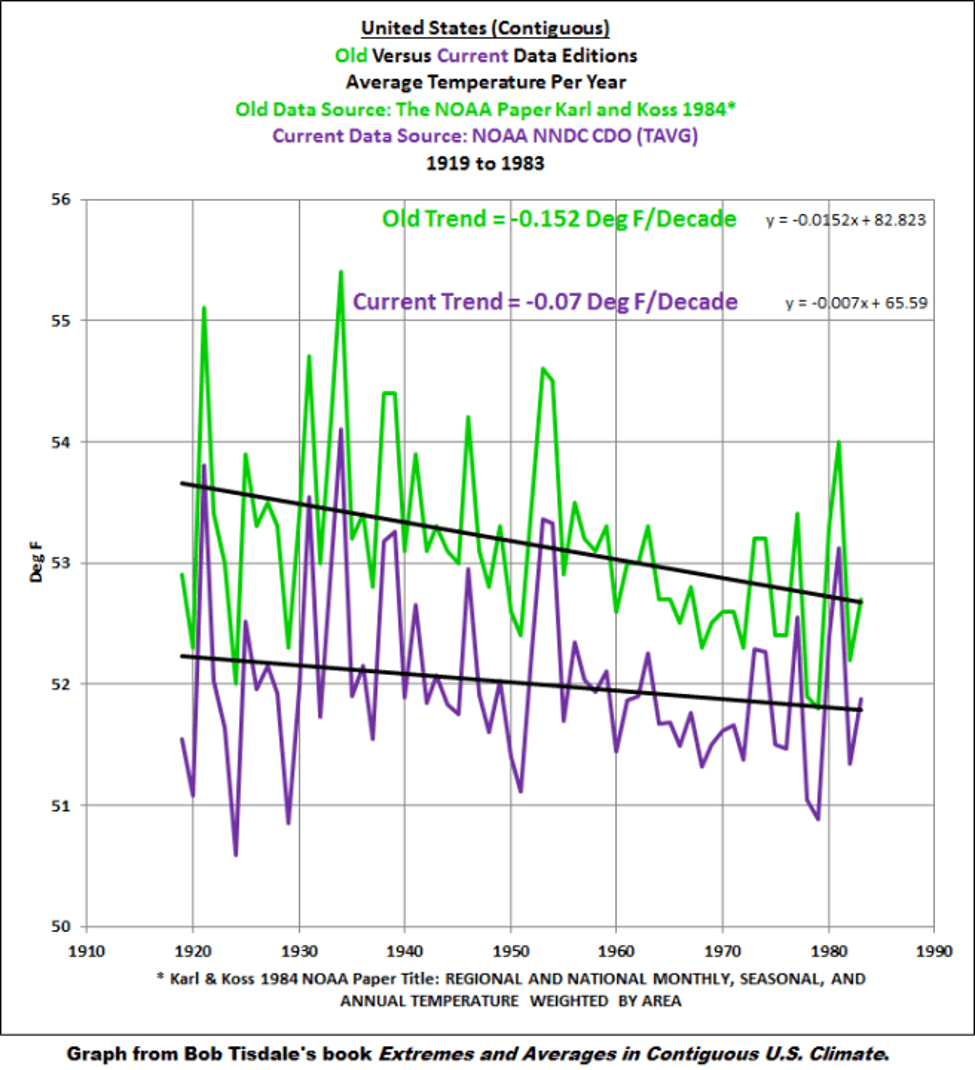
From Watts Up With That, some data for the continental United States over the last 100 years, in graph form.  Here’s the lead graph.

Cooling? Say, what? Notice the year-on-year variability, too. Sort of puts the “warming” since the mid- to late-80s in perspective.

Other data are similar in vein: precipitation data—flat; drought severity, when we have one—slightly rising.

RTWT