Education and Needs

A couple of Letter writers in The Wall Street Journal‘s Sunday Letters section expressed concern for a high school student who was suspended for violating his school’s hair length rule.

The state shouldn’t prohibit haircuts of one type or another and suspend students from school for violating the policy unless it can really show this is needed.

And

Schools need to focus on teaching kids and not worrying about [clothing and grooming standards].

Among the needs and teaching focuses in high schools, and in lower schools, is personal discipline. Clothing and hair grooming rules are badly needed milieus for teaching that badly needed skill.

There’s plenty of time for students to dress as they wish and to grow and groom their hair as they wish after they’ve graduated and are looking for work.

Why Trump Remains on the Ballot

The US Supreme Court ruled Monday that former President and current Republican Primary Presidential candidate Donald Trump will remain on all of the relevant election ballots, overruling the Colorado State Supreme Court directly and Maine’s Secretary of State by extension. The Court’s reasoning is important. From the ruling’s second paragraph:

Because the Constitution makes Congress, rather than the States, responsible for enforcing Section 3 [of the 14th Amendment] against federal officeholders and candidates, we reverse.

The Court expanded on this, quoting Chief Justice Samuel Chase in his 1869 Griffin’s Case ruling:

[t]o accomplish this ascertainment [of which person[s] are explicitly barred under Section 3] and ensure effective results, proceedings, evidence, decisions, and enforcements of decisions, more or less formal, are indispensable.

The Supreme Court went on:

The Constitution empowers Congress to prescribe how those determinations should be made. The relevant provision is Section 5 [of the 14th Amendment], which enables Congress, subject of course to judicial review, to pass “appropriate legislation” to “enforce” the Fourteenth Amendment.

The Court concluded [emphasis in the original]:

We conclude that States may disqualify persons holding or attempting to hold state office. But States have no power under the Constitution to enforce Section 3 with respect to federal offices, especially the Presidency.

The three modern-day liberal/activist Justices, Sonya Sotomayor, Elena Kagan, and Ketanji Brown

Jackson, while concurring in the overall judgment that Trump stays on the ballot(s), were superficially Roberts-esque in their dissent from the sweeping nature of the Court’s ruling. They began by quoting from Dobbs v Jackson Women’s Health Organization:

If it is not necessary to decide more to dispose of a case, then it is necessary not to decide more.

But only superficially: they then wrote [citations omitted],

Today, the Court departs from that vital principle, deciding not just this case, but challenges that might arise in the future. … They decide novel constitutional questions to insulate this Court and petitioner from future controversy. Although only an individual State’s action is at issue here, the majority opines on which federal actors can enforce Section 3, and how they must do so. The majority announces that a disqualification for insurrection can occur only when Congress enacts a particular kind of legislation pursuant to Section 5 of the Fourteenth Amendment. In doing so, the majority shuts the door on other potential means of federal enforcement. We cannot join an opinion that decides momentous and difficult issues unnecessarily, and we therefore concur only in the judgment.

[S]huts the door on other potential means: This is the activist Justices’ desire to keep this controversy alive, to keep a Presidential candidate of whom they have only contempt facing a constant and long-lasting barrage of cases seeking nothing more than to interfere in our 2024 election by interfering with a major and leading (redundancy deliberate) political candidate’s ability to campaign freely. And thereby to deny to us ordinary Americans our ability, our right, to decide for ourselves who we will choose for our President. These Justices do this solely because they personally disapprove of the particular candidate.


The Court’s ruling can be read here.

The Next Step

It’s becoming necessary. I wrote yesterday about the need for tariffs on a variety of tech-oriented goods that the People’s Republic of China is heavily subsidizing for production and export.

It’s rapidly becoming necessary—if it hasn’t been for some time already—to take the next step vis-à-vis trade with the PRC.

Trade routes snaking through former Soviet republics Kazakhstan and Kyrgyzstan are among the many paths into Russia for so-called dual-use goods—singled out by the US and its allies because they can be used on the battlefield.
Despite their efforts, Central Asia is a growing pipeline for Russia, made possible by thousands of miles of open borders, opaque trade practices and opportunistic middlemen. The goods often originate in China, where they are manufactured in some cases by major US companies, which say the items are being imported by Russia without their permission.

Such goods include war-relevant items like computer chips, routers, and ball bearings used in tanks. These items are important for, if not critical to, the barbarian’s war machine and his war against Ukraine. A lot of these items are US products produced in the PRC for delivery to Western and other Asian customers. The PRC is redirecting much of that output to its “friend forever,” Russia.

It’s become time to take the next step: bar American companies that produce such dual-capable goods from producing them in the PRC or exporting them from other sources into the PRC market. The transition away to other production sources and supply chain pathways will be expensive, but not nearly so expensive as the barbarian overrunning and enslaving Ukraine, with sights on targets further west, and the PRC’s subsequent invasion of the Republic of China and closing off the East China Sea commerce lanes to Korea, Japan, and the US.

Subscriptions

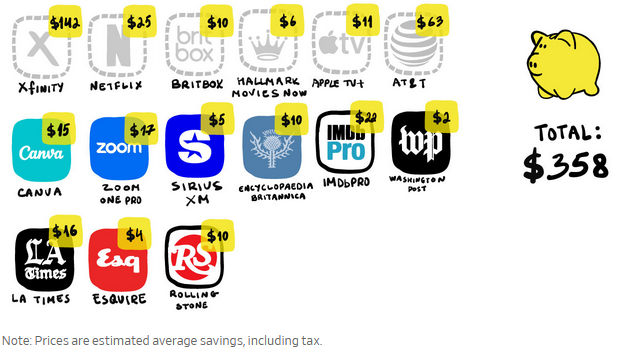
A Wall Street Journal Finance writer wrote an article bragging about how all the subscriptions he had that he canceled pays for his lease on a Tesla Model Y. The key takeaway for me was the vast number of subscriptions this Finance writer had accumulated. This screen shot shows the large number of subscriptions that he canceled (or in the case of SiriusXM, the price cut that he negotiated):

And he still has all of these sucking money.

We still have Disney+, Hulu, Max, the language-learning service Duolingo and, of course, Spotify. We get three print newspapers delivered and many more digital news subscriptions.

It’s certainly true that a finance writer could easily need all those news outlet subscriptions, but who has that many extraneous subscriptions? Especially subscriptions to which, as this writer freely admitted in his article, they don’t even listen to or watch for weeks, months, on end.

My wife and I have an online subscription to the WSJ, a two-line subscription to Verizon for our cell phones, and a Spectrum cable subscription that provides us with our TV (no premium cable channels; it’s not quite the most basic bundle, but it’s pretty bare bones), Internet, and landline. There is a double potful of online news outlets to which we can link, for free, through our browser, and there are libraries in the nearby, also. And books. We read those for entertainment, edification, and straight up education. We read them in print version: those libraries, brick-and-mortar bookstores, and online booksellers.

We’ve thought about cutting the landline out of our cable subscription, but it’s proved too useful as a honeytrap for all the spam calls that come rolling in. As it happens, we have an answering machine capability on our landline phone that plays any messages being left as they’re being left. On those rare occasions when we recognize the voice and are interested in talking to the person, we can go ahead and pick up.

Oh, and he had this in his brag about having saved enough to cover the cost of his car:

…the cost [of his Model Y] dropped to $53 for a car we desperately needed.

He might have desperately needed a car, but he only desperately wanted the Tesla.

Tariffs

When considering the utility of tariffs, it’s useful to keep in mind that foreign trade has very little to do with economics and very much to do with foreign policy. Tariffs, within that framework, can be either good or bad, although as with any tools used in any conflict, they won’t come without cost.

Tariffs imposed solely to protect domestic industry are strictly protectionist, and they result in a less efficient economy with higher costs for domestic consumers. However they might seem justified at their outset—to give a nascent industry (not a nascent company) a chance to get established, for instance—they don’t get canceled once the need for the protection is gone. After that, protectionist tariffs just become a drag on the domestic economy. A canonical example of this is the LBJ-era chicken tax on German light pickup trucks, still in place to the point that we import no German light pickups at all.

On the other hand, tariffs to influence foreign nations to change their ways are matters of foreign policy more than they are of protection, for all that their impact is economic. Such tariffs impose the same domestic costs as protectionist tariffs, but the long-term gain, if they’re done carefully, will outweigh those short-term costs—just as is the case with any set of tools used in other sorts of conflicts.

This is the case, for instance, when a foreign nation government subsidizes its own output to gain an advantage in an otherwise free market international trade environment. It’s especially the case when those subsidies effectively close off that nation’s own domestic market to nations that would otherwise compete in the subsidizing nation’s domestic market with their own exports into it.

This is especially the case when the foreign nation is an enemy nation using its subsidies as its own foreign policy tool to dominate our economy with a view to…influencing…our own international—and domestic—actions.

That brings me to the People’s Republic of China in particular.

[The PRC] is competing with advanced economies in cars, computer chips, and complex machinery—higher-value industries that are viewed as more central to technological leadership.

And

Beijing…plowing money into factories, especially for semiconductors, aerospace, cars, and renewable-energy equipment, and selling the resulting surplus abroad.

That money is cheap, state-directed loans, and from those subsidies, PRC companies are glutting foreign markets.

To be sure, the PRC is rationalizing this—as are many non-PRC economists—as a need to revive its domestic economy, one that, at 5.2% GDP growth year-on-year, is outgrowing our own. It does seem that the PRC economy is slowing, but it’s slowing from a very high growth rate to a high growth rate. The outcome remains one of potential dominance of our economy, especially in national security-critical technologies and energy production. This is coupled with the PRC’s nakedly acquisitive moves in the South China Sea and to a growing extent in the East China Sea, and with its increasingly overt and threatening behavior toward the Republic of China.

That brings me to tariffs as a foreign policy tool.

We should be answering the PRC’s behavior with tariffs of our own, and we should be working to get our friends and allies to apply tariffs, also. To be sure, they will be unlikely to go along with us, but they certainly won’t if we don’t make the effort to persuade.

Such tariffs ordinarily would only be high enough to offset the subsidy advantage the PRC is looking to achieve and return those markets to free competition. However, the PRC’s overall behavior makes these tariffs important foreign policy tools rather than merely protectionist. The tariffs to be imposed should be designed to strongly influence the PRC’s overall international behavior, especially in its current, apparently shrinking, economic position.

The tariffs we impose should begin at least twice the value of the PRC subsidies, and increase—rapidly, don’t give time for the PRC to adjust—from there until the PRC’s international behavior has been suitably altered.