
AI Surveillance

Police forces around the nation are on the verge of getting Artificial Intelligence assistance in identifying folks of interest to them in real time on our cities’ streets.  The image below and its caption illustrate the thing.
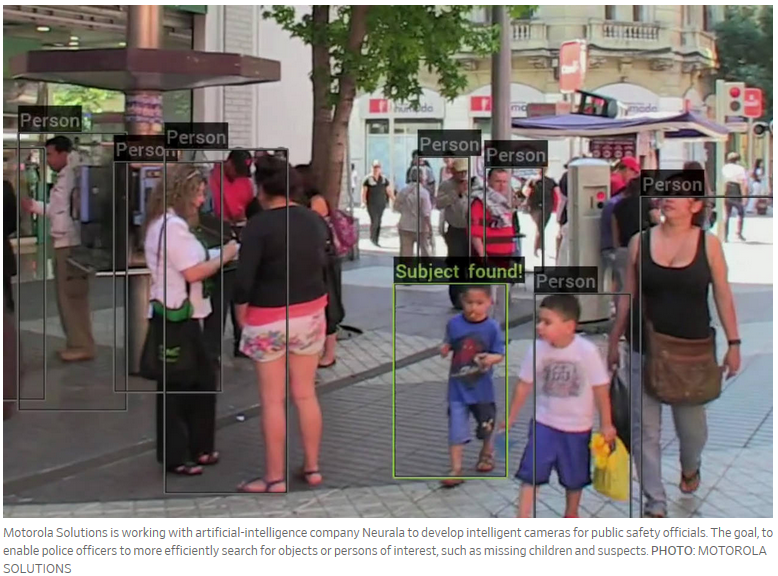
I’m all for assisting the police, especially regarding the subject of that cynically tear-jerking caption.  But this sort of thing needs to be looked at with a very jaundiced eye.  It isn’t too far away from what the People’s Republic of China already is doing in terms of routine surveillance and tracking of everyone.

It’s not that everything the PRC does is bad, but some things are inherently dangerous, no matter who developed them or uses them extensively.  This sort of technology can very easily become a direct assault on our ability to be anonymous in public spaces.

TaeWoo Kim, chief scientist at One Smart Labs, a New York-based startup that is working on such software, said the technology is “creepy and a bit Big Brother-y,” but said it is “purely intended to fight crime, terrorism and track wanted subjects.”

The road to Hell is paved with good intentions. Governments can’t be trusted with such capabilities, and we don’t even need to invoke nefarious intent or “Big Brother-y” conspiracies to see that. Governments will end up misusing, even abusing, this sort of thing just in the ordinary outcome of normal bureaucratic imperatives to justify the bureaucrat’s and his bureaucracy’s existence, to grow, to expand the bureaucracy’s power and budget.

William Bratton, the former commissioner of the NYPD, says that the public was similarly worried about DNA testing when the technology first emerged. The technology has been credited in freeing wrongfully convicted people from prison.

This is a false analogy, though.  DNA testing isn’t used for routine, real-time surveillance of the population or even of small groups or of individuals, and current technology doesn’t allow such use.  AI-based image surveillance technology lends itself to exactly that real-time watching.

Too Much Privacy?

That’s actually a serious question.

The firestorm over Facebook Inc’s handling of personal data raises a question for those pondering a regulatory response: is there such a thing as too much privacy?

And

Law-enforcement agencies rely on access to user data as an important tool for tracking criminals or preventing terrorist attacks. As such, they have long argued additional regulation may be harmful to national security.

Unfortunately, no government can be trusted with citizens’ privacy, as the Star Chamber secret FISA court, the FBI leadership (and not just the current or immediately prior crowd—recall J Edgar Hoover), prior DoJ leadership, the Robert Mueller “investigation,” and much more demonstrate.

If our government wants to learn things, it needs to get back into the HUMINT business rather than relying so much on hacking IT systems.  And get an honest warrant, not just a FISA one.

Counting US Citizens is Illegal

That’s what California’s Attorney General, Xavier Bacerra (D), says.  The Commerce Department has said the 2020 census form will include a question asking whether the respondent is an American citizen, and Bacerra doesn’t like it.  In the op-ed he co-wrote with California’s Secretary of State Alex Padilla (D) for the San Francisco Chronicle, he wrote

Including a citizenship question on the 2020 census is not just a bad idea—it is illegal[]

and he repeated that claim in one of his tweets.

Never mind that there’s plenty of precedent: the Census Bureau asked this question during its decennial census-takings every time from 1820 through 1950, and every year through today on its annual census sampling.

The two politicians claim further that

California, with its large immigrant communities, would be disproportionately harmed by depressed participation in the 2020 census.  An undercount would threaten at least one of California’s seats in the House of Representatives (and, by extension, an elector in the electoral college).

The second part of that claim is true—undercounting the eligible folks would reduce legitimate representation.  The first part of that claim is patently false.  Here’s what the 14th Amendment says on the matter [the 19th Amendment broadened the franchise to include women]:

…when the right to vote at any election for the choice of electors for President and Vice-President of the United States, Representatives in Congress, the Executive and Judicial officers of a State, or the members of the Legislature thereof, is denied to any of the male inhabitants of such State, being twenty-one years of age, and citizens of the United States, or in any way abridged, except for participation in rebellion, or other crime, the basis of representation therein shall be reduced….

Citizens of the United States (who also are citizens of California, as the 14th Amendment also makes clear) and legally resident non-citizen immigrants have no fear of answering the Census’ question.  The only folks who might be hesitant are the illegal aliens.  Since they’re not citizens, and so not eligible to vote, their “undercounting” can have no effect on California’s apportionment of seats in the House of Representatives or in the Electoral College.  Bacerra, especially, as the highly educated, trained, and talented lawyer that he is, knows this full well.

It’s plain that these Progressive-Democrats, in the expectation that illegal immigrants would vote Progressive-Democrat, want the illegals to dilute the votes of American citizens, not all of whom do vote Progressive-Democrat—even in California.

It’s also true that “undercounting” can have the effect of depressing Federal funds transfers to the States that are undercounted.  Here, though, it’s the responsibility of those States allowing illegal residents to stay—even actively protecting them—in violation of Federal law to pay the costs of those illegalities.  No Federal funds should be transferred for those costs.  These Progressive-Democrats, though, are anxious to keep the spigot of OPM wide open for their own spending imperatives.

Arms Keeping and Bearing “Reform”

The House passed a bill last December that greatly expands background checks and that mandates concealed-carry reciprocity among the several States.

The Senate should take up that bill without further delay and pass it as well.  With the much broader background checks, there’s no longer any rational argument for opposing concealed-carry reciprocity.

It’s a pipedream, though; there aren’t enough Progressive-Democrat Senators willing to vote for cloture.  The lack of progress is too important to them as a campaign issue.

Agency Fees

These are fees unions in a raft of jurisdictions are allowed to charge non-union members as a condition of those workers’ right to work at all.  Ostensibly, the fees are for the unions’ labor efforts in negotiating wages, benefits, and working conditions for everyone in the workplace.  The Supreme Court is considering a case, Janus v AFSCME, concerning whether such fees are constitutional.

It’s already the case that

Agency fees already are forbidden from paying for advocacy and other political activity.

Money is fungible, though, and even though agency fees might be barred from the purpose, the existence of the fees allows unions to reallocate equivalent money from other sources to the purpose—making it impossible actually to say that agency fees aren’t being used for the illegal purpose.  After all, if a union has $100, it can’t afford to engage in political activity.  If the union also collects a $10 agency fee from a non-union member, it now has $110, and it can afford to spend $10 on political activity, even if it’s forbidden by dollar bill serial tracking from using the non-union member’s $10 for the purpose.  Those ten bucks went illegally, however indirectly, to the political activity.

Moreover,

…plaintiffs in the Supreme Court case argue that negotiating with public agencies requires taking positions on government’s size and scope, which is a political question, so forcing employees to pay for the negotiations violates the First Amendment.

There’s the crux of the matter.  Agency fees are eminently unconstitutional, but I’m not sanguine that the Court will see it that way.  Both CJ Roberts and J Kennedy have shown themselves unreliable defenders of the Constitution, and the four Liberal Justices are a rock-solid bloc.