A(nother) Thought on Climate…Change

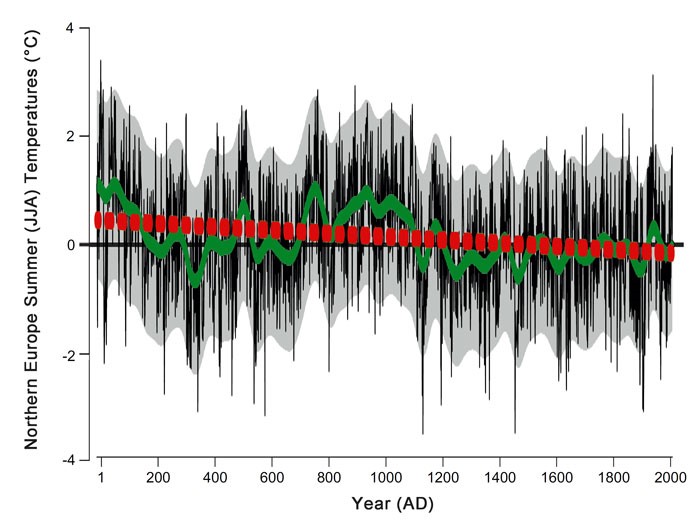
Watts Up With That has a summary article and graph on this; the basic article is on the other side of a link in the summary. It’s typically academic in its language, but it’s well worth a layman’s time in slogging through. Here’s the graph (which is a construction of Watts’; it’s not in the linked-to article):TreeRingSummary

Northern Europe summer (June, July, August) temperature reconstruction. Data shown in °C with respect to the 1961-1990 mean. Adapted from Esper et al. (2014).

The black lines are individual data points, and the grey shading smoothes the data. The green line represents the center of the grey shading, and the red line approximates a regression line showing the long-term rate of cooling over these 2,000 years. All the representations show the same thing: it was warmer in northern Europe 2,000 years ago, during the time of the Roman Empire, than it is today.

The take away for me, though, is what’s represented by the black lines and the grey shading. Compare those to the alleged warming trend of the last 100 years—and its stagnation over the last 20 years (fully a fifth of those 100 years).

Now show that that recent “trend” is distinguishable from the noise level apparent in the data and their first smoothing, the grey shade.

Technology, Oil, and Government

Falling oil prices are a good thing. Except when they’re not. Or….

The irony in the falling prices is that the success of US producers using hydraulic fracturing and horizontal drilling technologies is partly responsible, along with slowing demand by struggling Asian and European markets. Now that success could come back to bite the so-called fracking industry and other drillers in America.

[Wyoming Governor Matt, R] Mead acknowledged that in the short term, lower gas prices will benefit businesses and residents in his sparsely populated state, where distances between towns are often calculated in hours instead of minutes.

But, he pointed out, “If we see low prices continue for some time, we’ll see rigs start to lay down. And it’s not just the direct revenue. It’s the hotels, restaurants and all that goes with that.”

Not to mention jobs.

This is normal in a free market economy, though. New technologies, or old technologies like fracking whose time has come, are always disruptive. Recall the stereotypical, but no less accurate for that, impact on horse-drawn buggy and whip manufacturers with the advent of the horseless carriage and then the assembly line for making those automobiles cheap.

So it is with fracking. Not only does it make hard-to-get oil and natural gas (much) easier and (much) cheaper to get, it drastically increases the supply of these commodities, each of which individually drastically lowers the price of these, and together they synergistically do.

But when supply overshoots demand, and the price obtainable for oil and gas cannot cover even the lowered cost of extraction, many of the suppliers, extractors, stop producing, stop extracting. This has negative effects on both fracking jobs and the ancillary jobs Mead mentioned.

However, in a free market, supply and demand quickly match each other, and prices—and jobs—stabilize. With the technological advances associated with this commodity, too, as with any technological advance, the new pricing equilibrium will be lower than the prior equilibrium. It’s uncertain whether oil and gas pricing in particular will stabilize at their current levels, continue a little lower, or go a little higher. But it’s virtually certain we’re done with $100 oil for the foreseeable future, which is to the good of utilities, manufacturers, consumers, and anyone and anything that uses energy.

And those jobs? They’ll recover with the stability and predictability of the new normal in oil and gas extraction. The widespread use of fracking and related technologies also will lead to a net increase in employment when all is said and done, just like in those early automobile days.

The kicker here is identified by Kathleen Sgamma, Western Energy Alliance Vice President of Government and Public Affairs [emphasis added]:

There is a point at which the lower commodity price combined with the increased regulatory cost will put new wells out of business—they just won’t be drilled[.]

And [emphasis added]

whether a well is on private, state, or federal land, “because the regulatory environment is such that it makes it more expensive to develop on those federal or tribal lands.”

Government’s intrusive regulation wasn’t a factor in Henry Ford’s disruption.

Taxes and Congress

The 113th Congress, in its last days, has passed and sent to President Barack Obama for signature (or veto) a bill extending expired tax breaks through the end of this year. It’s retroactive because the expiration occurred at the end of last year. And the extension is good only for a couple more weeks. The breaks are an amalgam of exemptions that

benefit big corporations and small businesses, as well as struggling homeowners and people who live in states without a state income tax.

A couple things about this. First, notice that phrase “tax breaks.” These represent special carve outs for selected businesses and selected individual Americans, and they’re a mix of crony capitalism and social engineering.

The other thing is the end-of-year decision making regarding the tax code. This isn’t unique to this Congress; Congresses have been pulling this stunt for decades.

If we had real tax reform, say a tax code that eschewed social engineering, that had a single, low, flat rate without loopholes, carve outs, subsidies, credits, and so on, and that everyone with an income paid, there’d be no need—no opportunity—for this late year, late night, wrangling. And there’d be no need for tax breaks, loopholes, carve outs, subsidies, credits, and so on.

This also would both reduce the breadth of influence of special interests and reduce the availability of our tax code—and our tax money—for government-determined social engineering.

This is a thing the 114th Congress should take up with some urgency—”on day one.” It’s highly likely that Obama would veto real tax reform, but that in itself would be not so bad. At worst, that would help shape the 2016 elections and clarify differences between those who understand and respect the wisdom of American citizens and those who think government must be involved in our lives for our own good.

This is a test of both camps.

“Green” Energy, Competition, and Consumers

Technologies that can’t compete in the market place aren’t ready for market, nor are they ready for our consumption. Subsidizing these not-ready techs is one way of plusing them up. Another way is to penalize their competition for being too successful.

The New York Times tells this tale, albeit carefully buried in the nether regions of Katharine Seelye’s article. Overarching all of this is this:

New England [Connecticut, Maine, Massachusetts, New Hampshire, Rhode Island, and Vermont] already pays the highest electricity rates of any region in the 48 contiguous states because it has no fossil fuels of its own and has to import all of its oil, gas, and coal.

That’s not strictly true; the Marcellus Shale holds more natural gas than you can shake a…drill…at, and a significant fraction of that lies under western New York. New York, though, is throwing every road block they can think of in the way of extracting the natural gas, which would give the Northeast a nearby, if not local, source of natural gas.

There are two items of interest that backdrop this. One is the spiking energy prices in the Northeast. For instance,

[f]or October, [a small business owner] had paid $376. For November, with virtually no change in his volume of work and without having turned up the thermostat in his two-room shop, his bill came to $788, a staggering increase of 110%.

The other is the lack of infrastructure: there are all of five pipeline systems in the region, with seven new systems proposed.

The six states’ governors had agreed to a regional solution to this, involving building those additional pipelines.

However.

Just last August,

the Massachusetts Legislature rejected the plan, saying in part that cheap energy would flood the market and thwart attempts to advance wind and solar projects. That halted the whole effort.

That halted the whole effort.

But, it’s OK. Progressives and “environmentalists” have your back. And they have sharpened their knives.


h/t Power Line

Do We Want To Do Business with Racist Europe?

That’s a bit polemic, but this is an important matter.

Leicester City Council in England last month voted to boycott goods made in Israeli settlements in the West Bank. All services run by the council will be free of any product or technology made in any of the settlements. The motion “condemns the Government of Israel for its continuing illegal occupation of Palestine’s East Jerusalem and the West Bank” and resolves “to boycott any produce originating from illegal Israeli settlements.”

And more “Zionistfrei:”

Pro-Palestinian campaigners lobbied the town’s [Kinvara, Ireland] retailers, restaurants and cafes to expunge from their premises anything produced in Israel. All the businesses agreed, meaning Kinvara is now, in the eyes of anti-Israel agitators, morally pure. It is held up as a model town by numerous European backers of the Boycott, Divestment and Sanctions, or BDS, movement.

And

[T]he French city of Lille in October ripped up its twinning accord with the Israeli city of Safed.

And on and on.

Never mind that the Palestinian Unity Government is sworn to the destruction of Israel, and Iran has as its paramount national goal the erasure of Israel from the map. Their “product or technology” are jake in Leicester City, Great Britain, and elsewhere in Europe.

Shades of Europe’s Judenfrei of the last century.