
Change We Can Hope For

A post-World War II-era program that forces raisin producers to give part of their annual crop to the government could soon be a relic of history.

Several Supreme Court justices expressed doubts Wednesday that federal officials can legally take raisins away from farmers without full payment even if the goal is to help boost overall market prices.

An immediately post-war New Deal law allows the Federal government to manipulate the market’s raisin supply by seizing a significant fraction of a raisin farmer’s crop and thereby prop up raisin prices—for the benefit of that farmer, you see.

Raisin farmers, over the specific period at issue (because law suits, quite properly, have to be specific in their allegations), were required to give up 47% (!) of their crop to the Feds. Marvin and Laura Horne were among the farmers so afflicted, and they demurred, refusing to give up their property, their raisins. For their effrontery, the Feds have fined them almost $700,000.

The law in question, though, is a follow-on from the Supreme Court’s earlier Wickard v Filburn case that gutted the Commerce Clause by allowing the Federal government to dictate to farmers how much wheat they could grow—and therewith to manipulate market prices. Wickard made possible all of the subsequent market interferences and farm diktats that the government has inflicted on the nation.

This case, Horne v Department of Agriculture, is an opportunity for the Supremes to begin correcting that original mistake.
Who’s Protecting Whom?

The Drug Enforcement Agency has the way of the Secret Service, at least in Colombia: partying with prostitutes. DEA seems to have taken the thing a step further, though: the parties appear to be funded by the drug cartels the partying agents were sent to investigate.

The agents’ punishment? Two weeks of suspension. Naturally, Congress is…dismayed…both with the behavior and with the wrist-slap. How the anger is expressed is instructive, though. DEA Administrator Michelle Leonhart testified in front of the House Oversight Committee that there’s not much more she can do; civil service system law and regulations keep her from doing more. She’s not even allowed to have input on the sanctions to be applied for such misbehavior.

The solution to such impediments is obvious.

However, Congressman Stephen Lynch (D, MA) won’t can’t see that obvious solution. Instead, he’s accusing Leonhart of having a hand in the failure:

You’re protecting the people who solicited prostitutes who had 15 to 20 sex parties, went through this whole operation, and used taxpayer money to do it.

And there’s the Committee’s Ranking Member, Elijah Cummings (D, MD) asking Leonhart

Do you think you’re the right person for this job?

Of course, there’s no thought by the Democrats (and apparently none by the Republicans, either) to changing the civil service laws that Leonhart thinks handcuff her. There’s no thought here to curtailing the power of the various civil service unions so that Agency and Department heads can fire miscreants promptly for misbehavior.

Gotta protect those unions. There’s too much money at stake here.

A Problem with Censorship

[Ukraine’s] Parliament voted Thursday to ban Soviet as well as Nazi symbols here….

Lawmakers voted 254-0 in favor of the bill, which outlawed any “public rejection of the criminal nature” of the Soviet or Nazi regimes in Ukraine, a former Soviet republic that was overrun by the Germans in World War II.

Their heart is in the right place.

Yuriy Lutsenko, a senior Member of Parliament with the Petro Poroshenko Bloc, added this about the legislation:

Symbols including five-pointed stars and hammers and sickles will disappear from the streets of Ukrainian cities[.]

But the USSR’s flag isn’t the only thing that uses the symbology of a five-pointed star. So do the United States flag and the European Union flag—the latter which Ukraine would like to join.

This illustrates a problem with government censorship. Leaving aside the fundamental inappropriateness of censorship by governments, it’s tough for government to censor narrowly enough to block the target without also blocking the friends.

Liberals and Unions

In December 2014, the NLRB passed a final rule on a partisan 3-2 vote that greatly shortens the time for a workplace union-organizing election. … Mr. Obama issued a “memorandum of disapproval”—essentially a veto—to kill the Congressional measure [to overturn the rule] and preserve the NLRB rule.

From now on unions will have unlimited time to prepare their campaigns to organize a workplace, springing the election paperwork on an employer when they figure they have the best chance to prevail. By reducing the time before an election to as little as two weeks from the current average of 38 days, unions will be able to lobby workers and make their case before a company can counter with its own argument.

Because with Liberals and unions, there’s only one side to a story. No need to hear from anyone else.

All the more Reason

…to speed reform of the way in which our economy produces medical care services and in which we pay for them.

[A] 66-year-old couple retiring this year with average Social Security benefits can expect medical costs to consume 67% of the Social Security they will receive in retirement.

A 55-year-old couple who plan to retire in 10 years can expect to devote about 90% of their lifetime Social Security benefits to healthcare costs.

There’s more:

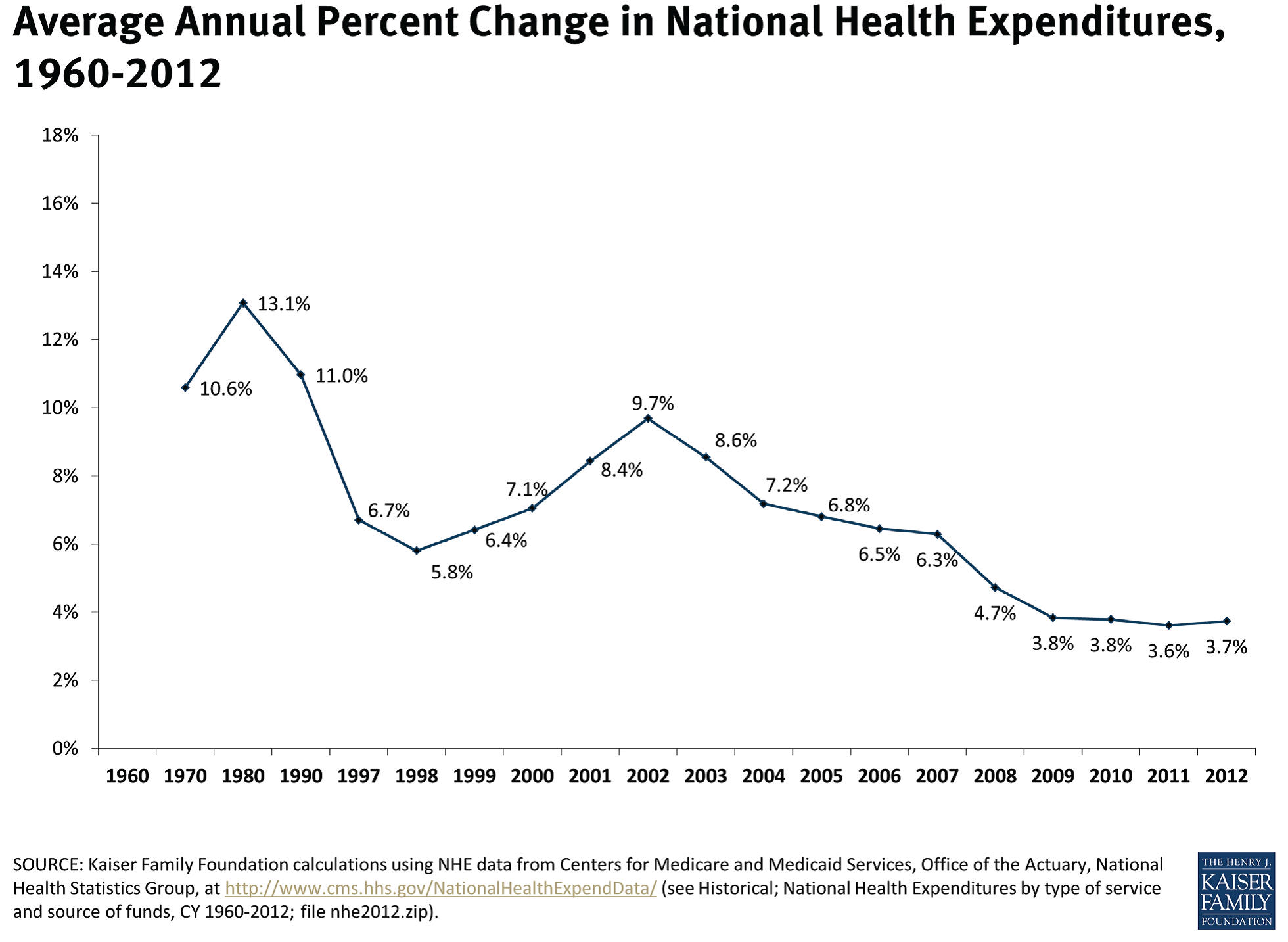
Social Security benefits typically grow by approximately 2% a year—the overall rate of inflation. But medical costs in general tend to rise by more, 5% to 7% a year[.]

There’s this graph, too, that illustrate cost change trends since 1960:HealthCostTrends

Since Obamacare was enacted and has started to take effect (since 2010), the then-eight-year-old trend of decreasing costs has been completely stopped. That’s the effect of government intervention into a free market.

If we’re to correct this, if we’re actually to hold down, not just the rise in costs, but the actual costs themselves, we need to get government out of the way and use free market solutions: get rid of the health welfare that is Obamacare, allow insurance companies—which would sell true insurance policies—to charge premiums based on the actual risk transferred from customer to company, and allow insurance policies to be sold across state lines—that is nationwide.

All government intervention succeeds in doing is preventing competition and market forces from reducing and then holding down costs. Which hits hardest the very people these government programs are claimed to help.