You Didn’t Hear It Here First

Although I have written something similar before.

Freedom of speech is on no use to a man who has nothing to say, and freedom of worship is of no use to a man who has lost his God.

And

We cannot read the history of our rise and development as a nation without reckoning with the place the Bible has occupied in shaping the advances of our Republic.

And

The lessons of history, confirmed by the evidence immediately before me, show conclusively that continued dependence upon relief induces a spiritual disintegration fundamentally destructive to the national fiber. To dole our relief in this way is to administer a narcotic, a subtle destroyer of the human spirit. It is inimical to the dictates of a sound policy. It is in violation of the traditions of America.

And on Social Security, as it was drafted originally (and ultimately as passed and evolved; although the remark was made of the draft):

This is the same old dole under another name.  It is almost dishonest to build up an accumulated deficit for the Congress of the United States to meet in 1980.  We can’t do that.  We can’t sell the United States short in 1980 any more than in 1935.

Who said this stuff?  A man not known for his modern conservatism: Franklin Roosevelt.

The catalog of Roosevelt’s economic and regulatory failures is long, but there also is much that the present administration could have listened to and thereby avoided the damage done by its own economic and regulatory failures—as could FDR, had he listened to himself.


h/t to Power Line

Higher Gas Prices: Yes, or No?

Earlier this week, Energy Secretary Steven Chu acknowledged at a Senate Energy and Natural Resources Committee hearing that he indeed told The Wall Street Journal in 2008 that

Somehow we have to find a way to boost the price of gasoline to the levels of Europe.

Now, with the damaging impact of rising gas prices on Obama’s approval rating, Chu claims a change of heart.

Senator Mike Lee (R, UT) asked Chu at that hearing

Are you saying that you no longer share the view that we need to figure out how to boost gasoline prices in America?

To which Chu responded

I no longer share that view.  When I became Secretary of Energy I represented the US government and I think that right now in this economic—very slow return—that we need to have, these prices well could affect the comeback of our economy and we’re very worried about that.  And so, of course, we don’t want the price of gasoline to go up.  We want it to go down.

Obama also was quick to downplay this rather dramatic shift.  At a news conference earlier this week, President Obama insisted to Fox News that it was foolish to think he wanted higher gas prices to wean Americans off fossil fuels, or for any other purpose.

You think the president of the United States going into reelection wants gas prices to go up higher?  Is that—is there anybody here who thinks that makes a lot of sense?”

Then, through his Press Secretary, Jay Carney, he insisted that he’d not instructed his Secretary to “clarify.”   No, Chu had made that earlier remark before he joined the administration, and so of course Republicans are taking it out of context to suggest it is administration policy.  This, though, means that Obama is claiming to have been utterly oblivious to Chu’s position when he selected Chu for Energy, that Chu’s preference for higher gasoline prices—to encourage Americans to shift to Obama’s “green” energy sources—couldn’t possibly have been among the reasons Obama selected Chu.

Never mind that Obama’s approval rating has slid to a nearby low of 41%, or that a new CBS News/New York Times poll indicates that 54% of Americans believe an American president can, indeed, do a lot about gasoline prices. That’s his story, and he’s sticking to it.

Since this change of heart is so plainly politically motivated, can we take Chu or Obama at their word on the matter?

On a separate but related note, Obama, through Carney, also tried to walk away from another allegation of his.  On Monday, Carney had said

What [Obama] is not willing to do is to look the American people in the eye and claim that there is a strategy by which he can guarantee the price of gas will be $2.50 at the pump.  Any politician who does that is lying, because…that strategy does not exist.

GOP Presidential candidate Newt Gingrich responded with a challenge to Obama to debate the matter, and energy policygenerally, offering a number of venues for Obama to select from: an oil rig, a gas station, a refinery, a university campus.  Obama avoided the challenge and had Carney respond, instead,

I said yesterday that anybody who said that would be a liar.  And I shouldn’t have gone into motivations.  I should have said anybody who says that doesn’t know what he’s talking about.

Hmm….

Do We Really Need This Sort of Thing?

The Federal Housing Finance Agency, according to The Wall Street Journal, is looking at the development of a system that could replace both Fannie Mae and Freddie Mac, whose continued financial existence is an open question.

Given the lack of coherence in Congressional or Executive support for reform in this arena (beyond agreeing that “something” ought to be done “real soon now”), the FHFA wants to maintain flexibility in its own views of how deeply the government should support the $10.3 trillion mortgage market.

One of the things the FHFA is considering is combining the several forms of mortgage-backed securities (all those MBS, CMOs, etc. of not-so-long-ago fame) that Fannie Mae and Freddie Mac write into a single, standardized (mortgage-backed) security that each would issue.  The idea is that with this single instrument issued by both, it would be easier to eliminate both FMs in favor of a single agency.  Simplification is a step in the right direction, but this seems just a variation on a theme, and not real reform—it would retain the concept of a government agency in the mortgage business.

Another option under consideration is the transfer of mortgage portfolio responsibility to a third-party investment firm, but FHFA says that doing this would likely be more expensive and come at higher risks for the regulator.   But this perpetuates the myth that a government regulator should be involved at all.

In the meantime, in the administration’s usual vague manner, Treasury Secretary Timothy Geithner “pledged to lay out more detail on the administration’s approaches to reforming the U.S. housing finance system this spring.”

Why not carry out real reform, and get government out of the housing market entirely, while freeing the lenders to lend according to actual risk assessments, with no favoritism forced for government-approved groups of borrowers?

Another Unintended Consequence

And this one is entirely predictable, so we have no excuse for it occurring.

The Obama administration has closed the comment period on a new set of automobile fuel efficiency standards, taking the government-mandated average from the current 2016 requirement of 35.5 mpg to 54.5 mpg by 2025—a 53% increase in those 9 years.  Superficially, this seems good for the environment and good for the amount of oil we buy from the Middle East.

However.

These fuel efficiency standards will add $3,200 to the price of a new car.  As a result, the National Automobile Dealers Association estimates that nearly 7 million drivers won’t be able to buy them because they’ll be unable to qualify for the loans necessary.  After all, most car buyers do so with loans against the car or pickup that they’re buying.  As the NADA points out, during the loan approval process,

…it matters not whether the new vehicles in question offer improved fuel economy performance characteristics compared to the transportation options currently being used by prospective purchasers. … All that matters is whether prospective purchasers are creditworthy.

As a result, cash-strapped—and other frugal—buyers will simple keep their existing cars longer or buy off the used car lot, thus keeping the (relative) gas guzzlers on the road longer.  Any claimed savings from the greater fuel efficiency is just “fantasy” for these 7 million drivers.

Moreover, the Alliance of Automobile Manufacturers estimates that compliance costs will reach $133 billion to $157 billion by the end of the process.  This is separate from the loss of sales of some $175 billion from those drivers not buying the new “fuel-efficient” car at a naively estimated $25,000 per.

Greek Bailout, More

I wrote last fall on this subject.  Even though a new round of bailout funding is being discussed, my argument hasn’t changed.  Now, though, Spiegel Online International reports that it appears that European leaders are beginning to recognize the folly, as well: it’s best to cut the Greeks loose to find their own way, and to find their freedom from the fiscal bondage that ever-increasing debt and continued Greek resistance to making serious spending cuts are creating.  Yet the majority continue to cling to their asserted need for bailouts.

Everyone knows that Greece cannot repay its massive pile of debts, now at more than €350 billion ($459 billion).  But instead of effectively reducing the financial burden, European politicians intend to approve new loans for the government in Athens and go on fighting debt with new debt.  “If the country wants to remain in the euro zone, we should support it,” says Austrian Chancellor Werner Faymann.

And

If there are no other options, says Luxembourg Finance Minister Luc Frieden, “the public sector may have to provide more money.”

And

The representatives of the so-called troika, consisting of the European Commission, the European Central Bank (ECB) and the International Monetary Fund (IMF), estimate the shortfall [for the second round of bailout payouts] to be about €15 billion, meaning that Greece needs €145 billion instead of €130 billion.

The only other option is to redistribute the burden. Under the current program, the IMF is responsible for about one-third, and the Europeans for two-thirds of the costs.

But these illustrate the depth of the Greek problem, and the inability of additional borrowing, of additional bailouts to solve the problem.
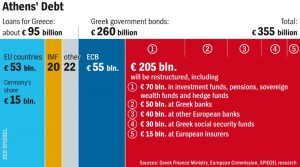
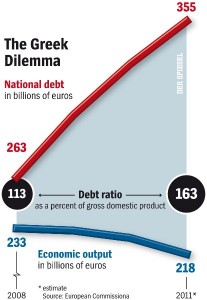


With the Greek debt exploding and its economic output shrinking, if not actually collapsing, there is no hope of repayment—or of growth at all.  Furthermore, this leadership school assumes, erroneously, that the “burden” should exist in the first place.  And it demonstrates their confusion of who it is that bears this burden.  It’s not the EU piggy bank owners from whom the bailout funds are intended to be collected.  It’s the Greeks, who are being burdened with even greater debt that they cannot repay, and so with even greater servitude, onto whom this burden is being loaded.  It has even been proposed that an external “budget commissioner,” with authority to veto Greek tax and spending decisions, be imposed on Athens.

But others of the political class are beginning to object to continuing the bailout.

[I]n Germany, the main donor country, leading politicians within the two coalition parties, the CDU and the business-friendly Free Democratic Party (FDP), do not believe that a majority of parliamentarians will vote for additional aid to Greece.

More generally,

The German government feels that the financial sector should bear much of the additional burden. If additional funds were needed, the banks would simply have to contribute more, the Germans argue.

This attitude is spreading beyond Germany, too; although without the economic powerhouse of Europe, the future of any more bailing out is highly questionable.

Moreover, the reasons for the growing reluctance, beyond a growing understanding of the folly of bailing out a debt crisis by increasing debt, are becoming more apparent.

The Greek economy is not productive enough to generate growth. Aside from olive oil, textiles and a few chemicals, there are hardly any Greek products suitable for export. On the contrary, Greece is dependent on food imports to feed its population.

“Greece has been living beyond its means for years,” an unpublished study by the German Institute for Economic Research (DIW) concludes. “The consumption of goods has exceeded economic output by far.”

And this [emphasis added]:

…lack of progress on austerity measures long-since passed.  Attempts to privatize state-owned enterprises, for example, have met with limited success at best.  The Greek government initially announced it intended to raise €50 billion in four years by selling state-owned companies and property—a sum that was calculated into the country’s financing needs.

But lack of interest has crippled the program.  In 2011, the government’s privatization program brought in just €1.7 billion instead of the €5 billion planned.  In 2012, expectations have been reduced from €11 billion to just €4.7 billion. Government-owned enterprises in Greece are simply not competitive enough to attract investors.

A solution is being offered.

Instead, economists recommend finally doing what is already unavoidable: sending the country into an orderly insolvency. Greece’s government creditors, which include the ECB and, most of all, the partner countries that have lent the country money until now, would have to abandon about half of their claims so that the country’s mountain of debt could be reduced to a tolerable level.  Then the measures that can return the Greek economy to growth on its own can become more effective: reforms in the labor market, more competition in the service industries and foreign investment.

I’ve insisted all along that Greek bankruptcy is necessary to free the Greeks and give them a new start.  If the Europeans think an “orderly bankruptcy” can be arranged, more power to them.  However, the success of this, with its continued Greek membership of Greece in the EU and in the euro zone, depends on those follow-on reforms actually be implemented—particularly labor reforms, and one not mentioned: getting all Greeks to pay all of their taxes.  I’m not sanguine about either, but especially about the reforms.  Nevertheless, bankruptcy is the only way out for Greece, the only way back to freedom and solvency.
