
There’s Growth and then there’s Growth

The outcomes of the Greek and French elections last week, serve to emphasize a perceived, and real, need for economic growth.  That need exists in the US, also; those elections serve to highlight our need, as well.

But what kind of growth is intended?  Carsten Volkery hints at the version preferred by the Left in Europe (and, I submit, it’s a view shared by our Progressives, here at home; accordingly, I’ll just write about Europe in this post and incorporate our Progressives by extension).

Volkery opens his description of the Left’s version of growth this way.

[The European fiscal pact, an effort at national budget discipline] will, however, be augmented by a separate “growth pact.”  It is currently unclear just what form this growth pact will take.  But it seems safe to assume that it will not be particularly ambitious—European leaders want to stimulate the economy without putting too much strain on their budgets.  Massive debt-financed investments are still regarded as a taboo. Additional transfers from the wealthy north to the impoverished south also seem unlikely.  It is, in short, unclear if Europe can even afford growth.

Stimulate the economy through their budgets.  Can Europe afford growth?  I.e., more government spending of some sort.  Volkery then suggests some ways to achieve this greater spending, this “growth.”

Relax the austerity targets…domestic demand would benefit….

But this Keynesian adherents’ conflation of a government-fueled artificial demand with the true economic demand of a nation’s private economic participants—the citizens and their businesses—has already been proven to result in failure to stimulate anything beyond growth in government: here in the US in the 1930s and again in the years since 2008, and in Europe in that same post-2008 era.

Cheap money from the ECB…cut interest rates further, which would stimulate demand.

The US Fed has been holding interest rates artificially low, to the point of going negative in real terms, for years.  No demand stimulus has resulted.  Further, cheap borrowing still is more debt, the wrong answer for an economic dislocation caused by too much borrowing.

Structural reforms…liberalizing the labor market, increasing the retirement age and reducing barriers to trade [to] increase competitiveness, and…stimulate the economy.  Such reforms only have one problem: they don’t help much in the short term.

This is true enough, but it’s not an argument to not implement the reforms; it’s an argument to stop dithering about them, and get them in place.  As the reforms take effect, government’s intrusion into their citizens’ lives will be reduced, they’ll have more room for their own decisions—and more money with which to act on those decisions.  More true economic demand.

EU investments: These could take different forms.

And every one of them amounts to increased government spending, increased government borrowing, or increased government selection of business winners and losers, or all three.

No, the only growth each of these various plans for increasing government spending and borrowing can stimulate is in the size of government’s debt and the size of government and its intrusion into the lives of men and women.

To truly stimulate growth in economies, what is needed is not budget discipline through reduced government spending and increased taxes, but budget discipline through reduced government spending and reduced taxes on a broadened tax base, and reduced government borrowing.  Most especially, there’s no room for increasing (again) government spending or borrowing.

The more money that is left in the hands of the people who’ve earned it, the more freedom those people will have to set their own goals, to develop their own ideas, to do their own innovation, to form their own small businesses—and to hire even just one or two or three others to work in their businesses.  In the aggregate of all these burgeoning small businesses is the growth of employment—with even more money in the hands of those earning it.

The less government competition for goods and services—and labor—the lower prices will be, and so the money left in the hands of those earning it will go farther—further stimulating economic growth.  Yes, those lower prices will impact those small businesses, but those lower prices will impact  their supply prices, too.  The businesses will thrive with the growing demand from that increase in money and decrease in prices—costs.

There’s another effect from reduced government spending that’s often overlooked.  Government spending often serves to substitute for individual spending: why should a person buy this or that good or service, if government is going to buy it for him?  Less spending reduces this substitution effect, putting the money back into the private economy where it belongs.

With more people having skin in the game—from everyone being taxed, for instance, even at those reduced rates—more people will play an active role in their own lives and in the politics that, ultimately, structure their lives.  This is entirely appropriate.  A free people must be politically active, or they lose their freedoms.  Pericles and Plato were right on this.
France and the US

Guy Milliere has an interesting article on the French elections last Sunday and on the decline of a once proud nation (the article was written before the elections, but what he wrote remains valid today–RTWT).

Milliere decries the failure of France and sees its present strait as no better than the precipice, beginning with:

…among the 10 candidates in the first round [of the French presidential elections last month], three were Trotskyites advocating a Leninist revolution; a disciple of Lyndon La Rouche; a former Norwegian judge who appears to think she is an environmental Robespierre (Eva Joly); a populist from the extreme right (Marine Le Pen); a moderate who would find his place in the left wing of the American Democratic Party (François Bayrou); a Gaullist speaking as if it were still 1965 (Nicolas Dupont Aignan); a very « socialist » Socialist (François Hollande); and the outgoing President Nicolas Sarkozy, a Bonapartist who, in the UK, would be to the left of the Labour Party.

At least with a two-party system (and occasional third-party spoiler) like ours (or even a three-party system with occasional spoiler flashes in the pan, as in Great Britain), the fringe groups don’t have much post-election effect, beyond the spoiling aspect of turning an election from one main party to the other.

But Milliere continued:

…no candidate defended free-market principles;…all of the candidates harshly attacked the financial world, multinational corporations, and globalization;…of the two finalists, one[‘s]… program appears to have been written before the development of the Internet.

Now we get to the parallels.  President Obama’s hostility toward free market principles, and toward business generally and banks explicitly, are both manifest (his claims to the contrary even as he follows them with screeds against the fat cats notwithstanding) and rooted in (and unchanged from) the late ’60s and early ’70s radical “community organizing” of his mentors.

Milliere went on:

France’s problems date from long before the presidency of Nicolas Sarkozy.  [It is a] country where no budget has been balanced since 1974, and where public expenditures have risen continuously in recent decades to represent a crippling 56% of its gross domestic product….  It is a country whose public debt is growing far faster than the public debt of its main economic partners in Europe, and will hit 87% of GDP this year (actually 146%, if what France owes to the European Union is included).  It is a country where reports on the inevitable failure of pension systems were presented to successive governments for over 25 years without a decision being proposed or taken.  It is a country where the…number of people living in poverty is between eight and ten million out of a population of 65 million.  It is also a country where…two-thirds of all higher education diplomas are worthless on the labor market.  Graduates with Master’s degree become fast-food servers or cashiers in a supermarket—if a position is available.

So it is in the US.  Our current economic disaster has been years, and administrations, in the making: very few actually balanced (as opposed to accounting gimmick balancing) budgets and national debt exploding over the last three years.  We’ve been ignoring the impending failure of our entitlement programs for decades, even though the originally forecast date range of their bankruptcy has moved very little in all that time.  Nearly 45 million Americans are currently receiving food stamps, which is roughly the same 14% of our population as is Milliere’s Frenchmen living in poverty; although, according to the CBO report at the link, that number is 70% higher than it was in 2007, immediately before the housing bubble burst.  And we insist on loaning taxpayer monies to students who wish to degree in gender studies, women’s contemporary literary issues, or basket weaving instead of in the productive STEM skills that a burgeoning and technologically evolving economy needs for national survival.

It’s necessary to change course.  And that course change must be in the direction of smaller, limited government that leaves more of our money, and our responsibility, in our hands.

Or we’ll end up like France.

Tomorrow!

President Obama once said that if he doesn’t turn our economy around, he would be a one-term president.  Now he says that the question

is not just about how we’re doing today, it’s about how we’re doing tomorrow.

But as the Progressive’s hero, John Maynard Keynes once said

In the long run we are all dead.

Indeed.  Americans are hurting today.  Today, the labor force is shrinking to historic lows as people give up on finding a job.  Today, people can’t pay their bills.  Today, people are losing their homes.  Today, people are becoming ever more dependent on food stamps.

No, as Obama said in another of his sound-bite slogans, “We can’t wait” for tomorrow.

Tomorrow, Tomorrow, I love you, tomorrow
You’re always a day away

Unemployment and Unemployment

Last Friday, the Bureau of Labor Statistics jobs data were released.  Superficially, they seem encouraging—the unemployment rate dropped a tenth of a point to 8.1%, the lowest rate since the month of President Obama’s inauguration.  Moreover, nonfarm payroll employment rose by net 115,000 (130,000 new private sector jobs against a loss of 15,000 government sector jobs).  But the data behind these numbers are appalling.

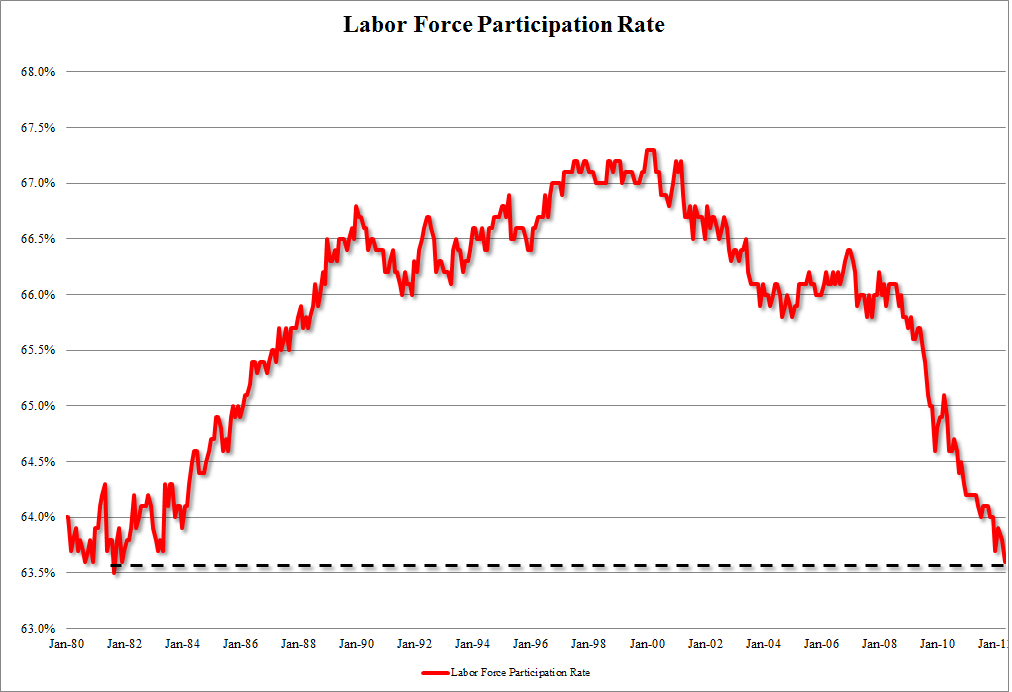
By April, the number of people not in the labor force at all had risen to nearly 88.5 million, the highest non-participation rate on record.  Indeed, this is a rise of over half a million (ex-) workers just since the March data release.  This has driven the labor force participation rate—the per centage of our population that hasn’t yet given up and are still actively working or looking for work, to 64.3%, a 30-year low.  Other estimates confirm this: 342,000 people dropped out of the labor force, while the ranks of the unemployed fell by just 173,000.

The Wall Street Journal also reported [emphasis added]

Friday’s report was weak across categories.  Manufacturing employment, an area of strength in recent months, grew by a disappointing 16,000 jobs.  Construction employment fell slightly.  Full-time employment plunged by more than 800,000 jobs.

That’s why that headline unemployment rate dropped.  The unemployment ratio is a fraction consisting of the number of people out of work divided by the number of people working or looking for work, and more people gave up and left the work force—became non-persons in the eyes of the Government’s jobs bean counters—than found jobs.  The number of people left who are working or looking for work shrank precipitously.

A couple of pictures illustrate the story.  (The graphs might be a little hard to read.  The Labor Force Participation Rate graph is in two-year increments from January 1980, and the Persons Not In Labor Force is in three-month increments from December 2007.)

The number of folks wanting to work, that labor force participation rate, rose rapidly in the optimism of the Reagan economic boom into the dot-com bubble.  When the bubble burst, participation rate fell off, but was recovering during Bush the Younger’s second term (when his own tax cuts were starting to take effect) until the Barney Frank housing bubble burst.  And during the Obama administration, the participation rate has fallen off a cliff, as more and more Americans give up due to the current administration’s policy failures and stop looking altogether for work.

Beginning with that housing bubble starting its failure, the population no longer in the work force began running up more steeply, and it’s continued without break throughout the present administration’s set of “economic” policies.


h/t GayPatriot

Some Thoughts on Free Markets and Limits

I was driving to the airport to pick someone up after a too-long absence the other day when the traffic load struck me (figuratively).  I was driving on a modern freeway with no impediments to traffic flow.  Adjacent to this was a frontage road with traffic lights.  Even though the traffic loads were the same on both roads, the traffic on the frontage road stayed bunched up and slow moving—neither the drivers who wanted to go faster nor the slower drivers were able to go as fast as they wished due to the limits imposed on everyone traffic by those lights.

On the freeway, however, the traffic quickly got strung out and widely spaced, as the faster drivers moved apace, and the slower drivers—moving faster than their brethren on the frontage road—moved at their preferred slower pace.

What has this to do with free markets, one might ask.  It’s those limits.  The traffic lights—the limits a government applies to a centrally managed economy that requires (limited) licenses to manufacture so as to not over produce, licenses to sell so as to avoid unsanctioned pricing, licenses to handle the manufacturing scraps, donations to the correct political cause, and “protection” for everyone—keep everyone bunched up and slow-moving.  Certainly, the speed range between the fast-movers and the slow-movers was much narrower than the speed range on the freeway, but everyone was moving much more slowly than we were on our freeway.

Of course, on closer inspection, the analogy breaks down, but that closer inspection, now that we have the overall picture from the analogy, demonstrates the power of the free market economy compared to one that’s controlled by government, one that has those “traffic lights.”  Within the context of this post, the individual actors on each of the two highways are largely unrelated to each other, with the cars on the traffic light-limited highway, for instance, connected only by the physical presence of a car in front that’s held up by a red light or that is a slower-moving car in the forced bunch and so is holding up all the cars behind it.

In a free market economy, though, all the players are inextricably intertwined.  Indeed, the fast-movers don’t merely facilitate the slow-movers’ ability to get along down the market road, these fast-movers actually help pull the slow-movers along—even though the speed range between economic fast-movers and slow-movers in the free market is wider than it is in the managed economy.

Take luxuries, for example.  Two come to mind: air conditioners and televisions.

Oh, wait; these aren’t luxuries anymore, and they haven’t been for decades.

When these things first came out, only the rich, the economic fast-mover, could afford an air conditioner in the window of his house or a TV in his house’s living room.  But in a free market, these fast-movers helped create the market for the air conditioner and the television.  Call it a status symbol—I’ve arrived—or a desire to be first on the block to have one, or any other reason, only the rich both could afford such things and were interested in acting on the desire.

Air conditioner and television producers, wanting to sell more into that nascent market, produced more, and so more were bought.  In the free market economy, others wanted a piece of that action, and they produced air conditioners and televisions.  Competition between the producers—which doesn’t exist in a managed economy—began driving prices down, which made these luxuries more affordable—which drew in more producers wanting a taste of the money, which drove prices down even more, and ultimately, nearly everyone could—and did—buy.  Today, most houses have central air, and of those that don’t, most have window air conditioners that cost as little as $100—an unheard of level of cheapness 50 years ago—and air conditioning comes standard in our cars.

Today, most houses have multiple televisions, and increasing numbers have 50″ and 60″ plasma or LCD televisions, technologies not even imagined in the ’50s when television sets first started to become widely affordable.  And our higher end (no longer strictly high end, even) cars now have DVD players, or streaming video, or both—again, technologies unheard of just a bit ago.

Moreover, it’s those fast-movers that do the hiring of those slow-movers, either directly into their own production facilities, or indirectly, by the market’s push to get more manufacturing online, into other production facilities that are newly built or expanding existing operations to support the burgeoning market for all those (ex-) luxury goods. The ripples spread, too.  Supporting functions grow: the transistor and chip manufacturers to support the circuits in all those televisions, for example.

All this because the economic fast-movers wanted a luxury good, and a free market, unlimited by government “guidance,” enabled those luxuries to become commodities.

Finally, one too-often overlooked result is that those relatively farther behind free market slow-movers are vastly better off than are their slow-moving counterparts in the managed economy.  And with the jobs created by that free market, they have excellent opportunities to move up their economic ladder.