
Special Snowflakes

…gotta be part of the blizzard. That’s the opening lament of a collection of graduate pupils in the University of California’s Master of Arts program in Art and Design. These Magnificent Seven, an entire class of the program and who have completed a year of it, wrote a letter explaining their decision to withdraw en masse from the program and posted it on the Art&Education Web site.

Some high points of their letter follow.

We are a group of seven artists who have been forced by the school’s dismantling of each of these elements to dissolve our MFA candidacies.

No, Dears. No one, including USC, stuck a gun in your ears. You made this decision all by yourselves.

We were fully aware of the scarcity of, and the paucity of compensation for, most teaching jobs…. However, a different funding model was presented to us by the Roski administration upon our acceptance to the program: we would receive a scholarship for some of our first-year tuition; and for the entirety of our second year we would have a teaching assistantship with fully-funded tuition, a stipend, and benefits, upon completion of our first-year coursework. We, the incoming class of 2014, were the first students since 2011 to take on debt to attend Roski, and the first students since 2006 to gain no teaching experience during our first-year in the program.

So, before you signed accepting Art and Design’s appointments of you to their program, you knew the funding parameters which would apply to you, and you knew the nature of the changes made from the status quo ante. And you knew a priori the limited employment opportunities following graduation. Now you’re complaining because after a three year (three whole years) interregnum, reality intruded into the program and the monies available to support it, and you can’t get a free ride for both years—you only get benefits and a “fully-funded tuition, a stipend” for the second year, assuming your scholarship was enough up to snuff for the school to continue you.

Oh! The impermanence of Life! How will you get on in the real world, where change is reality, plans don’t match the world forever, or even for very long?

In a slew of unproductive, confounding, and contradictory meetings with the dean and other assorted members of the Roski administration in early 2015, we were told that we would now have to apply for, and compete with a larger pool of students for, the same TAships promised to us during recruitment.

Having to mingle with the unwashed, actually to compete with those not as good as you for scarce resources? The ignominy of it. Whatever to do? Oh, wait—you’ve decided that. Quit, and run away.

We will continue to hold crits ourselves and be involved in each other’s work. We will be staging a series of readings, talks, shows, and events at multiple sites throughout the next year, and will follow with seven weeks of “thesis” shows beginning in April of 2016. Our collective and interdependent force….

That’s what initiative is all about. That’s what you should have been doing right along during your year in the program. You shouldn’t need—as you’re belatedly discovering—to wait on someone else to tell you what you should do; faculty in a graduate program guides and critiques, they don’t tell or spoon-feed like a first grade teacher must.

RTWT. It’s sad and a tired, played out complaint.
Help, or Watch?

Unfortunately, we already know which President Barack Obama will select, as he’s made clear in another venue.

The cause for concern this time is the economic strait in which Ukraine finds itself.

The contraction in Ukraine’s economy accelerated to 17.6% in the first quarter compared with a year earlier, the State Statistics Service said Friday, hammered by a conflict with Russia-backed separatists in its eastern industrial heartland that has slashed industrial output.

Obama—and Europe, to be fair—have already refused to supply Ukraine with the wherewithal to defend itself militarily against Russia’s invasion and support of the rebels in eastern Ukraine and Crimea. Indeed, his Secretary of State already has surrendered both areas to Russian occupation with his offer to lift economic sanctions against Russia if only they will agree to go no further.

If we—or the Europeans, but they seem even more timid than our own administration—don’t start providing serious economic aid to the Ukrainians, Russia won’t need further military advances in order to gain control over all of Ukraine. Ukraine’s economic collapse will hand what’s left of the nation to the Russians without any further ado.

Instead, we should be arming the Ukrainians and ratcheting up the sanctions on Russia, driving the Russians into economic collapse. It’s anybody’s guess, though, whether Ukraine can hold out for another year and a half at which point we might have a more responsible and capable White House.

Banks, Government, and Risk

Fed governor Jerome Powell, in remarks prepared for a conference of community bankers in New York, said banks under a certain asset level, “perhaps $10 billion,” should be exempt from Dodd-Frank compensation restrictions. The restrictions, which are being developed by the Fed and other agencies, are designed to remove encouragements for bankers to take excessive risk.

Couple things about this. Why $10 billion? Why not $20 billion? Why not $5 billion? Based on what logic is this limit chosen? Based on what logic is any limit chosen? How is “system risk” from bank failure, the putative rationale for Dodd-Frank at all, a lesser risk than government’s intervention into the market place?

The other thing is “excessive risk.” Based on what criteria? What constitutes “excessive?” Under what circumstance is risk excessive here, but not there? What about government’s excessive risk from the bailouts and “stimulus” package of the 2008-2009 period; risks from which our economy still has not recovered?

How is government—politicians and bureaucrats—better qualified to determine what is excessive than the businessmen and shareholders and investors involved? How are those politicians’ and bureaucrats’ solutions to actual business failure and economic dislocation better than the folks involved—including in the aggregate, the collected citizenry? We still haven’t recovered from those government men’s last set of solutions.

Overseas Cash Hordes

The [Financial Times] reports that just “five US companies are hoarding nearly half a trillion dollars as the country’s tax code and a tepid global economy deter businesses from spending their overseas cash piles. Apple, Microsoft, Google, Pfizer, and Cisco are sitting on $439bn of cash—accounting for more than a quarter of the total $1.73tn being held by US groups, according to Moody’s Investor Services.”

How to get this money back into the United States? Let’s see: lower the tax rate on foreign money being repatriated? Currently, we tax those funds at existing domestic tax rates; moving to a more territorial system where we tax only domestically earned income would lower the total rate some, giving some encouragement to repatriation of those overseas caches.

But wait. Who is best qualified to put that money to use? How about getting rid of the corporate tax structure altogether? Corporate customers pay the bulk of those taxes anyway in the form of higher prices. Then, with the vast bulk of those half-trillion dollars coming back and staying in the private economy because government isn’t taking a chunk as taxes leaves the money in the hands of the best decision makers: the companies earning the money, and the employees earning their cut with their labor.

Now there’s a half-trillion dollar shot in the economic arm for the US.

The Ex-Im Bank

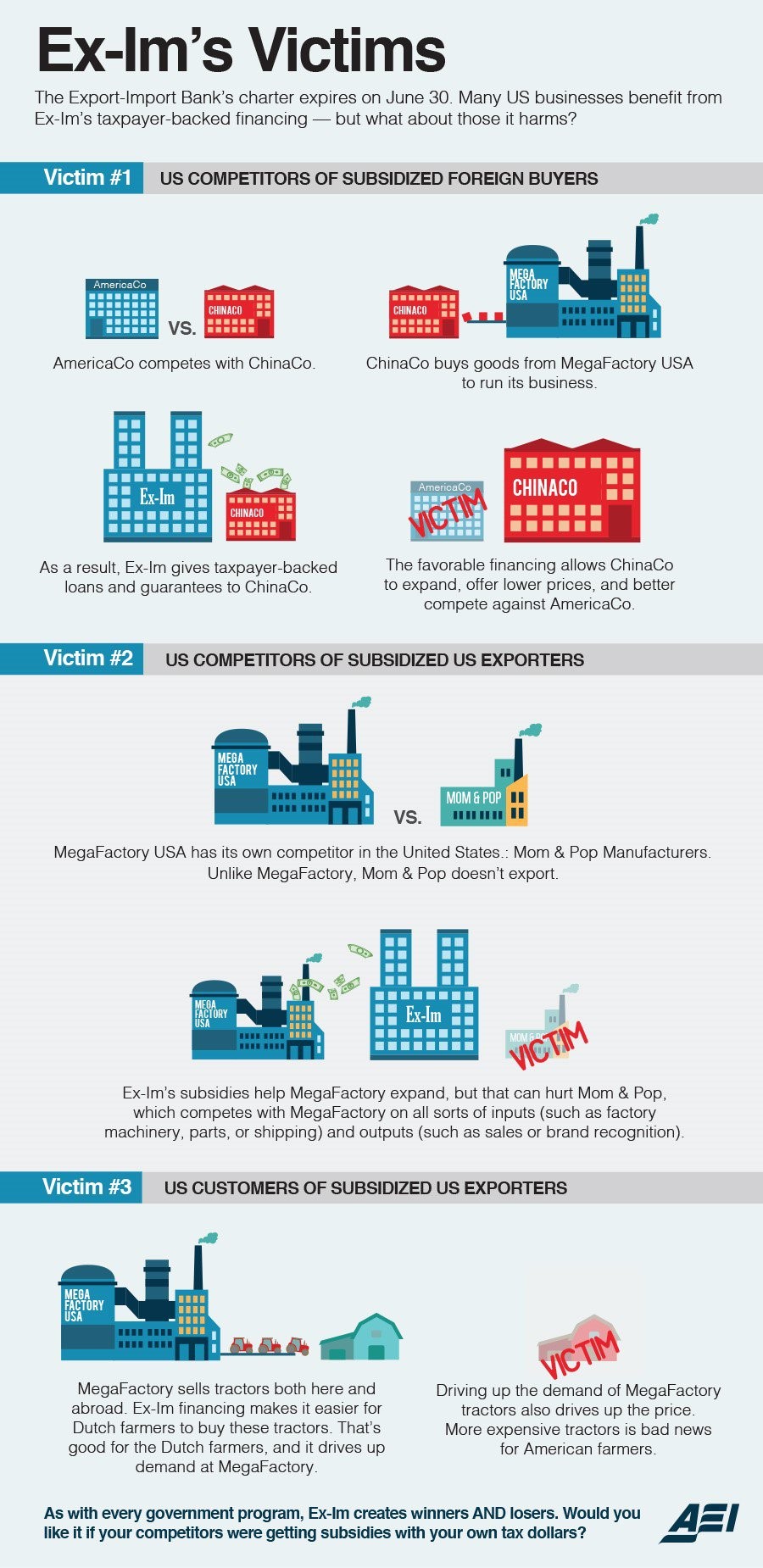
The Export-Import Bank’s charter is up for renewal in our Congress this spring. The bank is alleged to help American companies by lending money to foreign buyers of and American company’s products so that buyer can afford the purchase, which in turns helps the US company, and its employees.

That’s a pretty good deal, right?

Maybe not so much. It’s American taxpayers who are on the hook—not just the one American company and its employees—if the foreign buyer defaults on the loan. But that’s not all. American companies trying to compete with that foreign buyer also are harmed, whether or not that foreign buyer defaults. See the graph below, from AEIdeas:ExImBank

Don’t renew the bank’s charter.