
Iran, Nuclear Weapons, and Sanctions

Our intel suggests that Iran can build a nuclear weapon in about a year.  The Obama administration that that’s time for economic sanctions to work and to convince Iran not to go ahead.  This week, President Obama implored Israeli Prime Minister Benjamin Netanyahu not to go through with a preemptive attack on Iran’s nuclear development facilities.  But is it true?  If Iran is within a year of building a nuclear weapon, can sanctions work at all anymore?

Consider: for sanctions to work, the Iranian government must agree that the costs of those sanctions are greater than the gains from possessing nuclear weapons.  Stipulate, arguendo, that the latest round of sanctions work insofar as oil sales are cut off, that Russia and China don’t continue to trade with Iran, simply bypassing the global financial network.  What are those costs?  Economic dislocation.  High prices.  Scarcity of goods.  But no one dies.  Everyone is safe.

Think about the sanctions that have been in place all these last several years: the Iranians don’t have any gasoline for their cars, for instance—and this one is largely self-inflicted.  They’re major oil exporters, but they’ve made a conscious decision not to do any refining domestically.  Food is expensive, the transportation network undermaintained and cumbersome to use.  Internet, cell phone, etc. contact with the outside world for the general population is hard to achieve.  Most goods beyond bare necessities are hard to come by, and their prices are very high.  Yet their nuclear weapons development program is proceeding apace and has been all along.  What are the gains?  I’ll come back to these below.

Consider: why does Iran want nuclear weapons?  It isn’t only for the status of being a nuclear power.  There are three primary purposes for nuclear weapons.  On the occasion of their first use, the reason was to hold down total casualties—both friendly and enemy—associated with invading a mountainous island nation.  Later, the weapons’ purpose was in their existence: to deter attack by others, whether those others also were nuclear powers  or not.  The third reason for having nuclear weapons is to use them, and/or to give/sell them to surrogates who will use them.

In a 2005 interview with an American journalist, the then leader of Hezbollah (an Iranian proxy terror organization), Hussein al-Moussawi, said

We are not fighting so that you will offer us something. We are fighting to destroy you.

Moreover, the Iranian government is on record, repeatedly, as saying that they want to see Israel wiped off the map.  They want to kill the Great Satan (i.e., us).  It’s clear that Iran wants nuclear weapons to use them and/or to pass them to others who will use them.

For sanctions to have the effect on the Iranian government we expect them to have, the Iranian government has to think like we do.  But they don’t think like us.  Moreover, their tolerance for pain is higher than ours.

What will Iran gain from obtaining nuclear weapons?  The destruction of Israel.  Weapons to pass to surrogates for use within the United States—and Europe—to kill as many of us and them as can be done—even to destroy us.

Will sanctions work on Iran?  Can Iran be dissuaded without military force, in this environment and with this mind set, from obtaining nuclear weapons?
Automobile Automation

The Wall Street Journal‘s L. Gordon Crovitz is writing about the really quite nearby future of driving.  There is an upside to this:

Tom Vanderbilt, author of the book Traffic, writes: “After a few minutes the idea of a computer-driven car seemed much less terrifying than the panorama of indecision, BlackBerry-fumbling, rule-flouting, and other vagaries of the humans around us—including the weaving driver who struggled to film us as he passed.”

There’s a downside, too, beyond the aspects of the (still very important in my not at all humble view) sheer joy of driving my car and the need for a human to be in control of his machine, rather than the other way around:

[T]he legal and regulatory system will need to accept that driverless cars sound risky only compared with cars driven by error-prone humans.  Among looming questions certain to be relished by plaintiff lawyers: If people aren’t driving, who will be liable for accidents?  Car makers?  Manufacturers of GPS hardware?  Software companies?

The answer to the liability question is straightforward and easily enforced, though.

The larger problem I have with such a system is this.  We need to improve, vastly, our computer and communications systems security before such a thing becomes viable and truly safe.  In an age where we can’t even protect our power and water grid, much less our Space and Defense systems or our GPS use, from either foreign or domestic hacking, why would we want to expose our transportation grid to similar hack jobs and shutdown?

Qualified Opinions

Do we allow those around here?  Even Massachusetts may be coming around.  Governor Duvall Patrick (D, MA) is looking at his state’s business regulations with a view to reducing their footprint on…business.  The Wall Street Journal is reporting that, among other things, he’s going to insist on what amounts to a business impact statement before a new regulation can go into effect.  The regulator proposing a new rule would be required to answer such questions as

Is this likely to encourage or deter the formation of business?

which is standard pap, but then Duvall cuts to the chase with a follow-up:

Who did you consult from the small business community to come to this conclusion?

Hmm….

The governor’s look includes rescission/tweaking of such regulations as a requirement that a hair salon owner selling her shop to an employee must first close down while the state processes associated paperwork, and a requirement that funeral directors must hire full-time apprentices only; part-timers are barred.  He’s also looking at an additional roughly 800 regulations across 60 state agencies.

Time will tell whether this is a serious look, or primarily politically useful tweaks, but it’s a promising start.

There is reason for skepticism.  Last year, President Obama made a big deal about the regulatory review process he was initiating.  That, though, has turned out to be a sham, consisting of minor changes to minor regulations without addressing his overall regulatory environment, which has been entirely anti-business.

Progressive Energy Subsidies

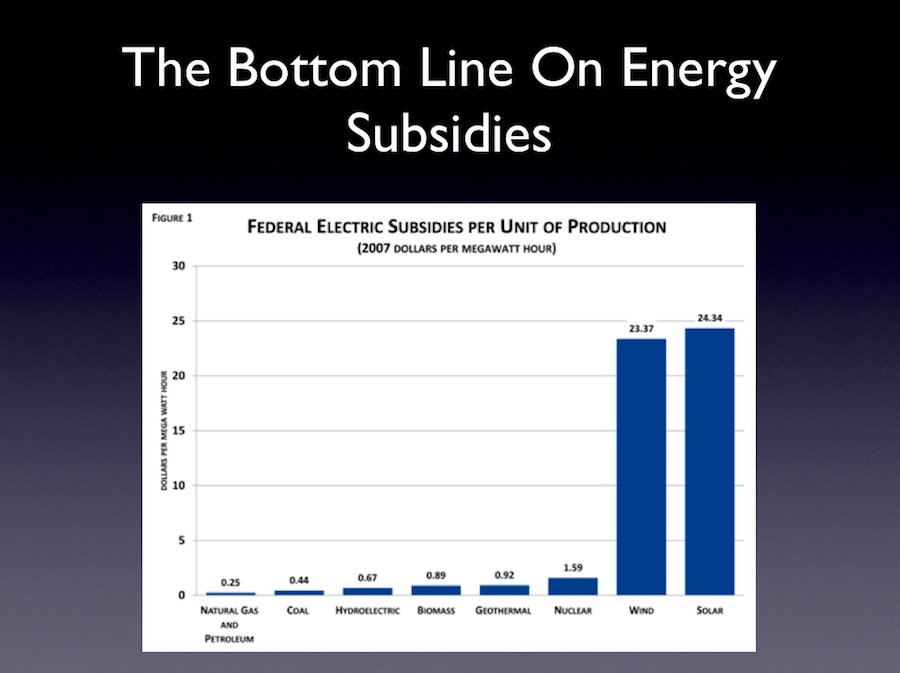
John Hinderaker has a couple of slides from a Power Line post of his from the middle of last month that are instructive.  The first indicates the relative overt subsidy payments for a range of electric energy producer types.

In case you’re having trouble reading it, the salient parts are these: the figure shows Federal electric subsidies in dollars per MW-hr produced (2007 dollars).  The values on the left are for Natural Gas and Petroleum and for Coal at $0.25 and $0.44, respectively.  The values on the right are for Wind and for Solar at $23.37 and $24.34, respectively.  Those evil oil, natural gas, and coal companies get less than 2% of the subsidy Precious wind and solar companies get.

Pop quiz: which are the market-competitive companies?

There’s also this slide, which shows oil production rates over the last several years.  Recall its backdrop: President Obama’s claim that, on his watch, oil and gas production are up sharply.

The blue line indicates oil production on Federal land, and the Red line indicates production on private and State land.  The key interval is from 2007 on, when the Progressives had control of the Congress, followed shortly by Progressive control of the Executive Branch.  Notice that while production from private and State land was rising, production from Federal land was being driven down.  This, coupled with Obama’s slow-walking of Gulf deep water drilling permits; his refusal to allow new drilling, much less production beyond existing wells, into/from known oil deposits on Federal land; his EPA’s CO2 regulation over even a Progressive Congress’ objection; his killing of the Keystone XL pipeline; and so on, represent a far more powerful, and far more insidious, subsidy of his Precious “green” energy producers: active suppression of competition from production of cheap hydrocarbon-based energy from nearby sources.

Some subsidies are more equal than others.

This Is What A Progressive Government Stands For

Our illustrious Treasury Secretary, Timothy Geithner had this to say in a recent The Wall Street Journal op-ed about the role of government in private decision making.  In setting up his meme, he described Bear Stearns’ risky investments and our own risky mortgage borrowing behavior.

Neither the Fed, nor any other federal agency, had the necessary comprehensive authority over investment firms…or the government-sponsored mortgage giants Fannie Mae and Freddie Mac.

Regulators did not have the authority they needed to oversee and impose prudent limits…. And they had no authority to put these firms, or bank holding companies, through a managed bankruptcy.…

Household debt rose to an alarming 130% of income, with a huge portion of those loans originated with little to no supervision and poor consumer protections.

Hmm….  He decries the lack of government control over our businesses and our personal borrowing.  He decries government’s inability to bypass the bankruptcy court system (except for two dinosaur car companies, whose government regulation he doesn’t mention).

He insists that  Government knows better the risks, government knows better the decisions that ought to be made.  His solution, thus, is increased intrusive government management of our decisions and our businesses.  As to the costs of this, he dismisses them:

Are the costs of reform too high? Certainly not relative to the costs of another financial crisis. Credit is relatively inexpensive….

He omits to add that cheap credit is due entirely to artificially suppressed Federal Reserve Bank rates—through which the Federal government is imposing an extreme inflationary risk on our economy.  He omits to acknowledge that the financial institutions are under resumed government pressure to quit sitting on cash and to lend—by lowering credit standards again—another government-imposed risk to our economy.

Are these reforms complex? No more complex than the problems they are designed to solve.  And, it should be noted, most of the length and complexity in the rules is the result of the care required to target safeguards where they are needed, not where they would have a damaging effect.

He chooses complexify a fundamentally simple problem: let the experts in business and business risk—businessmen themselves, exercise their own judgment, and suffer the consequences of bankruptcy if their judgment is faulty—or if they have bad luck.  He doesn’t mention the fact that the same government that wants to insert its own lending judgment in the place of our own and our business enterprises is the same government that is still owed tens of billions of dollars by those two American car companies that can never be paid back—and that one of those dinosaurs isn’t even American anymore; it’s Italian.  He also complexifies what is truly straightforward: get government out of the way, streamline regulations, and keep only those that are useful, with no overlap or conflicts.  He also demonstrates a lack of understanding of the problem: if the targets of the safeguards need “length and complexity” to address, it’s because the regulators don’t understand the targets well enough to articulate them simply and clearly, so that, if actually needed, they can be “targeted.”  The very complexity is another government-created risk.

Is there some risk that these reforms will go too far with unintended consequences? That depends on the quality of judgment of regulators in the coming months as they flesh out the remaining reforms.

Indeed.  That’s another enormous risk imposed by a Know Better government.  Look for instance, at the performance of the NLRB and the EPA, two example regulatory agencies devoid of objective judgment.  These are Progressive regulators, but there’s no reason to believe that “conservative” regulators wouldn’t wind up just as abusive, just as lacking in judgment, albeit in another direction.  The problem here is the existence of the regulators, not their political agendas.  Today’s problem, though, is compounded by so many of the regulators being subject to no oversight.

And then there’s our health.  Over in the legislative branch, Nancy Pelosi called the just-defeated Blunt Amendment a

“devastating legislation” and “the latest ploy in the Republican agenda of disrespecting the health of American women.” Planned Parenthood claimed the “dangerous proposal” would have allowed “your boss”—yes, yours—to decide “which prescriptions you can get filled and which medical procedures you can have,” including cancer screening, maternity care and AIDS medications.

Of course, it was nothing of the sort.  It was simply an effort to restore choice to women’s (and men’s) health decisions.  Yet, as the WSJ points out,

The fact that Democrats don’t dare to accurately describe their own positions, or the regulations that they want to foist on everyone else, shows how extreme those positions and regulations really are.


This is, then, what the Progressive government stands for.  A big, intrusive Federal government making business decisions for Americans and our businesses and deciding our health issues for us.  All, of course, with the best of intentions: to protect us from ourselves, and to protect us from our foolish decisions and their outcomes.  But at what cost?

At the cost of our freedom to make stupid decisions, our freedom to make decisions with which our governmental Betters might disagree, and our freedom to profit from risky decisions, or safe ones, of our choosing and not of our Betters’.  At the cost of our freedom to decide for ourselves what our health care might—or might not—entail..

At the cost of our ability to make any of our own choices.  At the cost of honoring our responsibilities ourselves, rather than having them surrendered to government to handle for us.